... .mainHeader { background: rgba(255,255,255,0.15); backdrop-filter: blur(15px); -webkit-backdrop-filter: blur(15px); border: 1px solid rgba(255,255,255,0.18); }
Updated August 2026

Canada Work Permit: types, requirements and application strategy

Understand which Work Permit route fits your situation, whether LMIA applies, what evidence you need and how to plan extensions, refusals and longer-term immigration options.

Open or employer-specificChoose the correct legal permit category.
LMIA or LMIA-exemptUnderstand the employer-side requirements.
Extension & maintained statusPlan before your current authorization expires.
Refusal-risk reviewIdentify weaknesses before filing or reapplying.
2 main permit typesOpen and employer-specific Work Permits.
3 application contextsOutside Canada, inside Canada or eligible port-of-entry cases.
CAD 155 base feeVerify current government fees with IRCC before filing.
Case-specific timingProcessing varies by location, route and complexity.
Decision-first UX

Which Work Permit route fits your situation?

Instead of reading a generic article from top to bottom, start with the route that matches your real situation and then move into the exact legal and document requirements.

01

I have a Canadian job offer

Review whether the proposed job requires an LMIA, whether it may qualify under an LMIA-exempt category and what employer-side documentation is needed before the Work Permit application is submitted.

Read the Job Offer & LMIA guide →
02

I may qualify for an Open Work Permit

Open permits are not available to everyone. Eligibility depends on a recognized category such as an eligible spouse, graduate or another specific immigration situation.

03

My permit is expiring

Extension timing affects maintained status, continued work authorization and future compliance. Do not wait until the last moment to plan the next step.

04

I studied in Canada or want a family-based plan

Work Permit strategy can connect with study status, spousal eligibility and long-term settlement planning. Use the correct page for Study Permit, PGWP or family considerations where those routes are relevant.

Explore study-related pathways →
05

My Work Permit application was refused

A refusal is not just a setback — it is evidence about how the case was understood by the officer. Reapplication, reconsideration and legal review each require a different strategy.

Review refusal options →
Core explanation

What is a Canada Work Permit?

A Work Permit authorizes a foreign national to work in Canada under specified conditions. It is different from a travel visa, an eTA, an LMIA and permanent residence.

  • The correct permit depends on the applicant’s legal situation and the proposed employment.
  • An employer-specific permit may involve LMIA or LMIA-exempt employer compliance steps.
  • An Open Work Permit is only available to applicants who qualify under an eligible category.
  • Permit strategy can affect spouses, extensions, change of employer and future PR planning.

Employer-specific Work Permit

Usually tied to the employer and conditions shown on the permit. A genuine job offer is normally central to the application.

Open Work Permit

Less employer-restricted, but available only in specific eligible immigration situations rather than by simple applicant choice.

LMIA-exempt routes

Some employer-specific Work Permits can proceed without an LMIA under the International Mobility Program, subject to the applicable exemption.

Application context matters

Where are you applying from?

Eligibility and process can change depending on whether the worker is applying from outside Canada, from inside Canada or through an eligible port-of-entry scenario.

01

Outside Canada

Many applicants prepare and submit their Work Permit applications from abroad, then follow the approval and travel steps required for their case.

Best for most foreign applicants who are starting the process before travel.
02

Inside Canada

Not every person physically present in Canada can apply from inside the country. Current IRCC rules require a specific eligible in-Canada situation.

Do not assume visitor status alone creates Work Permit eligibility.
03

Port of Entry

Some workers may be able to apply at a Canadian port of entry, but that possibility depends on nationality, documentation and the exact Work Permit stream.

Border eligibility should be confirmed before travel, not guessed at the airport or land border.
Employer-side decision point

Does your job need an LMIA?

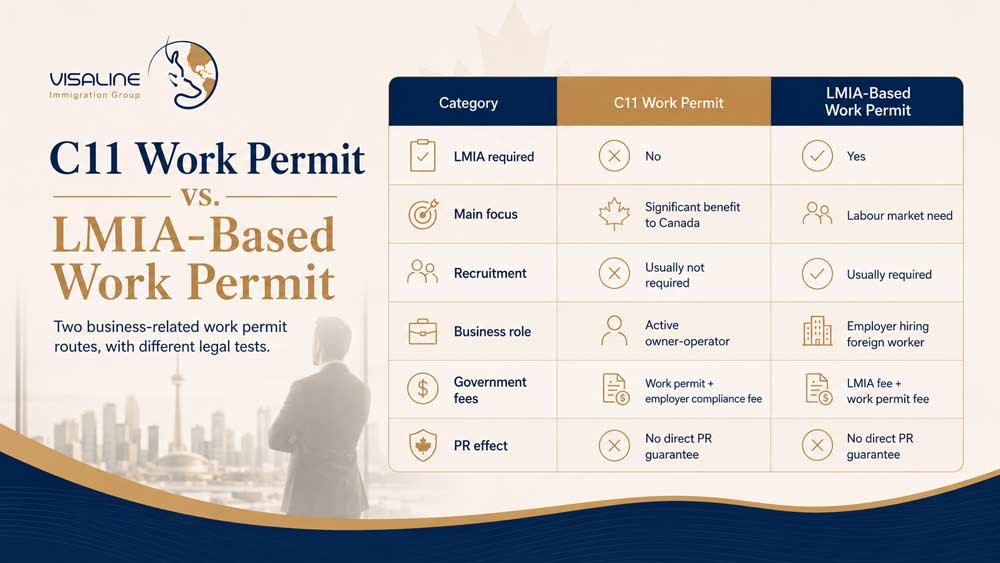
An LMIA is a labour-market assessment managed through ESDC / Service Canada. It is not the Work Permit itself. Some employer-specific cases require a positive LMIA; others are LMIA-exempt under the International Mobility Program.

Read the Job Offer & LMIA guide →

LMIA-required

The employer normally completes the LMIA process first and the worker then uses the approved employer-side documentation in the Work Permit application.

LMIA-exempt employer-specific

Some categories use the International Mobility Program. There may still be Employer Portal and compliance steps even though no LMIA is needed.

Open Work Permit

Open permits rely on the applicant’s eligible immigration context rather than a named employer supported by LMIA-based recruitment.

Application roadmap

Canada Work Permit application process

A strong application is built in the right sequence. Many avoidable problems come from choosing forms before confirming the legal route and evidence strategy.

1

Choose the route

Open, LMIA-supported or LMIA-exempt employer-specific.

2

Confirm where to apply

Outside, inside Canada or eligible POE context.

3

Complete employer steps

LMIA or Employer Portal obligations if applicable.

4

Prepare evidence

Employment, qualifications, status and admissibility.

5

File with IRCC

Submit forms, supporting documents and fees.

6

Respond to requests

Biometrics, medical exam or added documents.

7

Approval & arrival

Follow travel, entry and permit-issuance instructions carefully.

Evidence strategy

Build an evidence file, not a paper pile

The exact checklist varies by stream and applicant profile, but a strong file consistently proves identity, genuine employment, qualifications, legal status and admissibility.

Identity & status

  • Passport and identity records
  • Current immigration status, where applicable
  • Marriage or family records for accompanying family
  • Travel history when relevant

Employment evidence

  • Employment offer or contract
  • LMIA confirmation, where required
  • Offer-of-employment number for applicable exempt cases
  • Job duties, wage and work location

Qualifications

  • Résumé and work history
  • Education and professional credentials
  • Licensing proof for regulated occupations
  • Evidence matching the proposed duties

Admissibility & support

  • Biometrics where required
  • Medical examination when applicable
  • Financial support evidence
  • Explanations addressing temporary-residence compliance
CAD 155Basic Work Permit processing fee
CAD 100Open Work Permit holder fee when applicable
CAD 85Biometrics fee for an individual when required
VariableProcessing time depends on stream, location and file complexity
Business-owner pathway

Entrepreneur and C11 Work Permit considerations

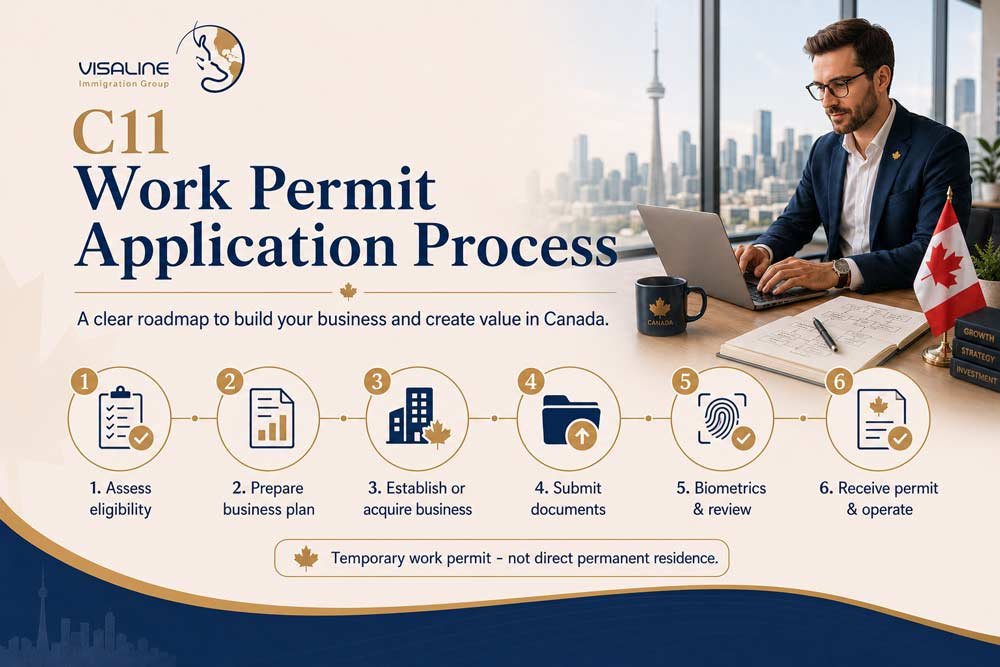
C11 is an LMIA-exempt significant-benefit route for qualifying entrepreneurs and business operators. Buying or incorporating a business does not by itself create Work Permit eligibility.

Before your permit expires

Extensions, maintained status and changing employer

Work Permit strategy does not end at approval. Future applications, timing and employer changes can directly affect your authorization to work and your legal compliance in Canada.

Can I keep working while an extension is processed?

If an eligible application is filed in time, maintained status may arise. The exact conditions depend on what was filed, the worker’s prior status and whether the person remains in Canada.

Can I change employers on an employer-specific permit?

Usually not automatically. A new employer often requires a new process, and starting work too early can create serious compliance issues.

What if my permit has already expired?

Restoration of status may need to be assessed. Restoration is different from maintained status and does not automatically mean the person can keep working.

Common refusal risks

Where Work Permit applications often fail

Refusals often result from a weak fit between the chosen permit category and the evidence submitted. Small inconsistencies can undermine an otherwise promising file.

Wrong permit categoryThe file is built around a route that does not fit the real facts.
Weak employment evidenceJob details, wage, duties or employer-side records are incomplete.
Qualifications mismatchThe worker’s background does not convincingly support the proposed role.
Temporary-residence concernsThe officer is not satisfied with compliance, intent or overall credibility.
Insufficient support recordsIdentity, funds, medical or status evidence is missing or inconsistent.
Inconsistent historyForms, letters and prior records do not tell a coherent story.
Employer-side problemsLMIA, compliance or genuine-job issues weaken the application.
Unsupported open-permit claimThe applicant assumes open-permit eligibility without actually meeting the legal criteria.
Long-term planning

Can a Work Permit lead to permanent residence?

A Work Permit can support a longer-term immigration plan, but permanent residence always requires separate eligibility under a PR pathway in effect at that time.

Work lawfully in CanadaChoose the correct temporary route and maintain compliance.
Build qualifying factorsCanadian work experience, language, provincial support or other factors.
Apply through a PR programFor example, a suitable PNP or other available permanent pathway.
Frequently asked questions

Common questions about Canada Work Permit

These questions target the natural search intent we see around Work Permit eligibility, LMIA, extensions, refusals and future immigration planning.

What is a Canada Work Permit?

A Canada Work Permit is authorization that allows a foreign national to work in Canada under specified conditions. It is different from a travel visa, eTA, LMIA or permanent residence document.

What is the difference between an Open Work Permit and an employer-specific Work Permit?

An employer-specific permit is normally tied to the employer and conditions listed on the permit. An Open Work Permit is less employer-restricted, but only available to applicants in specific eligible immigration situations.

Can I get a Canada Work Permit without a job offer?

Possibly, but only if you qualify for a category that does not depend on a specific employer, such as certain eligible Open Work Permit situations.

Does a Canadian job offer guarantee a Work Permit?

No. The officer still assesses the route, employer-side documentation, the worker’s qualifications, admissibility and the overall legal fit of the application.

Do I need an LMIA for a Canada Work Permit?

Some employer-specific permits require an LMIA; others are LMIA-exempt. Open Work Permit cases are assessed under different legal bases.

Can I apply for a Work Permit from inside Canada?

Only if you meet an eligible in-Canada situation under current IRCC rules. Simply being inside Canada does not automatically create eligibility.

Can a visitor convert to a Work Permit in Canada in 2026?

Applicants should not rely on broad temporary public policies discussed in earlier years. A visitor must qualify under the current normal rules or another specific measure in force at the time.

Can I change employers on an employer-specific Work Permit?

Not automatically. A new employer often requires a new application and any corresponding employer-side steps before the worker can lawfully start the new job.

Can I keep working while my extension is processing?

In qualifying circumstances, maintained status may allow continued work under applicable conditions after a properly timed application is filed.

What happens if my Work Permit has already expired?

Restoration of status may need to be assessed, if still legally available. Restoration is not the same as maintained status and does not automatically authorize work.

Can my spouse get an Open Work Permit?

Some spouses or common-law partners may qualify, but family open-permit eligibility is specific and should always be checked against current IRCC rules.

How long does a Canada Work Permit take?

There is no single timeline for all applications. Processing depends on location, stream, biometrics, medical requirements, screening and case complexity.

Can a Work Permit lead to permanent residence in Canada?

It can support a broader strategy, but permanent residence requires separate eligibility under a PR program such as a qualifying provincial or federal pathway.

Editorial standard

Visaline Legal Editorial Team

Last reviewed: August 2026General Canadian immigration information. This page does not replace individualized legal advice.
Primary references

Official sources to verify before filing

  • Immigration, Refugees and Citizenship Canada (IRCC): Work Permit eligibility and application guidance
  • IRCC: Apply from outside Canada / apply from inside Canada / extend or change conditions
  • Employment and Social Development Canada (ESDC): Labour Market Impact Assessment
  • IRCC: International Mobility Program and employer compliance requirements
  • IRCC: Current fees and processing-time tools
Individual case assessment

Before you submit, know where your Work Permit application is vulnerable.

A focused consultation can help confirm the correct permit category, employer-side requirements, evidence gaps and refusal risks before you submit.

Route assessmentLMIA / exemption reviewDocument strategyRefusal-risk review
Visaline Canadian immigration consultation