Canada Spouse Sponsorship 2026: Bring Your Partner to Canada
You met someone. You fell in love. And now you are ready to build a life together in Canada. But your partner lives in another country, or maybe they are already here with you on a temporary visa. Either way, the distance between you and the person you love feels like the hardest part of your immigration journey. Canada’s spouse sponsorship program exists to close that gap. Visaline is with you on your immigration journey, from dream to reality, helping you navigate the requirements and bring your partner home.
Table of Contents
- What is Canada spouse sponsorship?
- Who can you sponsor?
- Sponsor eligibility requirements
- Sponsored person eligibility
- Proving your relationship is genuine
- Documents required for spousal sponsorship
- Step-by-step sponsorship process
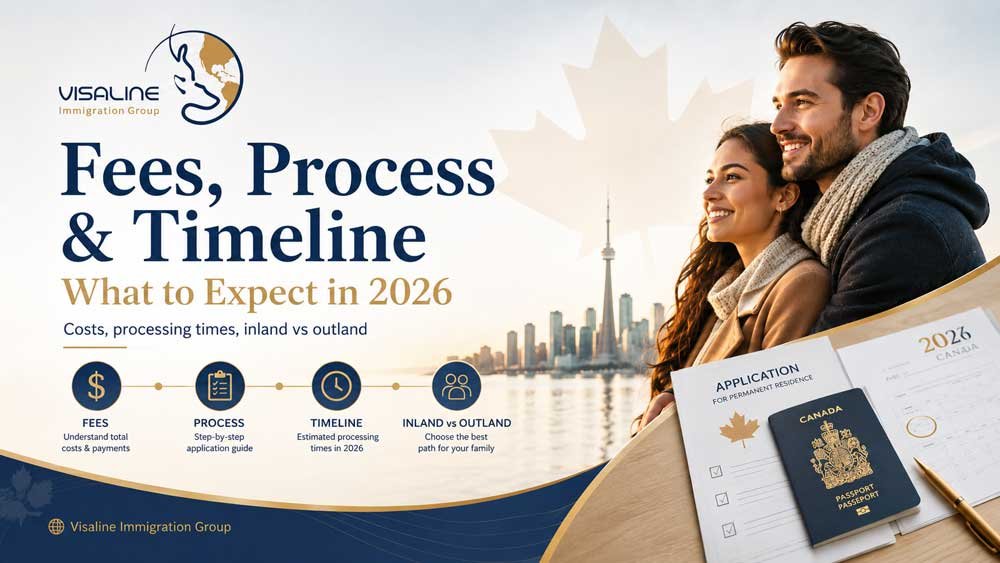
- Costs and fees in 2026
- Processing times in 2026
- Inland vs outland sponsorship
- Spouse sponsorship vs other immigration pathways
- Frequently asked questions
- Conclusion
What Is Canada Spouse Sponsorship?
Canada spouse sponsorship is a family class immigration program that allows Canadian citizens and permanent residents to sponsor their spouse, common-law partner, or conjugal partner for permanent residence. It is one of the most direct and reliable pathways to PR through marriage or a committed partnership.
Unlike economic programs like Express Entry, spousal sponsorship does not require the sponsored person to meet specific criteria based on skills, education, or language ability. Instead, the focus is on the genuineness of your relationship and the sponsor’s ability to provide financial support.
The program is currently open and accepting applications. Canada welcomes tens of thousands of sponsored spouses and partners each year under its Immigration Levels Plan.
Who Can You Sponsor?
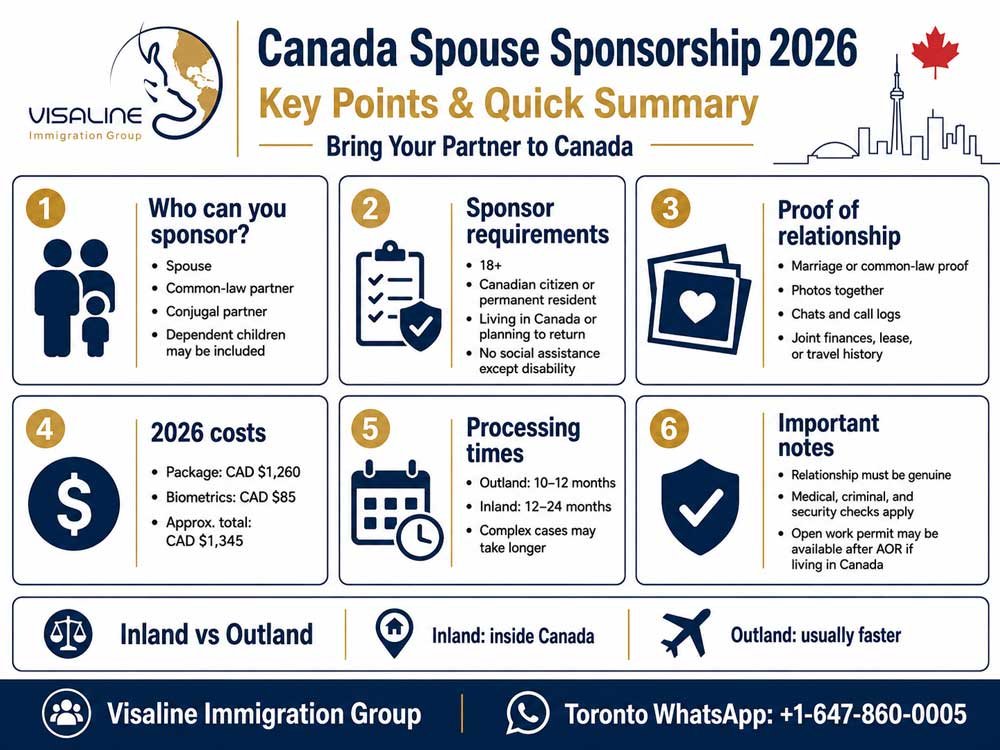
You can sponsor the following types of partners:
- Spouse: Someone you are legally married to. You must provide a valid marriage certificate. Same-sex marriages are recognized.
- Common-law partner: Someone you have lived with in a conjugal relationship for at least 12 consecutive months. There is no legal marriage required, but you must prove continuous cohabitation.
- Conjugal partner: Someone you are in a genuine relationship with but cannot live with due to legal or immigration barriers in their home country (e.g., divorce is not legally possible, or you cannot obtain a visa to visit each other). This is the most difficult category to prove and is rarely approved.
You can also include your dependent children on the same application.
Sponsor Eligibility Requirements
To sponsor your spouse or partner, you must meet these requirements:
- Be at least 18 years old
- Be a Canadian citizen, permanent resident, or a person registered as an Indian under the Indian Act
- Live in Canada (Canadian citizens living abroad can sponsor a spouse or partner if they plan to return to Canada when the sponsored person becomes a permanent resident)
- Demonstrate that you are not receiving social assistance for reasons other than a disability
- Sign a sponsorship agreement and undertaking with the Minister of IRCC
You cannot sponsor if you:
- Are in prison, bankrupt, or under a removal order
- Have been convicted of a serious violent or sexual offense
- Defaulted on a previous sponsorship undertaking
- Are in default of an immigration loan or court-ordered family support payments
- Were sponsored as a spouse and are within five years of becoming a permanent resident
Sponsored Person Eligibility
The person you sponsor must:
- Be admissible to Canada (pass medical, criminal, and security checks)
- Not be barred from entering Canada for any reason
- Be in a genuine relationship with you, not entered into primarily for immigration purposes
- Not be too closely related to you by blood (e.g., you cannot sponsor a sibling or parent as a spouse)
If the sponsored person is inadmissible — for example, due to a serious criminal record or a contagious disease that poses a public health risk — the application will be refused regardless of the relationship.
Proving Your Relationship Is Genuine
IRCC scrutinizes spousal sponsorship applications carefully to ensure the relationship is genuine and not entered into primarily for immigration purposes. This is often the most challenging part of the process.
You need to provide evidence that demonstrates:
- The relationship is authentic: You and your partner have a real, ongoing emotional connection.
- The relationship is not for immigration purposes: You did not marry or enter the partnership solely to get PR.
- You are in a committed, long-term relationship: You have a shared life, shared finances, and shared plans for the future.
Types of evidence that help prove a genuine relationship include:
- Marriage certificate or proof of common-law partnership
- Photographs and videos together from shared events, trips, and family gatherings
- Records of communication, such as text messages, call logs, emails, and social media exchanges
- Joint bank account statements, credit card statements, or investment accounts
- Joint leases or mortgage documents showing shared residence
- Utility bills in both names
- Travel itineraries and boarding passes showing visits to each other
- Letters from friends and family confirming the relationship
- Affidavits from both partners describing the history and nature of the relationship
For common-law partnerships, you must provide proof of at least 12 consecutive months of cohabitation. This is a strict requirement — living together for 11 months and 29 days does not qualify.
Documents Required for Spousal Sponsorship
The documents you need include:
- Proof of identity: Valid passports for both sponsor and sponsored person
- Proof of relationship: Marriage certificate, common-law declaration, or conjugal partner evidence
- Proof of genuine relationship: Photographs, communication records, joint financial documents, travel history
- Sponsor’s proof of Canadian status: Canadian passport, permanent resident card, or citizenship certificate
- Sponsor’s financial documents: Notice of Assessment (tax return), employment letters, pay stubs
- Police certificates: From all countries where the sponsored person has lived for six months or more since turning 18
- Medical examination results: Completed by an IRCC-approved panel physician
- Digital photographs: Meeting IRCC specifications
- Completed application forms: Including the sponsorship application (IMM 1344), the permanent residence application (IMM 0008), and supporting forms
The quality and completeness of your evidence matters significantly. Missing or inconsistent documents are a common reason for application returns or refusals.
Step-by-Step Sponsorship Process
- Determine your eligibility. Confirm that you meet the sponsor requirements and that your partner qualifies as a spouse, common-law partner, or conjugal partner.
- Gather your documents. Collect all required forms, supporting documents, and evidence of your genuine relationship.
- Pay the application fees. Pay the sponsorship fee, processing fee, right of permanent residence fee, and biometrics fee online through the IRCC portal.
- Submit the application. Mail or submit your complete application package to the appropriate IRCC processing center.
- Receive acknowledgment of receipt (AOR). IRCC will confirm they have received your application and begin processing.
- Provide biometrics. The sponsored person will receive a letter asking them to provide biometrics (fingerprints and photograph) within 30 days.
- Attend medical examination. The sponsored person must complete a medical exam with an IRCC-approved panel physician.
- Respond to any requests. IRCC may request additional documents or information during processing.
- Receive a decision. If approved, the sponsored person will receive a confirmation of permanent residence and a permanent resident visa.
- Land in Canada. The sponsored person must arrive in Canada before their visa expires and complete the landing process.
Costs and Fees in 2026
The government fees for sponsoring a spouse or partner in 2026 are as follows:
| Fee type | Amount (CAD) |
|---|---|
| Sponsor your spouse or partner (includes sponsorship fee, processing fee, and RPRF) | $1,260 |
| Sponsor your spouse or partner (without RPRF) | $660 |
| Include a dependent child (per child) | $180 |
| Biometrics fee (per person) | $85 |
| Biometrics fee (family of 2 or more) | $170 |
The total for a spouse-only sponsorship is approximately $1,345 in IRCC government fees in 2026. This includes the $1,260 sponsorship package and the $85 biometrics fee.
Additional costs to budget for include:
- Medical examination: $200–$500 per person
- Police certificates: $20–$100 per country
- Language translations and certifications: $50–$200 per document
- Professional consultant or lawyer fees: $2,000–$5,000 depending on complexity
Only the Right of Permanent Residence Fee ($600) is refundable if the application is refused or withdrawn. All other fees are non-refundable.
Processing Times in 2026
Processing times for spousal sponsorship applications in 2026 vary depending on where the application is submitted:
| Application type | Processing time |
|---|---|
| Spouse or partner living outside Canada (outland) | 10–12 months |
| Spouse or partner living inside Canada (inland) | 12–24 months |
| Complex cases or certain regions | May take longer |
These are service standards, not guarantees. Actual processing times depend on the completeness of your application, the complexity of your case, and the volume of applications being processed at the visa office handling your file.
Background checks can take an additional 6–8 months on average. If IRCC requests additional documents, the clock pauses until they receive your response.
Inland vs Outland Sponsorship
You can submit a spousal sponsorship application from inside Canada (inland) or from outside Canada (outland). The choice affects processing times, work permit eligibility, and your options if you need to travel.
| Factor | Inland sponsorship | Outland sponsorship |
|---|---|---|
| Where the sponsored person lives | Inside Canada | Outside Canada (or inside Canada) |
| Processing time | 12–24 months | 10–12 months |
| Open work permit eligibility | Yes, after AOR | Yes, after AOR (if living in Canada) |
| Can the sponsored person travel? | Yes, but must maintain status | Yes, no restrictions |
| Best for | Couples already living together in Canada | Couples separated by borders |
Sponsored spouses and partners can usually qualify for an open work permit while their applications are processed, allowing them to work for any employer in Canada. This is available for both inland and outland applicants, as long as the sponsored person is living in Canada.
Spouse Sponsorship vs Other Immigration Pathways
| Factor | Spouse Sponsorship | Express Entry | Provincial Nominee Program |
|---|---|---|---|
| Based on | Genuine relationship | Skills, age, education, language | Provincial labor market needs |
| Need a relative in Canada | Yes (sponsor) | No | No |
| Language/education tests | Generally no | Yes | Yes (for most streams) |
| Income requirement | No minimum income for spouse | Settlement funds | Varies by stream |
| Typical timeline | 10–24 months | ~6 months after ITA | 12–24 months |
| Best for | Couples where one partner is Canadian/PR | Skilled workers without a Canadian sponsor | Workers with a specific provincial connection |
Spouse sponsorship is often the most reliable route if you have a Canadian citizen or permanent resident partner who is willing and able to sponsor you. It does not require the sponsored person to have high language scores, advanced education, or specific work experience.
Frequently Asked Questions
What is Canada spouse sponsorship and how does it work?
Canada spouse sponsorship allows Canadian citizens and permanent residents to sponsor their spouse, common-law partner, or conjugal partner for permanent residence. The sponsor must meet eligibility requirements and sign a legally binding undertaking to financially support their partner for three years.
How much does Canada spouse sponsorship cost in 2026?
A spouse-only sponsorship costs approximately $1,345 in IRCC government fees in 2026. This includes the $1,260 sponsorship package (sponsorship fee, processing fee, and RPRF) and the $85 biometrics fee. Each dependent child adds $180.
What documents are required for Canada spouse sponsorship?
Required documents include proof of identity (passports), proof of relationship (marriage certificate or common-law declaration), proof of genuine relationship (photographs, communication records, joint finances), police certificates, medical examination results, and completed application forms.
What are the eligibility requirements for Canada spouse sponsorship?
The sponsor must be at least 18 years old, a Canadian citizen or permanent resident, and not receiving social assistance. The sponsored person must be admissible to Canada and in a genuine relationship with the sponsor. There is no minimum income requirement for spousal sponsorship.
How long does Canada spouse sponsorship take to process?
Spousal sponsorship takes approximately 10–12 months for applications from outside Canada and 12–24 months for applications from inside Canada. Processing times vary by visa office and case complexity.
What is the best consultant for Canada spouse sponsorship?
A licensed Regulated Canadian Immigration Consultant or immigration lawyer with experience in family class applications can help ensure your application is complete and accurate. Visaline can review your case and guide you through the process.
Conclusion
Spouse sponsorship is one of the most meaningful immigration pathways Canada offers. It recognizes that love and family are worth building across borders. Whether you are sponsoring a spouse you married years ago, a common-law partner you have lived with for years, or a partner you are finally ready to reunite with, the process is clear but requires careful preparation.
The key is proving your relationship is genuine and that you meet the eligibility requirements. Visaline can review your situation, assess your eligibility, and help you prepare a complete and accurate application. We do not promise outcomes we cannot deliver, but we do promise honest guidance and professional support.
Sources

Based on the latest regulations and program instructions published by Immigration, Refugees and Citizenship Canada (IRCC), including official pages on spousal sponsorship, fee schedules, and processing times.
Contact us today to review your case and book your immigration consultation. We also recommend following Visaline Immigration Institute on Instagram for real-time updates on IRCC news and immigration law changes.
☎️ Toronto WhatsApp: +1-647-860-0005
Published/Updated: July 23, 2026 Author: Visaline Legal Editorial Team