
Cost of Living in Canada in 2026: A Practical Guide for Newcomers
A salary that looks comfortable on an employment offer can feel very different after rent, payroll deductions, groceries, transportation and other monthly bills are paid. There is no single monthly cost of living in Canada in 2026: your real budget depends mainly on your city, household size, housing choice, transportation needs and immigration situation. IRCC notes that housing and utilities alone can consume a substantial share of household income and that take-home pay can be materially lower than gross salary.
At Visaline, “With you on your immigration journey, from dream to reality” also means helping applicants look beyond immigration approval and assess whether the financial reality of settling in Canada fits their plans.
Table of contents
- How expensive is Canada in 2026?
- Housing and rent in Canada
- Other monthly expenses in Canada
- How location changes your budget
- How to calculate a realistic newcomer budget
- Cost of living versus immigration proof of funds
- Costs newcomers often underestimate
- Frequently asked questions
How expensive is Canada in 2026?
Canada remains relatively expensive in major housing markets, but a national average tells only part of the story. The monthly cost of living can differ substantially between Vancouver, Toronto, Montréal, Calgary, Ottawa and smaller Canadian communities.
Statistics Canada’s Consumer Price Index showed prices nationally were 2.8% higher year over year in June 2026. Shelter prices were up 1.5% over the same period. June is the latest complete CPI figure available as of August 11, 2026; Statistics Canada has scheduled the July CPI release for August 17.
For someone preparing to move, a better question than “What is the average cost of living in Canada?” is:
- Which city or region will I live in?
- Will I live alone, with family or in shared accommodation?
- Will I rely on public transportation or need a vehicle?
- What will my actual after-tax income be?
- What one-time settlement expenses will I face after arrival?
These questions usually provide a more useful picture than any single Canada-wide monthly estimate.
Housing and rent in Canada
Housing is usually the largest part of a newcomer’s monthly budget. IRCC states that many Canadians spend approximately 35% to 50% of their income on housing and utilities, including rent or mortgage payments, heating, electricity, telephone service and water.
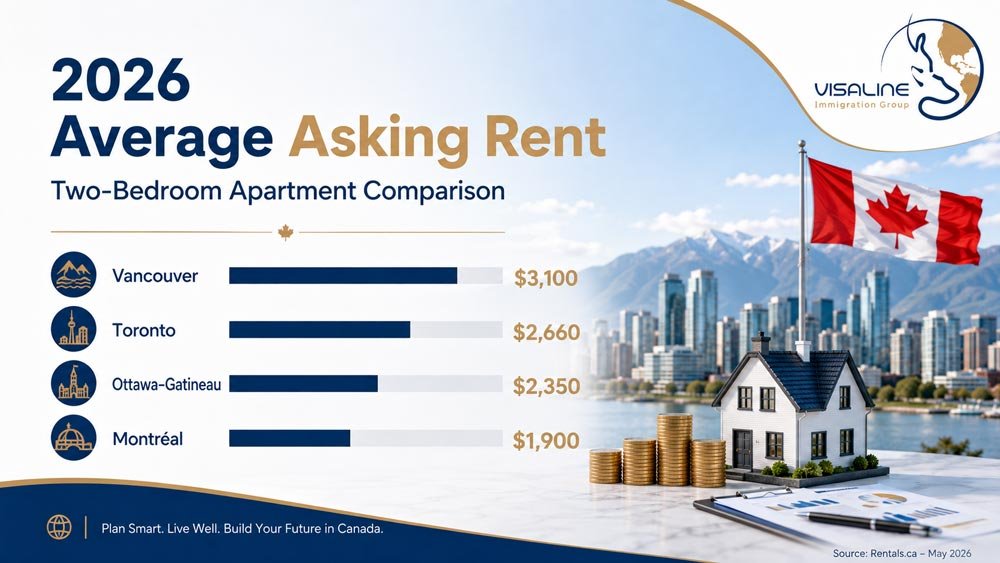
Average asking rent in major Canadian cities in 2026
Statistics Canada’s experimental Quarterly Rent Statistics provide a useful indication of what prospective tenants may encounter when searching for available units.
| Metropolitan area | Average asking rent for a 2-bedroom apartment, Q1 2026 |
|---|---|
| Vancouver | CAD 3,100 |
| Toronto | CAD 2,660 |
| Ottawa–Gatineau, Ontario part | CAD 2,350 |
| Montréal | CAD 1,900 |
| Calgary | CAD 1,900 |
| Edmonton | CAD 1,580 |
| All Canadian CMAs combined | CAD 2,150 |
These are asking rents for units advertised as available, not the average rent paid by every existing tenant. Statistics Canada also classifies the estimates as experimental and notes that unit quality, parking, utilities and other property characteristics can affect the figures.
There is also an important 2026 nuance: high rent does not necessarily mean asking rents are still rising rapidly. CMHC reports that increased rental supply and slower demand have contributed to declining asking rents in Toronto, Vancouver and Calgary, with Ottawa also experiencing softer asking rents. Existing tenants and different rental-market segments may experience different trends.
For newcomers, this means “average rent in Canada” should not replace city-specific research.

Other monthly expenses in Canada
Rent is only one part of Canada living expenses. A realistic budget should also account for recurring costs that vary significantly by household and province.
Common categories include:
- groceries and household supplies;
- electricity, heating and water when not included in rent;
- internet and mobile service;
- public transportation;
- vehicle payments, fuel, maintenance and insurance;
- tenant insurance;
- prescription medication;
- dental and vision expenses;
- childcare and school-related expenses;
- clothing, including winter clothing;
- entertainment and dining;
- debt payments;
- emergency savings.
Canada’s Consumer Price Index itself tracks major categories including food, shelter, household operations, clothing, transportation, health and personal care, and recreation, which illustrates why a household’s personal inflation experience can differ considerably from the headline national CPI.
Do not budget from gross salary
A common mistake is comparing a Canadian salary directly with monthly expenses without first estimating take-home income.
IRCC distinguishes gross income from net income or take-home pay and notes that payroll deductions may include income tax, Canada Pension Plan or Quebec Pension Plan contributions and Employment Insurance. Its newcomer guidance says deductions can, depending on the circumstances, reduce a paycheque by as much as 25% to 35%.
A CAD 70,000 salary therefore should not be treated as CAD 5,833 of monthly spending money.
The exact net amount depends on factors including province, tax situation, employment circumstances and deductions, so prospective newcomers should calculate after-tax income before choosing housing.

Healthcare costs newcomers should plan for
Canada has publicly funded provincial and territorial healthcare systems, but newcomers should not assume that every healthcare expense becomes free immediately after arrival.
A person generally needs to apply for a provincial or territorial health card. IRCC notes that in some provinces there can be a waiting period of up to three months before public health coverage begins and recommends arranging private insurance where a waiting period applies.
Prescription drugs obtained from pharmacies are often not fully covered by basic public insurance, and most dental services are also outside standard provincial healthcare coverage unless another public or private program applies.
For a newcomer budget, healthcare therefore may include:
- temporary private insurance;
- prescription medication;
- dental treatment;
- vision care;
- employer health-plan premiums or uncovered expenses.
Coverage varies by province, immigration status and individual circumstances, so the relevant provincial health authority should be checked before arrival.
How location changes your budget
Where you live can affect your overall cost more than almost any other decision.
A large metropolitan area may have higher housing costs but better public transportation and broader employment opportunities. A smaller community may offer more affordable housing while making vehicle ownership more practical or even necessary.
Consider the complete financial picture:
| Factor | Questions to ask |
|---|---|
| Housing | What is the current asking rent for the type of property I need? |
| Employment | Are jobs in my occupation available locally? |
| Transportation | Can I realistically live without a vehicle? |
| Income | What will my after-tax salary be in that province? |
| Healthcare | When will I qualify for provincial coverage? |
| Family | Are childcare and schools reasonably accessible? |
| Lifestyle | Which services will I use regularly? |
| Settlement | What expenses will I face during my first three months? |
The Statistics Canada rental figures illustrate the scale of geographic differences: in Q1 2026, the average asking rent for a two-bedroom apartment was CAD 3,100 in Vancouver compared with CAD 1,580 in Edmonton.
That does not automatically make Edmonton the better financial choice. Employment prospects, salary, transportation and family circumstances may change the conclusion.
How to calculate a realistic newcomer budget
A useful moving-to-Canada budget should be based on your expected life after arrival—not on a generic national cost calculator.
1. Choose the likely destination
Start with a city or region rather than “Canada.”
Research current rental listings and consider whether the neighbourhood allows you to reach work, school and essential services without creating large transportation costs.
2. Estimate your after-tax income
Use net income rather than gross salary.
Payroll deductions and provincial tax differences can substantially change your disposable monthly income.
3. Build a complete recurring-expense budget
Include housing, utilities, groceries, transportation, insurance, communications, healthcare and personal spending.
Do not assume utilities, parking or internet are automatically included in rent.
4. Add one-time settlement costs
The first months can cost more than normal monthly life because you may need furniture, household items, temporary accommodation, insurance, clothing and transportation before your routine stabilizes.
5. Maintain an emergency reserve
Your legal immigration financial requirement and the amount that makes you personally comfortable are two different figures.
A larger reserve may be appropriate when employment is uncertain, your family is larger or you are settling in a high-cost city.
Practical hypothetical example
Consider two newcomers with similar salaries.
Newcomer A rents a smaller apartment near rapid transit and does not own a car.
Newcomer B rents a larger suburban property with lower monthly rent but needs a vehicle for commuting.
Newcomer B may pay less for housing but more for insurance, fuel, maintenance and vehicle financing. The example is hypothetical, but it shows why comparing salary versus total cost of living is more useful than comparing rent alone.
Cost of living versus immigration proof of funds
Immigration proof of funds is a legal or program requirement; cost of living is a real-world household budget. They should not be treated as the same figure.
This distinction is particularly important for newcomers planning permanent residence or study in Canada.
| Issue | Real-life cost of living | Immigration financial requirement |
|---|---|---|
| Purpose | Determine what your household can actually afford | Meet a specific immigration-program requirement |
| Amount | Depends on city, lifestyle and household | Determined by the applicable immigration program |
| Housing market | Directly affects required budget | Usually not adjusted to the exact rent in your chosen city |
| Frequency of change | Can change continuously | Updated under applicable government policy |
| Minimum = comfortable? | No universal minimum | Meeting the legal minimum does not prove a particular lifestyle will be comfortable |
Express Entry proof of funds
For Express Entry, IRCC currently requires proof of settlement funds for applicants who need to meet the minimum requirements of the Federal Skilled Worker Program or Federal Skilled Trades Program. Canadian Experience Class applicants generally do not need to provide settlement funds, and certain applicants authorized to work in Canada with a valid job offer may also be exempt.
IRCC requires eligible settlement funds to be legally accessible. Borrowed money and equity in real property cannot be used as qualifying settlement funds under these rules. Official financial-institution letters must provide specified account and balance information.
The threshold is based on family size and is periodically updated, so applicants should verify the current IRCC table rather than relying on an amount copied from an older article.

Study permit financial support
Study permit applicants face a different financial framework.
For applications submitted on or after September 1, 2025, IRCC currently requires a single applicant studying outside Quebec to demonstrate CAD 22,895 for first-year living expenses, excluding tuition and transportation. The amount increases with accompanying family members and is updated annually. Quebec uses separate provincial financial requirements.
That CAD 22,895 figure is an immigration financial-support requirement. It should not automatically be interpreted as the amount that guarantees a comfortable year in Toronto, Vancouver or any other Canadian city.
If your immigration strategy depends on settlement funds or proof of financial support, a professional review can help determine which requirement applies to your specific program and family composition before documents are submitted.
Costs newcomers often underestimate
Newcomers often focus on rent and groceries while overlooking expenses that occur before a stable monthly routine is established.
Examples can include:
- temporary accommodation before obtaining a lease;
- furnishings and basic household equipment;
- tenant or private health insurance;
- prescription and dental expenses not covered by public insurance;
- winter clothing;
- commuting or vehicle setup costs;
- utility and telecommunications setup;
- the difference between gross salary and take-home pay;
- emergency expenses before stable employment begins.
IRCC’s newcomer financial guidance specifically emphasizes both housing costs and payroll deductions when preparing financially for life in Canada.
A reasonable settlement plan therefore needs both a monthly operating budget and an initial cash reserve.
Is Canada becoming more affordable for renters in 2026?
There are signs of improvement for people signing new leases in several major markets, but affordability remains uneven.
CMHC reports that rising rental supply has given prospective tenants more options and has contributed to softer asking rents in several major cities. At the same time, rents paid on occupied units have continued to rise in many circumstances, and the experience differs by market segment and city.
Statistics Canada’s Q1 2026 data similarly showed year-over-year decreases in average two-bedroom asking rents in Toronto, Montréal, Vancouver, Ottawa–Gatineau, Calgary and Edmonton, while Halifax recorded an increase.
The practical takeaway is not that Canada has suddenly become inexpensive. It is that newcomers should use current city-level data instead of older rent assumptions.
Frequently asked questions
How much does it cost to live in Canada per month in 2026?
There is no reliable single monthly figure for Canada. Housing, family size, city, transportation and lifestyle can change the total substantially. For example, Q1 2026 two-bedroom asking rent alone ranged from CAD 1,580 in Edmonton to CAD 3,100 in Vancouver among the major markets discussed above.
Is Canada expensive for new immigrants?
It can be, particularly during the first few months. Newcomers may face rent, temporary accommodation, furniture, transportation, insurance and other settlement costs while establishing employment and a normal monthly routine. Housing is typically the largest variable, and location can materially change the overall budget.
Which Canadian city has the highest rent in 2026?
Among the major metropolitan areas in Statistics Canada’s Q1 2026 comparison, Vancouver had the highest average asking rent for a two-bedroom apartment at CAD 3,100. Toronto was CAD 2,660. These figures describe advertised available units and may change as market conditions evolve. Is Alberta cheaper to live in than Ontario?
It can be, but province-wide comparisons can be misleading. Q1 2026 asking rents in Calgary and Edmonton were below Toronto’s two-bedroom average, but rent is only one cost. Salary, employment opportunities, vehicle dependence, taxes and household needs should also be considered.
Is immigration proof of funds enough to live in Canada?
Not necessarily. Proof of funds is designed to satisfy a specific immigration-program requirement, while your actual settlement budget depends on destination, household and lifestyle. IRCC’s Express Entry rules also vary by program and family size, so the official threshold should not be treated as a personalized monthly budget.
How much money does an international student need in Canada?
For a study permit application filed on or after September 1, 2025, one applicant outside Quebec currently needs to demonstrate CAD 22,895 for first-year living expenses, in addition to tuition and transportation costs. Different amounts apply when family members accompany the student, while Quebec has separate requirements.
Conclusion
The most useful way to understand the cost of living in Canada in 2026 is to build a city-specific and household-specific budget rather than rely on one national monthly average.
Housing will usually be the largest expense, but after-tax income, transportation, healthcare, family needs and initial settlement costs can materially change what is affordable. Current 2026 rental data also show why old assumptions should be avoided: market conditions are changing differently across Canadian cities.
Immigration proof of funds should be treated separately from your real-world settlement budget. If financial eligibility, family composition or immigration-program requirements affect your plans, a case-specific assessment may help clarify what must be demonstrated legally and what may be prudent financially.
Legal information notice
This page provides general information about living costs, settlement budgeting and selected immigration financial requirements in Canada. It does not constitute immigration, legal, tax or financial advice. Requirements can change, and individual circumstances should be assessed using current official information and, where appropriate, professional advice.

Sources
- Immigration, Refugees and Citizenship Canada — Prepare financially
- Statistics Canada — Quarterly rent statistics, first quarter 2026
- Statistics Canada — Consumer Price Index Portal
- Canada Mortgage and Housing Corporation — 2026 Mid-Year Rental Market Update (Canada Mortgage and Housing Corporation)
- Immigration, Refugees and Citizenship Canada — Express Entry: Proof of funds
- Immigration, Refugees and Citizenship Canada — Study permit: Proof of financial support
- Immigration, Refugees and Citizenship Canada — Access Canada’s universal health care system
Published/updated: August 11, 2026 Author:Afifeh Hosseini, Visaline Team Member and Content Creator
Contact us today to review your case and book your immigration consultation. We also recommend following Visaline Immigration Institute on Instagram for real-time updates on IRCC news and immigration law changes. ☎️ Toronto WhatsApp: +1-647-860-0005
