
Mandamus Application Canada: Legal Help for IRCC Delays
Suggested Meta Description: IRCC application taking too long? Learn when a Mandamus application in Canada may help address unreasonable immigration processing delays.
Waiting for an immigration decision can become more than frustrating when months pass with little explanation and your work, studies, family plans, or permanent residence remain on hold. A Mandamus application in Canada may allow you to ask the Federal Court to require IRCC to act when an immigration application has been subject to an unreasonable delay—but it does not guarantee approval of the application.
At Visaline, we believe legal action should begin with a realistic assessment, not a promise. With you on your immigration journey, from dream to reality, our role is to help determine whether your delayed IRCC application has reached the point where further follow-up or Federal Court proceedings should be considered.
Table of Contents
- What Is a Writ of Mandamus in Canada?
- When Is an IRCC Delay Unreasonable?
- Which Immigration Applications Can Be Delayed?
- Mandamus for Canada Work Permit Delays
- What to Do When IRCC Is Taking Too Long
- How a Mandamus Application Works
- Documents and Evidence to Review
- Mandamus vs. Judicial Review
- Frequently Asked Questions
- Conclusion
What Is a Writ of Mandamus in Canada?
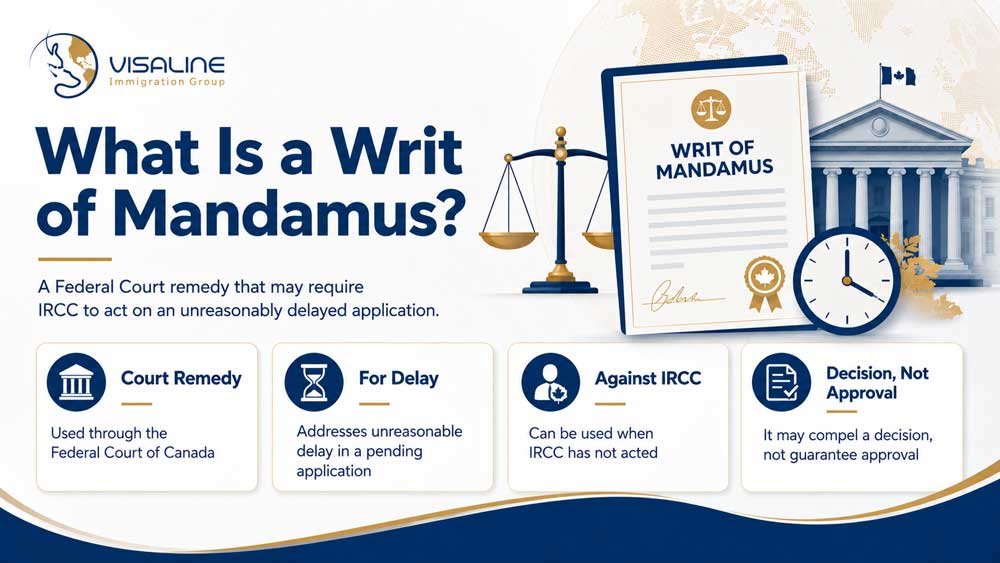
A Writ of Mandamus is a legal remedy available through the Federal Court of Canada. In an immigration context, an applicant may seek an Order of Mandamus asking the Court to require Immigration, Refugees and Citizenship Canada (IRCC) to perform its legal duty and move a pending matter toward a decision.
Section 18 of the Federal Courts Act gives the Federal Court jurisdiction to issue a writ of mandamus against a federal board, commission, or tribunal. Immigration proceedings are generally brought through an Application for Leave and for Judicial Review, and the Federal Court’s own immigration form specifically identifies whether the proceeding is a mandamus application.
The important distinction is simple:
Mandamus may compel IRCC to make a decision; it does not tell IRCC what that decision must be.
It is therefore not a way to guarantee a visa, work permit, study permit, or permanent residence approval.
When Is an IRCC Delay Unreasonable?
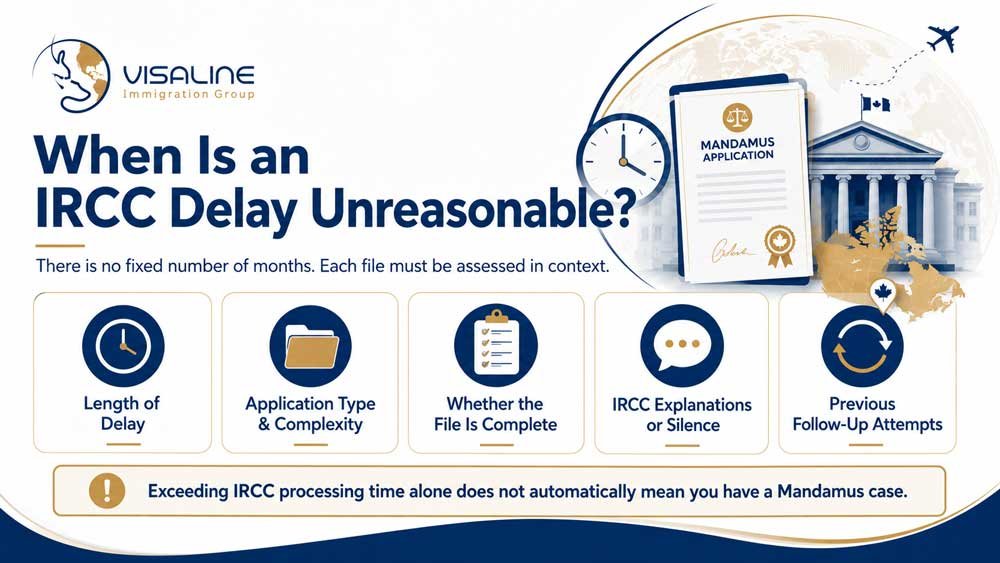
There is no universal number of months after which an IRCC application automatically qualifies for mandamus.
IRCC publishes processing times for different immigration programs, but those figures are estimates. IRCC itself states that processing times are updated regularly and are not maximum processing periods or guarantees.
A legal review of an IRCC unreasonable delay may consider factors such as:
- how long the application has been pending;
- the normal nature and complexity of that type of application;
- whether the applicant completed all required steps;
- whether IRCC requested additional documents, biometrics, medical examinations, or security information;
- whether any part of the delay resulted from the applicant;
- what explanations IRCC has provided;
- previous attempts to obtain an update; and
- whether another adequate remedy is available.
Canadian courts treat mandamus as a discretionary legal remedy, so simply exceeding the published IRCC processing time does not automatically establish an unreasonable delay.
Processing Delay vs. Possible Mandamus Case
| Situation | What It May Mean |
|---|---|
| Application remains within normal IRCC processing time | Usually continue monitoring the file |
| Processing time recently exceeded | Review status and make appropriate follow-ups |
| Prolonged delay with a clear IRCC explanation | Mandamus may or may not be appropriate depending on the circumstances |
| Significant delay with no meaningful explanation | Legal assessment may be appropriate |
| Applicant has outstanding requirements | The delay may not be attributable entirely to IRCC |
| Long-standing pending application despite completed requirements and repeated follow-up | A Mandamus application may warrant serious legal review |
Every file is different. A Canadian immigration delay should be evaluated on its own record rather than against a fixed online timeline.
Which Immigration Applications Can Be Delayed?
An immigration processing delay in Canada can arise in temporary residence, permanent residence, family immigration, and citizenship matters.
Potential files may include:
- Work Permit and Open Work Permit applications
- Employer-Specific Work Permits
- Study Permits
- Visitor Visas and Temporary Resident Visas (TRVs)
- Permanent Residence applications
- Express Entry applications
- Provincial Nominee Program (PNP) files
- Family and Spousal Sponsorship applications
- Citizenship applications
The fact that an application is delayed does not itself mean Federal Court action is appropriate. The key issue is whether the application processing delay has become legally unreasonable in the circumstances.
Mandamus for Canada Work Permit Delays
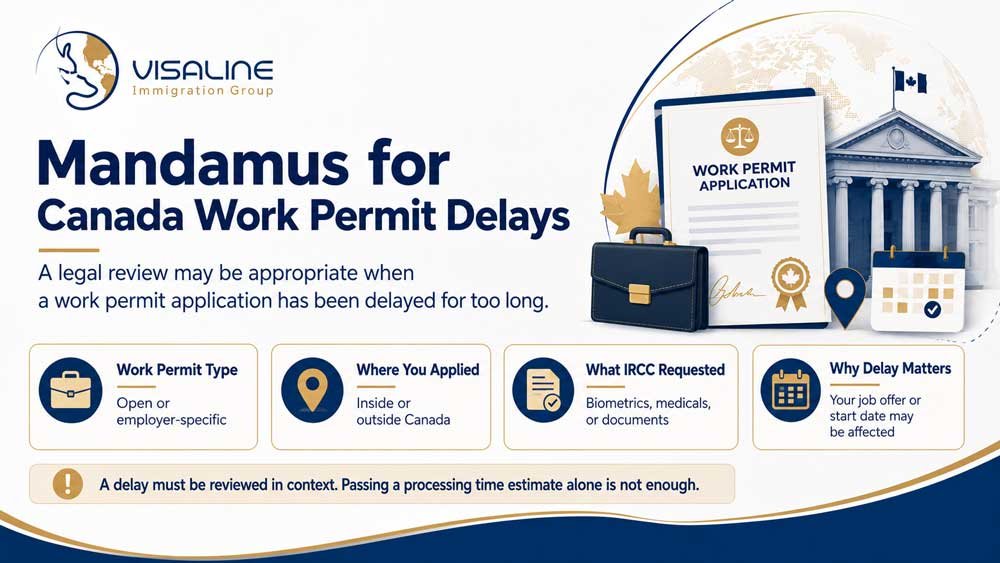
A Canada work permit processing delay can have immediate consequences. A worker may have an employer waiting, a planned start date approaching, or important decisions depending on the outcome of the application.
If your work permit application is taking too long, the first question is not simply whether the published processing time has passed. The full history of the application needs to be reviewed.
For example, a lawyer assessing an IRCC work permit delay may examine:
- when the application was submitted;
- whether it was filed inside or outside Canada;
- whether it involves an Open Work Permit or Employer-Specific Work Permit;
- whether biometrics, medical examinations, or additional documents were requested;
- whether IRCC has provided any reason for prolonged processing; and
- what follow-up steps have already been taken.
Applicants considering a new application or reviewing their immigration options can also read Visaline’s Canada Work Permit information.
A Writ of Mandamus for a work permit may be considered where the delay is significant and potentially unreasonable, but no responsible lawyer can determine that solely from the number of months shown on a processing-times page.
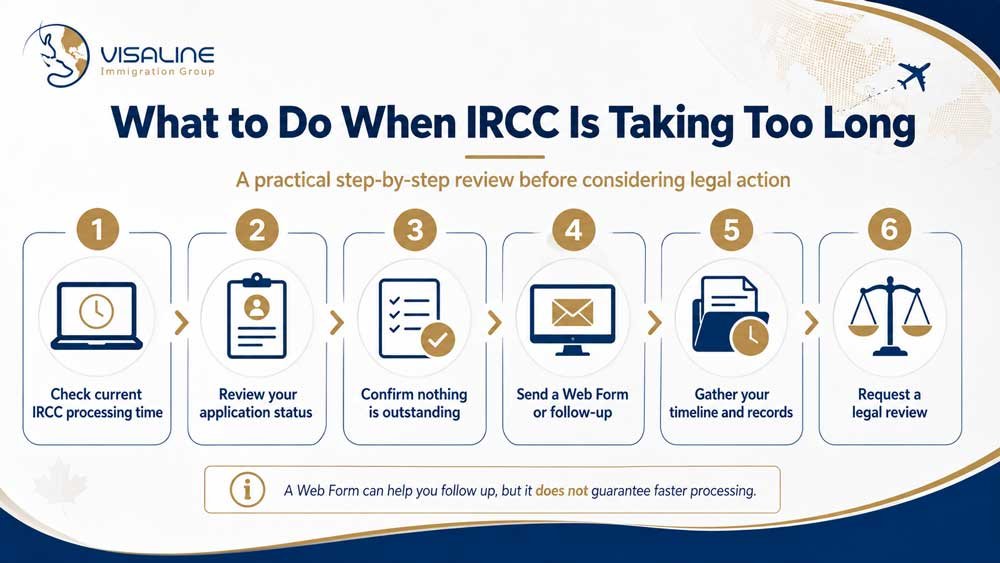
What to Do When IRCC Is Taking Too Long
If you have a delayed immigration application in Canada, a structured review is usually more useful than repeatedly sending the same inquiry.
- Check the current IRCC processing time. Compare your application category, location, and submission date with IRCC’s current information.
- Review your IRCC application status. Check your IRCC account or Application Status Tracker where available.
- Confirm that nothing is outstanding. Make sure IRCC has not requested documents, biometrics, medical information, fees, or other action.
- Follow up appropriately. An IRCC Web Form can be used to ask about an application when it is beyond normal processing time.
- Preserve a clear case timeline. Keep confirmation emails, application numbers, Web Form submissions, correspondence, and any responses from IRCC.
- Obtain a legal assessment if the delay continues. An immigration litigation professional can assess whether continued administrative follow-up is appropriate or whether a Federal Court application for IRCC delay should be considered.
An IRCC Web Form is a communication tool, not a guarantee that an application will be processed faster.
How a Mandamus Application Works
In immigration matters, legal action seeking mandamus proceeds through the Federal Court of Canada.
Section 72 of the Immigration and Refugee Protection Act provides that judicial review of an immigration matter in Federal Court begins through an application for leave. The Federal Court also publishes its own procedure and Form IR-1 for an Application for Leave and for Judicial Review.
In practical terms, a case may involve:
- reviewing the complete immigration history and processing timeline;
- determining whether the delay may meet the legal requirements for mandamus;
- reviewing previous requests and correspondence with IRCC;
- taking any appropriate pre-litigation steps;
- preparing and filing the Federal Court proceeding where justified;
- serving the required parties and preparing supporting evidence and legal submissions; and
- responding to developments in the case until the matter is resolved or determined by the Court.
A Federal Court writ of mandamus is litigation. It should therefore be based on the facts and evidence of the individual application, not used simply because an applicant is understandably frustrated with waiting.
Documents and Evidence to Review
For an IRCC delay immigration lawyer or immigration litigation professional to assess the matter properly, useful records may include:
- application submission confirmation or Acknowledgement of Receipt (AOR);
- application number and UCI;
- screenshots or records of IRCC application status;
- copies of IRCC correspondence;
- biometrics and medical examination records;
- additional document requests and responses;
- IRCC Web Form submissions and replies;
- previous follow-up requests;
- GCMS Notes or an ATIP Request, if available;
- documents showing relevant work, study, family, or personal timelines; and
- a chronological summary of the application’s history.
GCMS Notes are records associated with IRCC’s Global Case Management System and may sometimes provide additional context about case processing, although they are not automatically required in every potential mandamus matter.
Mandamus vs. Judicial Review
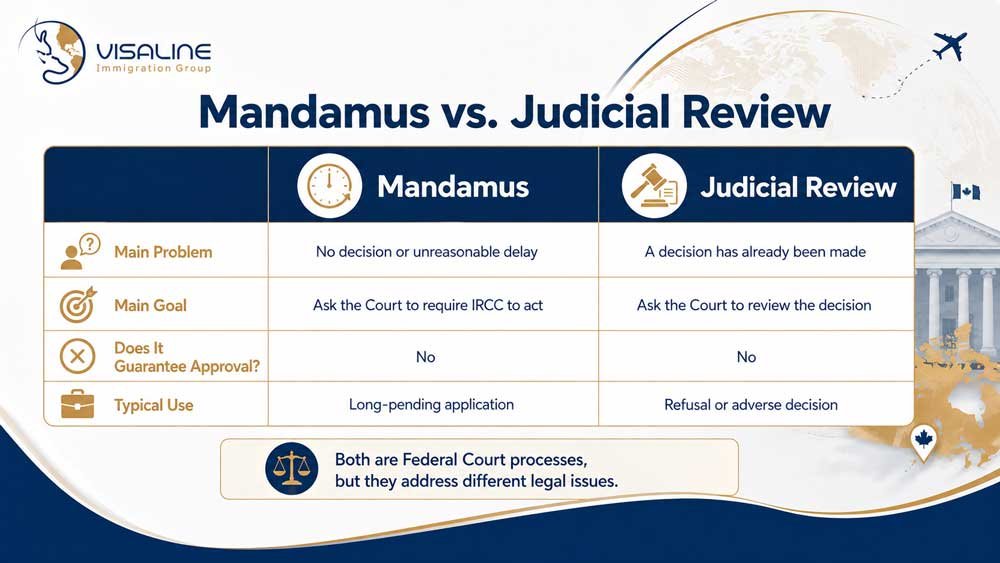
Mandamus and Judicial Review are related, but they address different problems.
| Mandamus | Judicial Review of a Decision |
|---|---|
| Usually concerns a failure or unreasonable delay in acting | Usually concerns a decision that has already been made |
| Seeks an order requiring the authority to act | Seeks Court review of the legality or reasonableness of a decision |
| Does not ask the Court to approve the immigration application | Does not normally ask the Court to substitute its own immigration decision |
| Common search issue: “IRCC application taking too long” | Common issue: visa refusal or another adverse decision |
Under Canadian immigration law, mandamus proceedings are brought within the Federal Court judicial-review framework.
If IRCC has already refused your application, the issue is no longer simply an IRCC application delay. Depending on the circumstances, you may instead need advice regarding reconsideration or Federal Court Judicial Review.
Applicants with a delayed Study Permit or Canada Visitor Visa should likewise have the specific history of their file reviewed before deciding whether legal action is appropriate.
Frequently Asked Questions
What is a Writ of Mandamus in Canadian immigration?
A Writ of Mandamus is a Federal Court remedy that can require a federal authority such as IRCC to perform a legal duty. In a delayed immigration case, the requested relief may be an order requiring IRCC to act on the application.
When can I file a Writ of Mandamus against IRCC?
There is no fixed waiting period that applies to every immigration application. The delay must be assessed in context, including its length, the type and complexity of the case, the applicant’s conduct, IRCC’s explanation, and available alternatives.
Can Mandamus speed up my immigration application?
A mandamus proceeding seeks Court intervention regarding an alleged unreasonable delay. It may result in movement or a decision in some cases, but no specific processing result or timeframe can be guaranteed.
Does Mandamus guarantee visa or work permit approval?
No. Mandamus is about requiring a decision or performance of a legal duty; it does not require IRCC to approve the underlying visa, work permit, study permit, or permanent residence application.
Can I file Mandamus if my application exceeds IRCC processing times?
Possibly, but exceeding IRCC’s published processing time alone is not enough to automatically establish a mandamus case. IRCC states that its processing times are estimates rather than maximum or guaranteed timelines.
Can I take IRCC to Federal Court for a delayed Work Permit?
Federal Court proceedings seeking mandamus may be available in an appropriate case involving an unreasonable IRCC delay. Whether a delayed Work Permit application meets the legal requirements must be determined from the individual file.
Conclusion
When an IRCC application is taking too long, the right response depends on more than a processing-time calculator. Some files require patience or an administrative follow-up; others may justify a closer legal review of the delay.
A Mandamus application in Canada is a serious Federal Court remedy designed to address failures or unreasonable delays in government action. It can seek to compel IRCC to make a decision, but it cannot guarantee what that decision will be.
If your Work Permit, Study Permit, Visitor Visa, PR, Express Entry, PNP, Sponsorship, or other immigration application has been pending for an extended period, Visaline can review the timeline, IRCC correspondence, and procedural history before discussing whether further follow-up or immigration litigation may be appropriate.

- Federal Courts Act, section 18 — Department of Justice Canada: Federal Court jurisdiction to issue a writ of mandamus.
- Immigration and Refugee Protection Act, section 72 — Department of Justice Canada: Judicial review of immigration matters in Federal Court.
- Federal Court of Canada — Application for Leave and for Judicial Review (Immigration): Official filing guidance and procedure.
- Federal Court Form IR-1: Official immigration judicial-review form identifying mandamus applications.
- Immigration, Refugees and Citizenship Canada — Check Processing Times: Current IRCC application processing estimates.
- IRCC Web Form: Official channel for asking about applications that exceed normal processing times.
Contact us today to review your case and book your immigration consultation. We also recommend following Visaline Immigration Institute on Instagram for real-time updates on IRCC news and immigration law changes.
☎️ Toronto WhatsApp: +1-647-860-0005
Published/Updated: August 9, 2026 Author: Visaline Legal Editorial Team