
Federal Court Judicial Review Canada: Challenging an IRCC Decision
Suggested Meta Description: Challenge an IRCC refusal through Federal Court Judicial Review in Canada. Learn deadlines, grounds, process and work permit options.
A refusal can put months of planning on hold—especially when you believe the officer misunderstood the evidence, applied the wrong legal test, or reached a decision that does not reasonably follow from the record. Federal Court Judicial Review Canada is the legal process through which an applicant may ask the Federal Court to review an immigration decision for a reviewable error; it is not a second visa application and does not guarantee approval. If the Court finds an error, the usual result is that the matter is returned for a new decision. (Canada)
At Visaline, With you on your immigration journey, from dream to reality means giving you a realistic assessment of your options after an IRCC refusal—not promising a result that no representative or lawyer can guarantee.
Table of Contents
- What Is Federal Court Judicial Review in Canadian Immigration?
- When Can You Challenge an IRCC Decision?
- Work Permit Refusal Judicial Review Canada
- Judicial Review or Reapplication?
- How an Application for Leave and Judicial Review Works
- Documents to Review After an IRCC Refusal
- What Happens If Judicial Review Is Successful?
- Frequently Asked Questions
- Conclusion
What Is Federal Court Judicial Review in Canadian Immigration?
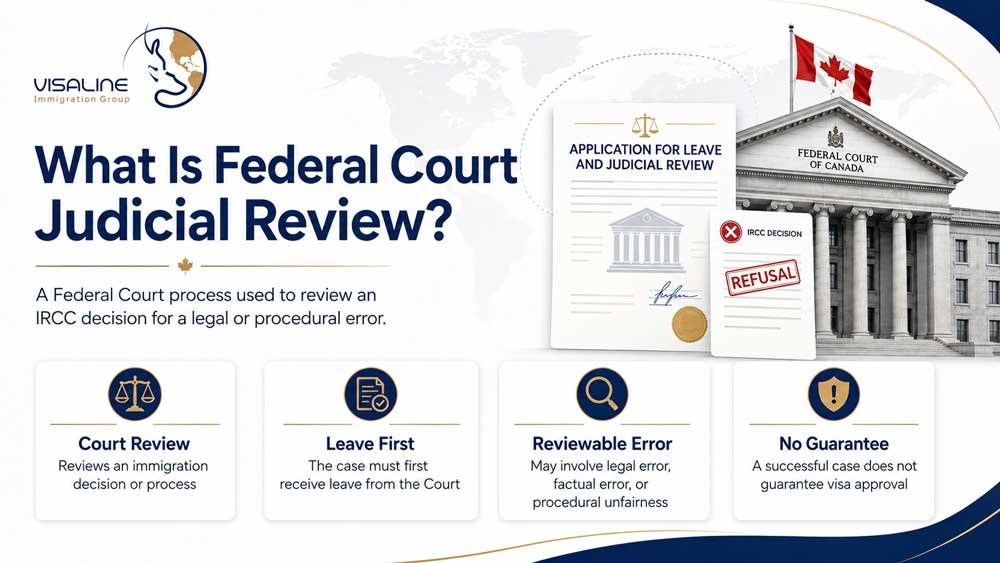
An immigration judicial review asks the Federal Court of Canada to review an immigration decision or matter arising under the Immigration and Refugee Protection Act (IRPA).
The formal process is called an Application for Leave and for Judicial Review. “Leave” simply means permission from a Federal Court judge to proceed to the judicial review hearing. If leave is refused, the judicial review does not proceed; if leave is granted, the Court schedules the hearing. (FCT Canada)
Judicial review may be relevant to decisions involving:
- Work Permits and Work Permit extensions
- Study Permits
- Visitor Visas and Temporary Resident Visas (TRVs)
- Permanent Residence applications
- Express Entry (replace with your actual page slug)
- Provincial Nominee Program-related immigration decisions
- Family or Spousal Sponsorship (replace with your actual page slug)
- Other immigration decisions governed by IRPA
The Court is not simply asked whether it would have made a different immigration decision. The legal issue is whether the decision or decision-making process contains an error that justifies Court intervention. IRCC itself describes an Application for Leave and Judicial Review as the process available to someone who believes an error was made in an IRCC decision. (Canada)
When Can You Challenge an IRCC Decision?
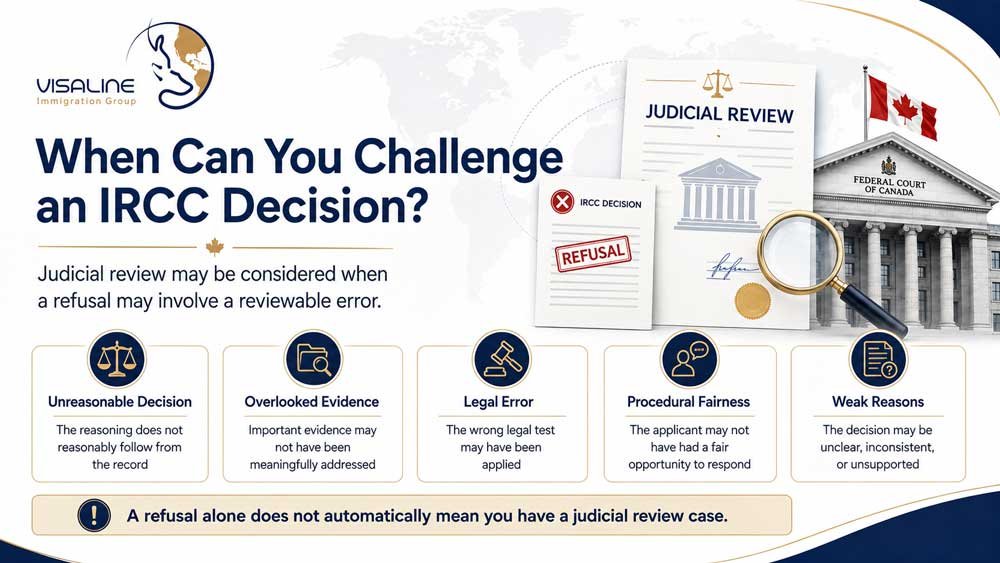
A refusal alone does not automatically mean there are grounds for IRCC judicial review. The refusal letter, officer’s reasons, evidence submitted with the original application, and applicable legal requirements need to be considered together.
Potential issues may include:
- an unreasonable decision or unreasonable finding;
- failure to meaningfully address important evidence;
- applying an incorrect legal test;
- findings that are not adequately supported by the record;
- contradictory or internally inconsistent reasoning;
- procedural unfairness, such as an applicant not being given a fair opportunity to respond where fairness required it; or
- another material legal or reviewable error.
For many refusals, IRCC now provides the deciding officer’s notes with the refusal letter. As of July 29, 2025, this applies to most temporary resident applications, including work permits, study permits and visitor visas; IRCC expanded the practice to most permanent residence applications on May 26, 2026. (Canada)
Judicial Review Deadlines Matter
Section 72 of IRPA currently requires an Application for Leave and Judicial Review to be filed and served within:
- 15 days for a matter arising in Canada; or
- 60 days for a matter arising outside Canada,
calculated from when the applicant is notified of or otherwise becomes aware of the matter. A Federal Court judge may allow an extension for special reasons, but an applicant should never assume an extension will be granted. (Department of Justice Canada)
This is why a refusal should be assessed promptly.
Work Permit Refusal Judicial Review Canada
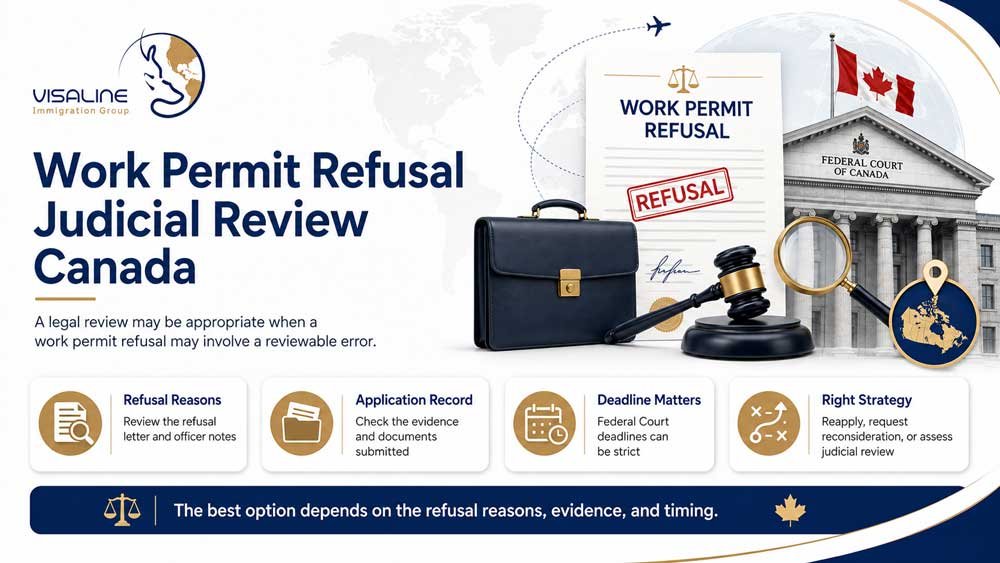
A Work Permit refusal Judicial Review in Canada may be worth assessing when there is a reasonable basis to argue that IRCC’s decision contains a reviewable error or that the decision-making process was unfair.
For example, imagine that an applicant provided detailed evidence addressing the purpose of employment, qualifications and supporting documentation, but the refusal reasoning appears to overlook evidence that was central to the application. The question is not simply whether the applicant disagrees with the visa officer. The question is whether the reasoning and process can withstand judicial review.
Before deciding whether to challenge a Canada Work Permit refusal, review:
- the refusal letter and officer decision notes;
- the complete Work Permit application as originally submitted;
- supporting employment documents;
- LMIA or LMIA-exempt documentation, where applicable;
- employer letters and job-offer information;
- evidence addressing the specific refusal grounds; and
- any communication between the applicant and IRCC.
Applicants considering a new application should also review Visaline’s Canada Work Permit page.
Should You Reapply After a Work Permit Refusal?
Sometimes, yes. IRCC states that a person whose application to come to Canada was refused may generally apply again unless the decision letter says otherwise, but recommends reapplying when new information can be included. (IRCC)
The right strategy depends on why the previous application failed.
Judicial Review or Reapplication?
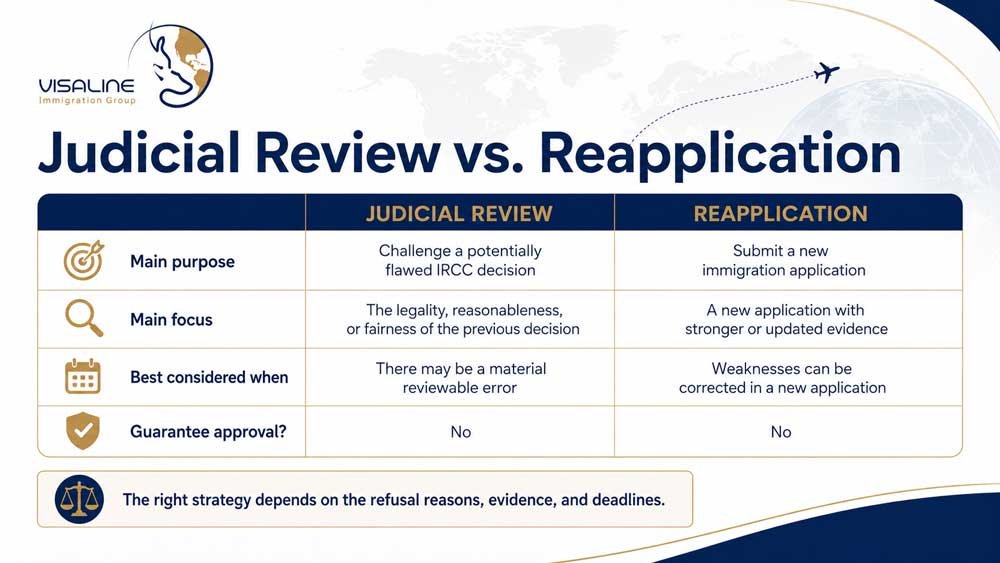
These are different remedies serving different purposes.
| Option | Judicial Review | Reapplication |
|---|---|---|
| Main purpose | Challenge a potentially flawed IRCC decision | Submit a new immigration application |
| Focus | The legality/reasonableness or fairness of the previous decision | A new application assessed by IRCC |
| New evidence | Generally focused on the decision and underlying record; evidentiary rules are specialized | New or stronger evidence can generally be included |
| Result if successful | Usually a new determination by IRCC | Approval or refusal of the new application |
| Best considered when | There may be a material reviewable error | Weaknesses can be corrected through a stronger new application |
| Does it guarantee approval? | No | No |
IRCC confirms that applicants can generally submit a new application after refusal, while the Federal Court/IRCC definition of judicial review focuses on reviewing whether an error occurred in the previous decision. (Canada)
In some cases, applicants also consider reconsideration. Reconsideration, reapplication and Federal Court proceedings should not be treated as interchangeable strategies; the best choice depends on the refusal reasons, available evidence and applicable deadline.
For general temporary-resident options, see Visaline’s Canada Visitor Visa (replace with your actual page slug) and Study in Canada (replace with your actual page slug) resources.
How an Application for Leave and Judicial Review Works
Under section 72 of IRPA, immigration judicial review starts with an application for leave to the Federal Court. The Federal Court’s current procedural guide sets out the following basic structure. (Department of Justice Canada)
- Review the IRCC decision and reasons. Identify the decision being challenged, the notification date and potential legal grounds.
- File the Application for Leave and Judicial Review. Form IR-1 identifies the decision, requested relief and grounds relied upon. The statutory 15- or 60-day deadline may apply depending on whether the matter arose inside or outside Canada. (FCT Canada)
- Prepare the Applicant’s Record. The Court’s rules require materials that can include the decision, written reasons, supporting affidavit evidence permitted in the proceeding and a memorandum of argument setting out the relevant facts and law. (FCT Canada)
- The Respondent files its materials. The respondent may file affidavits and a memorandum of argument, after which the applicant may file a reply memorandum within the prescribed time. (FCT Canada)
- The Federal Court decides whether to grant leave. Leave is considered in writing. If leave is refused, the file closes and there is no right of appeal from that leave decision. If leave is granted, the matter proceeds to a judicial review hearing. (FCT Canada)
- The Court hears the judicial review. The Court considers whether intervention is justified and issues its decision. A successful judicial review ordinarily results in the matter returning for a new decision rather than the Court simply issuing the requested visa or permit. (Canada)
Federal Court litigation has strict procedural requirements and deadlines. The Federal Court itself notes that court proceedings can be complicated and suggests that self-represented applicants may wish to seek legal advice. (FCT Canada)
Documents to Review After an IRCC Refusal
A Federal Court immigration lawyer assessing a potential case will usually need the actual record, not only a short description of why the applicant believes the decision was unfair.
Useful documents may include:
- IRCC refusal or decision letter;
- officer decision notes;
- complete application forms;
- all supporting documents originally submitted;
- IRCC correspondence;
- procedural fairness letters and responses, if any;
- relevant Work Permit, employment, study or family documentation;
- GCMS or other case notes, where available; and
- the exact date the decision was received.
Since IRCC now automatically provides officer decision notes with many Work Permit, Study Permit, Visitor Visa and PR refusals, applicants should check the refusal package before assuming a separate information request is necessary. (Canada)
What Happens If Judicial Review Is Successful?
Winning an IRCC Judicial Review does not normally mean the Federal Court approves your visa, Work Permit or permanent residence application.
IRCC’s official glossary explains that where the Court decides IRCC made an error, the usual consequence is that IRCC must make a new decision. (Canada)
That distinction matters:
Judicial Review can create an opportunity for lawful redetermination. It does not guarantee that the new decision will be positive.
Frequently Asked Questions
What is Federal Court Judicial Review in Canadian immigration?
It is a legal process in which the Federal Court reviews an immigration decision or matter for a reviewable error. Immigration cases under IRPA begin with an Application for Leave and Judicial Review. (Department of Justice Canada)
How long do I have to file Judicial Review after an IRCC refusal?
Under the current section 72 of IRPA, the deadline is generally 15 days for a matter arising in Canada and 60 days for a matter arising outside Canada from notification or awareness of the decision. Extensions may be available for special reasons but should never be assumed. (Department of Justice Canada)
Can I challenge a Canada Work Permit refusal in Federal Court?
A Work Permit refusal can potentially be the subject of Federal Court Judicial Review where there is an arguable reviewable error. Whether judicial review, reconsideration or a new application is more appropriate depends on the refusal reasons and the individual record.
Does winning Judicial Review mean IRCC must approve my visa?
No. If the Court finds an error, the usual result is a new IRCC decision. Judicial Review does not guarantee visa or permit approval. (Canada)
Should I reapply or file Judicial Review after a refusal?
Reapplication may make sense where the weakness can be corrected with new or stronger evidence. Judicial Review may be more appropriate where the existing decision itself may contain a material legal or procedural error. IRCC generally permits reapplication unless the decision letter states otherwise. (IRCC)
What is the difference between Mandamus and Judicial Review?
For practical immigration SEO purposes, think of the distinction this way: Judicial Review commonly addresses a decision that has already been made; Mandamus commonly addresses an alleged failure or unreasonable delay in making a decision. The exact Federal Court remedy must be assessed against the facts of the case and applicable law.
Conclusion
A Canadian immigration refusal does not automatically mean the decision should go to Federal Court—and it also does not mean you should automatically submit the same application again.
The first step is to understand why IRCC refused the application. For a Work Permit, Study Permit, Visitor Visa, Express Entry or another immigration matter, that means examining the refusal reasons, officer notes, original evidence, applicable law and the Federal Court deadline.
Where a significant reviewable error may exist, Federal Court Judicial Review in Canada can provide a legal mechanism to challenge the decision. Where the stronger solution is a corrected new application, reapplication may be the more practical route.
A timely legal assessment can help distinguish between those options before an important deadline passes.

Sources
- Immigration and Refugee Protection Act, sections 72–74 — Justice Laws Website: Governs leave and judicial review in immigration matters, including current filing deadlines and the judicial review hearing framework. (Department of Justice Canada)
- Federal Court of Canada — Application for Leave and for Judicial Review (Immigration): Official procedural chart covering filing, Applicant’s Record, respondent materials and the leave stage. (FCT Canada)
- Federal Court of Canada — How to File an Application for Leave and for Judicial Review: Official filing requirements, Form IR-1, timelines and procedural guidance. (FCT Canada)
- IRCC Glossary — Application for Leave and Judicial Review: Official explanation of the remedy and the usual consequence where the Court finds an IRCC error. (Canada)
- IRCC — Officer Decision Notes: Current information on decision notes provided with most temporary residence and permanent residence refusal letters. (Canada)
- IRCC Help Centre — Reapplying After Refusal: Official guidance on submitting a new application after an immigration refusal. (IRCC)
Published/Updated: August 9, 2026 Author: Visaline Legal Editorial Team
Contact us today to review your case and book your immigration consultation. We also recommend following Visaline Immigration Institute on Instagram for real-time updates on IRCC news and immigration law changes.
☎️ Toronto WhatsApp: +1-647-860-0005