Language Schools in Canada: ESL Programs, Study Permits and Work Rules
Suggested meta description: Compare language schools in Canada, ESL programs, study permit rules, work rights, documents and pathways to college or university.
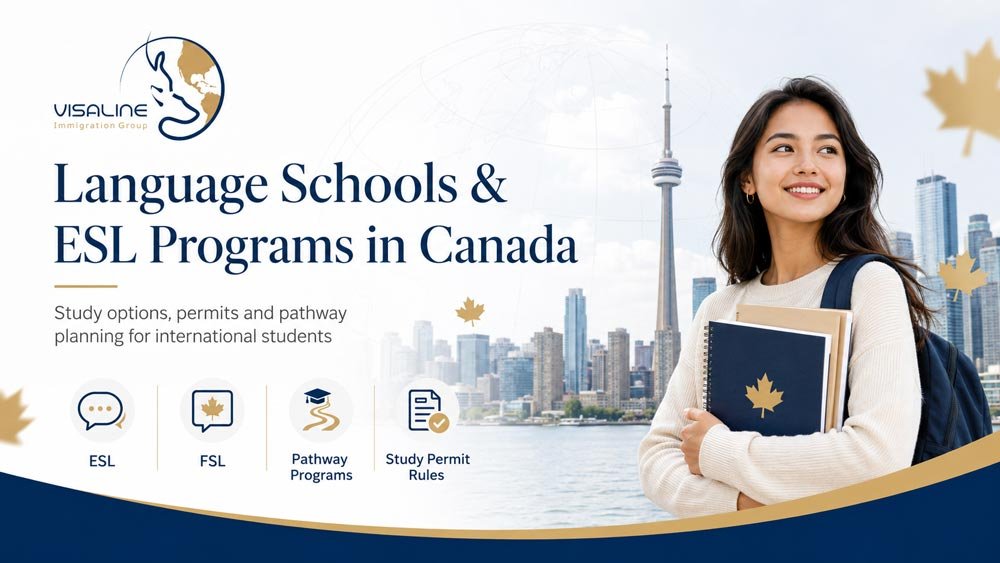
Learning English or French in Canada can be a useful bridge to university, employment or everyday life—but the course itself is not automatically an immigration pathway. Language schools in Canada offer ESL, FSL, academic English and exam-preparation programs. A course lasting more than six months generally requires a study permit, while a program of six months or less may be completed without one if you remain legally authorized to stay in Canada. At Visaline, “With you on your immigration journey, from dream to reality” means looking beyond the school brochure and checking how the program fits your academic, financial and immigration plans.
Table of Contents
- What are language schools and ESL programs in Canada?
- Types of English and French language programs
- Do you need a study permit for language school?
- How to choose a language school in Canada
- Documents required for an ESL study permit
- How to apply for a language-school study permit
- Can ESL students work in Canada?
- Do ESL programs qualify for a PGWP?
- Language pathways to college or university
- Language-school costs and financial planning
- Common mistakes to avoid
- Frequently asked questions
What Are Language Schools and ESL Programs in Canada?
Canadian language schools teach English as a Second Language, commonly called ESL, or French as a Second Language, known as FSL. Programs may be offered by private language institutes, colleges, universities or continuing-education departments.
Students commonly choose language training to:
- Improve everyday speaking and listening
- Prepare for IELTS, TOEFL, CELPIP, TEF or TCF
- Meet a college or university language requirement
- Develop academic writing and presentation skills
- Prepare for a professional or workplace environment
- Experience short-term cultural immersion in Canada
Think of language school as a bridge. It can prepare you to enter a later academic program, but the bridge is not the same as the degree, diploma or professional credential waiting on the other side.
Applicants planning to Study in Canada (replace with your actual page slug) should confirm the purpose of the course before paying a deposit. A general conversation class and an academic pathway program may lead to very different outcomes.
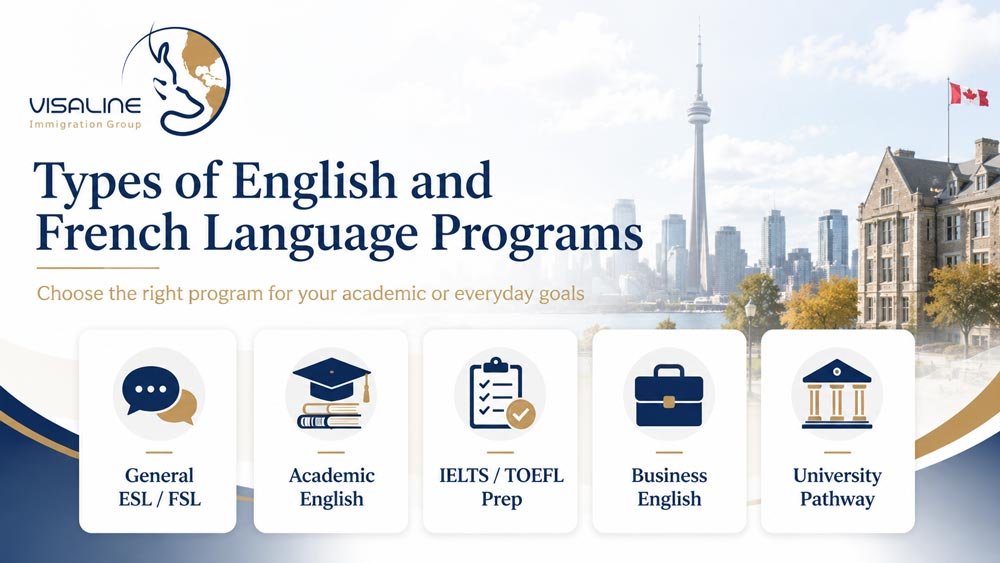
Types of English and French Language Programs
| Program type | Best suited for | Typical focus | Important consideration |
|---|---|---|---|
| General ESL or FSL | Students improving everyday communication | Speaking, listening, reading and writing | Usually does not lead to a formal academic credential |
| English for Academic Purposes | Future college or university students | Essays, lectures, research and presentations | Confirm whether the intended institution recognizes the pathway |
| IELTS or TOEFL preparation | Students needing an admission test | Exam format, strategies and timed practice | Course completion does not guarantee a particular test score |
| CELPIP preparation | Applicants preparing for a Canadian language test | Listening, reading, writing and speaking tasks | Mainly useful when CELPIP is accepted for the intended purpose |
| Business English | Professionals and job seekers | Meetings, emails, presentations and vocabulary | Does not by itself provide Canadian work authorization |
| University or college pathway | Students with conditional academic admission | Language preparation linked to further study | Review the admission conditions and progression rules carefully |
| Short-term immersion | Visitors and students seeking intensive practice | Language classes combined with cultural experience | Programs of six months or less may not require a study permit |
No course should be selected only because it uses words such as “pathway,” “career” or “international.” Ask the school to explain in writing what credential you receive and which institutions formally recognize it.
Do You Need a Study Permit for Language School?
The answer primarily depends on the length of the program and your immigration situation.
| Language course | Study permit position | Travel document | Work rights from the course |
|---|---|---|---|
| Six months or less | A study permit is generally not required if the course can be completed during your authorized stay | A visitor visa or eTA may still be required | Studying without a permit does not give you permission to work |
| More than six months | A study permit is generally required before studying in Canada | A visitor visa or eTA may also be issued or linked as applicable | ESL- or FSL-only students are not generally eligible for off-campus work |
| ESL or FSL followed by an academic program | Immigration planning should cover both stages | Depends on nationality and status | Work eligibility normally begins only after the student enters a qualifying program and meets IRCC conditions |
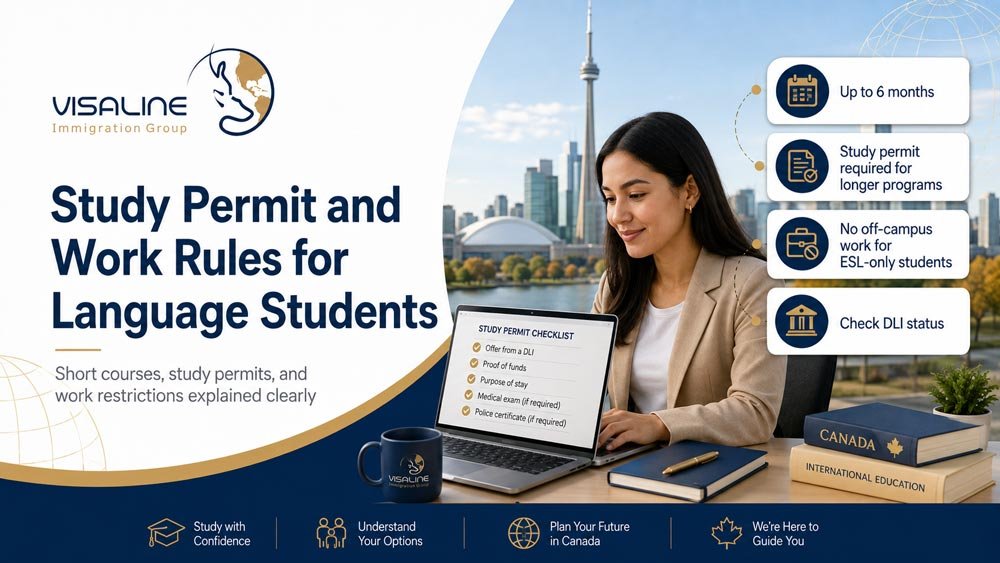
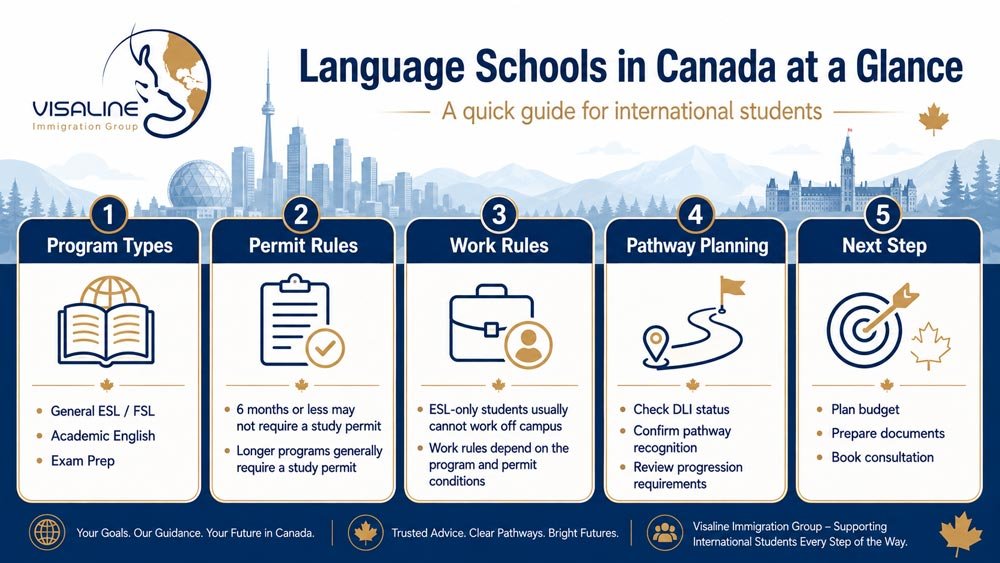
IRCC states that a course lasting six months or less can generally be completed without a study permit. The student still needs the appropriate travel authorization to enter Canada. A program lasting longer than six months requires a study permit.
A short course should not automatically be treated as a shortcut to a longer stay. When the real plan is to complete language training and then continue into a lengthy academic program, the full study plan should be considered from the beginning.
Is a language school required to be a DLI?
To obtain a study permit for post-secondary studies, you need a letter of acceptance from a designated learning institution, or DLI. A DLI is a school approved by a province or territory to host international students. If the school is not on the official DLI list, you cannot use its acceptance letter for a study permit application.
DLI status does not mean:
- Every program is eligible for a Post-Graduation Work Permit
- The government guarantees the school’s academic quality
- A study permit application will be approved
- Students in every program may work during their studies
The exact school name, campus and DLI number should match the acceptance letter.
How to Choose a Language School in Canada
A lower tuition quote is not always the less expensive option. A course that does not support your next step may cost more in lost time, additional applications and repeated tuition.
Before enrolling, review:
- The school’s current DLI status, if a study permit is needed
- The exact campus and program length
- Weekly instructional hours
- Class size and level-placement process
- Refund and deferral policies
- Homestay, residence or accommodation charges
- Health-insurance requirements
- Textbook, registration and activity fees
- Whether the program is general ESL or an academic pathway
- Which colleges or universities formally accept the pathway
- The minimum grade or language level needed to progress
- Whether conditional admission to the later program has been issued
- Whether the later academic program may be PGWP-eligible
Ask for the total cost in writing. “Tuition” may not include registration fees, materials, housing placement, insurance or airport pickup.
Documents Required for an ESL Study Permit
A typical application for a language program lasting more than six months may require:
- A valid passport
- A letter of acceptance from a DLI
- A provincial or territorial attestation letter, when required
- A Quebec Acceptance Certificate, or CAQ, for studies in Quebec
- Proof of tuition payment, where applicable
- Proof of funds for tuition, living costs and transportation
- A letter of explanation or study plan
- Academic records and language history
- Evidence of employment, family, financial or other ties
- Biometrics, if required
- A medical examination, if required
- Certified translations for documents not in English or French
Most study permit applicants need a PAL or TAL, unless they fall within a listed exemption. In Quebec, the CAQ generally serves as the provincial attestation document. The PAL or TAL should normally be submitted with the study permit application rather than added later.
IRCC also requires applicants to establish that they have enough money for tuition, living expenses and return transportation. A letter explaining why the particular language program makes sense is recommended.
How to Apply for a Language-School Study Permit
- Define the purpose of the language course.
Explain whether it supports academic admission, professional development or another credible objective. - Select a suitable DLI and campus.
Confirm that the exact institution is authorized to host international students. - Obtain the letter of acceptance.
Check the tuition, start date, end date and registration deadline. - Obtain the PAL, TAL or CAQ when required.
The school usually explains how to request the applicable document. - Prepare your financial evidence.
Show how tuition, living expenses and transportation will be paid without relying on unauthorized employment. - Write a focused study plan.
Connect the course to your education, career and future plans rather than using a generic statement. - Complete the online study permit application.
Upload clear documents, disclose immigration history accurately and pay the required government fees. - Respond to any IRCC requests.
Biometrics, medical results or additional documents may be requested.
The current government fee for a study permit is CAD $150. Other expenses, including biometrics, medical examinations and school fees, may apply depending on the case.
For more detailed immigration requirements, review the Visaline page on the Canada study permit (replace with your actual page slug).
Can ESL Students Work in Canada?
Students enrolled only in English or French as a second-language programs are not eligible to work off campus without a separate work permit. The same restriction generally applies to students taking only general-interest courses or prerequisite courses required for admission to a full-time program.
This means an ESL study permit should not be presented as a “study and work” package.
Eligible students in qualifying academic, vocational or professional programs may work up to 24 hours per week off campus during regular academic terms, but those rules do not automatically apply to language-only students.
IRCC also states that ESL, FSL and preparatory students are not eligible for a co-op work permit based on those courses.
What happens after moving from ESL to an academic program?
A student who completes a prerequisite language course and enters a qualifying full-time program may later become eligible for off-campus work. However, the conditions printed on the study permit may need to be changed before the student can work or obtain a Social Insurance Number.
Do not begin working simply because the language course has ended. Confirm that the new program, immigration status and permit conditions satisfy the current requirements.
Do ESL Programs Qualify for a PGWP?
No. Completing an English- or French-as-a-second-language program does not make a graduate eligible for a Post-Graduation Work Permit. General-interest, self-improvement and non-credit programs are also normally ineligible.
A language course may prepare a student for a later PGWP-eligible program, but only the later program is assessed for PGWP purposes. The institution and specific academic program must satisfy the rules in effect when the student applies.
Students who intend to work after graduation should investigate Post-Graduation Work Permit eligibility (replace with your actual page slug) before choosing the academic program that follows ESL.
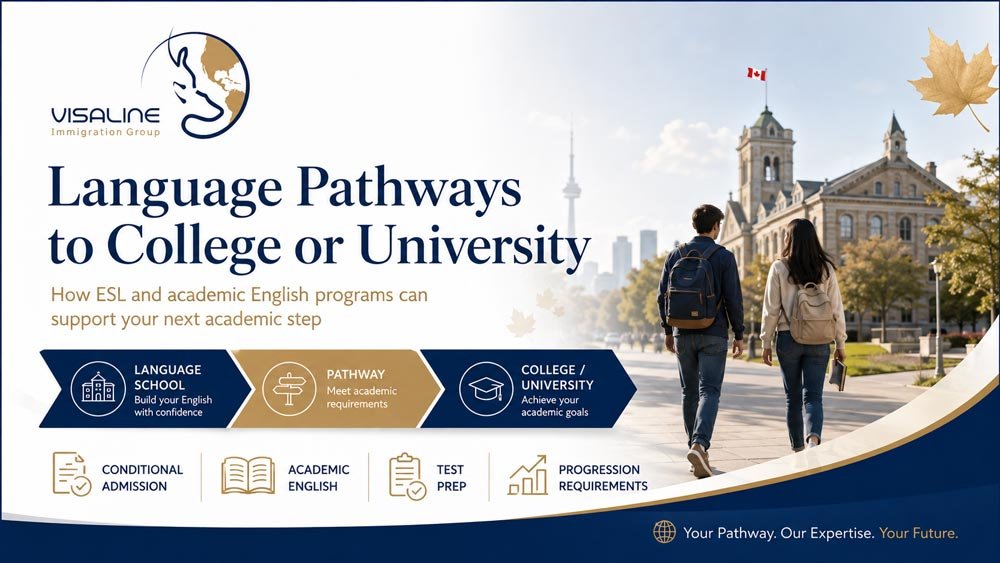
Language Pathways to College or University
Some colleges and universities offer conditional admission. The student is academically accepted but must first meet an English or French requirement.
This condition might be satisfied through:
- Completion of the institution’s own academic language program
- Completion of an approved partner-school pathway
- An accepted IELTS, TOEFL or other test score
- Previous education completed in an accepted language environment
- Another institution-specific exemption
Pathway agreements are not universal. Completion of one language school’s course does not mean every Canadian university will waive IELTS or another language test.
Before paying tuition, request written confirmation answering three questions:
- Which institution accepts the language pathway?
- What level or final grade must you achieve?
- Is admission to the academic program guaranteed after completion, or will the application be assessed again?
When moving to a different post-secondary DLI, a student may need a new study permit before starting at the new school. Current rules concerning changes of institution should be reviewed before transferring.
Language-School Costs and Financial Planning
Language-school tuition varies by city, institution, course intensity and duration. Your practical budget should include:
- Tuition and registration fees
- Textbooks and digital resources
- Health insurance
- Homestay or rental accommodation
- Meals
- Local transportation
- Mobile phone and internet
- Visa or study permit fees
- Biometrics and medical costs, where applicable
- Flights and emergency funds
For study permit applications submitted on or after September 1, 2025, a single applicant studying outside Quebec must currently demonstrate at least CAD $22,895 for first-year living expenses, excluding tuition and transportation. IRCC updates the financial requirement annually, so the current figure must be checked before submission.
A promise to find part-time work is not a replacement for proof of funds—especially because language-only students are generally not authorized to work off campus.
For a short language course, some students may enter Canada as visitors when eligible. The admission and financial considerations for a Canada visitor visa (replace with your actual page slug) are different from the requirements for a study permit.
Common Mistakes to Avoid
Choosing a school without checking its DLI status
A school can legally offer language instruction but still be unsuitable for a study permit application.
Assuming language school provides work authorization
ESL- and FSL-only students are generally excluded from off-campus work authorization.
Expecting a PGWP after ESL
Language training alone is explicitly excluded from PGWP eligibility.
Using a generic study plan
A study plan should explain why studying the language in Canada is reasonable for your particular education or career.
Relying on unclear pathway promises
Ask for a written agreement identifying the receiving college or university and the progression conditions.
Underestimating the total budget
Registration, insurance, accommodation and daily expenses can significantly exceed the advertised weekly tuition.
Treating a short course as automatic entry to a longer program
A visitor’s permission to complete a short course does not automatically authorize extended study, work or a later academic program.
Frequently Asked Questions
Can I study English in Canada with a visitor visa?
Yes, a course lasting six months or less can generally be completed without a study permit, provided it is completed during your authorized stay. You still need the appropriate visitor visa or eTA to travel to Canada.
Do I need a study permit for a three-month ESL course?
Generally, no. A study permit is not normally required for a course lasting six months or less. The course does not give you work authorization.
Can I work while studying ESL in Canada?
Not under the standard off-campus student work rules. A person enrolled only in an ESL or FSL program needs separate work authorization to work off campus.
Does an ESL program qualify for a Post-Graduation Work Permit?
No. English- and French-as-a-second-language programs do not qualify graduates for a PGWP.
Can a language pathway replace IELTS for university admission?
Sometimes. Certain institutions accept completion of their own program or an approved partner pathway, but the policy is set by the receiving school. Obtain written confirmation before enrolling.
Is every Canadian language school a DLI?
No. Only institutions appearing on the official DLI list can issue an acceptance letter that supports a post-secondary study permit application.
Conclusion
Language schools in Canada can help international students improve communication skills, prepare for admission and adjust to an English- or French-speaking environment. The right course depends on what comes next.
A short immersion program, an academic pathway and a stand-alone ESL course are not interchangeable. They can have different study permit, work and post-graduation consequences. Before paying tuition, confirm the school’s DLI status, pathway recognition, complete cost, work restrictions and whether the later academic program supports your long-term plan.
Visaline can review the proposed language course and immigration strategy so you understand the practical options and risks before making a financial commitment.

Contact us today to review your case and book your immigration consultation. We also recommend following Visaline Immigration Institute on Instagram for real-time updates on IRCC news and immigration law changes.
☎️ Toronto WhatsApp: +1-647-860-0005
Published/updated: August 6, 2026
Author: Visaline Legal Editorial Team