
Canadian Experience Class (CEC) 2026: Eligibility, Express Entry and Canada PR
You may have studied in Canada, obtained a Post-Graduation Work Permit or another valid work permit, and now accumulated Canadian professional experience—but one year of work in Canada does not automatically guarantee permanent residence. The Canadian Experience Class (CEC) remains an active Express Entry pathway in 2026 for skilled workers with qualifying Canadian work experience, but applicants must first meet the program requirements and then receive an Invitation to Apply based on the Express Entry selection system.
CEC is particularly important for people who have already established themselves in the Canadian labour market. At Visaline, “With you on your immigration journey, from dream to reality” means looking beyond the simple question of how long you have worked and examining whether your authorization, NOC duties, TEER level, language results and Express Entry profile actually support a CEC application.
Table of contents
- What is the Canadian Experience Class?
- CEC requirements in 2026
- Canadian work experience requirements
- What work experience does not count?
- CEC language requirements
- Is education required for CEC?
- Do you need a job offer for CEC?
- CEC and CRS score in 2026
- 2026 Express Entry category-based selection
- Do CEC applicants need proof of funds?
- Documents required for CEC
- How to apply through CEC
- What if your work permit is expiring?
- CEC fees and processing time
- Common CEC mistakes and refusal risks
- Frequently asked questions
What is the Canadian Experience Class?
The Canadian Experience Class is a federal economic immigration program managed through Express Entry for foreign nationals with qualifying skilled work experience in Canada.
Section 87.1 of the Immigration and Refugee Protection Regulations establishes the Canadian Experience Class for applicants who can become economically established in Canada based in part on their Canadian experience and who intend to live outside Quebec.
CEC is one of the three federal programs managed by Express Entry:
- Canadian Experience Class;
- Federal Skilled Worker Program; and
- Federal Skilled Trades Program.
Express Entry is the application-management system. CEC is the immigration program.
This distinction matters because meeting CEC eligibility does not automatically result in an Invitation to Apply (ITA). Once eligible, the candidate enters the Express Entry pool and is ranked through the Comprehensive Ranking System (CRS).
CEC requirements in 2026
To qualify for the Canadian Experience Class, an applicant generally needs at least one year of qualifying skilled Canadian work experience within the previous three years, the required language score and an intention to settle outside Quebec.
The core CEC requirements are:
- at least 1 year or 1,560 hours of qualifying Canadian work experience;
- experience acquired within the 3 years before the permanent residence application;
- work in NOC TEER 0, 1, 2 or 3;
- legal authorization to work in Canada;
- temporary resident status during the qualifying employment;
- performance of the NOC lead statement and a substantial number of the main duties;
- qualifying English or French language results;
- admissibility to Canada; and
- intention to live outside Quebec.
CEC requirements at a glance
| Requirement | CEC 2026 rule |
|---|---|
| Canadian work experience | At least 1 year / 1,560 hours |
| Recency | Within previous 3 years |
| Eligible occupations | NOC TEER 0, 1, 2 or 3 |
| Work authorization | Required |
| Paid employment | Required |
| Job offer | Not required |
| Education | No minimum education requirement |
| Language | CLB/NCLC 7 or 5 depending on TEER |
| Proof of settlement funds | Not required for CEC |
| Province of destination | Outside Quebec |
Canadian work experience requirements
CEC work experience must be skilled, paid, legally authorized and acquired while physically working in Canada under qualifying temporary resident status.
Your qualifying experience must generally be in one or more occupations classified as:
- TEER 0;
- TEER 1;
- TEER 2; or
- TEER 3.
You may combine eligible experience from more than one NOC occupation, provided the experience satisfies the program requirements.

How many hours do you need?
IRCC requires at least 1,560 hours of eligible work experience.
This can generally be accumulated as:
- 30 hours per week for 12 months in one full-time position;
- an equivalent amount of eligible part-time work; or
- qualifying hours from more than one job.
Working substantially more than 30 hours each week should not be treated as a way to compress the one-year requirement into only a few months. The CEC requirement is framed as one year of full-time work or its part-time equivalent.
Your actual duties matter more than your job title
A job title such as “manager,” “coordinator” or “supervisor” is not enough to establish the correct National Occupational Classification.
IRPR requires an applicant to have performed:
- the actions in the NOC lead statement; and
- a substantial number of the main duties, including the essential duties.
A strong CEC assessment therefore compares your real day-to-day duties with the claimed NOC—not merely the title appearing on your employment contract.
Can remote work count?
Remote work can potentially count if you were physically present in Canada and working for a Canadian employer.
IRCC specifically states that an applicant working remotely must have been physically in Canada and working for a Canadian employer for the experience to qualify as Canadian work experience.
This distinction can become important for employees who travelled outside Canada or worked remotely from another country for part of the qualifying period.
What work experience does not count?
Not every period of legal employment in Canada can be used toward the CEC minimum requirement.
The regulations exclude certain periods from qualifying Canadian Experience Class work experience.
Full-time student work
Work completed while you were engaged in full-time study does not count toward the CEC minimum work-experience requirement. This includes work during a co-op term for the purpose of CEC eligibility.
This is particularly relevant to international graduates.
If you completed a Canadian program and worked part-time while studying, those hours should not simply be added to your post-graduation employment to reach 1,560 CEC hours.
Self-employment
Self-employed experience generally does not count toward the CEC minimum requirement.
There is, however, a specific public-policy exception for certain foreign national physicians providing publicly funded medical services in Canada, including some fee-for-service arrangements that would otherwise be treated as self-employment.
Unauthorized work
Work performed without authorization cannot be used toward the CEC minimum requirement. The regulations require qualifying experience to have been acquired while the foreign national had temporary resident status, and unauthorized employment is specifically excluded.
Unpaid work
Volunteer work and unpaid internships do not meet IRCC’s paid-work requirement for CEC. Qualifying experience must involve wages or commission.
Practical example
Example: Nina completed a Canadian diploma and worked 20 hours per week in a TEER 2 occupation during her final year of study. After graduation, she obtained a valid work permit and began working full-time in the same occupation.
Her student employment cannot simply be combined with her post-graduation employment to meet the CEC minimum. She generally needs to accumulate the required qualifying experience after her full-time studies under circumstances that satisfy the CEC rules.

CEC language requirements
Your required language level depends on the TEER category of the Canadian work experience used for CEC.
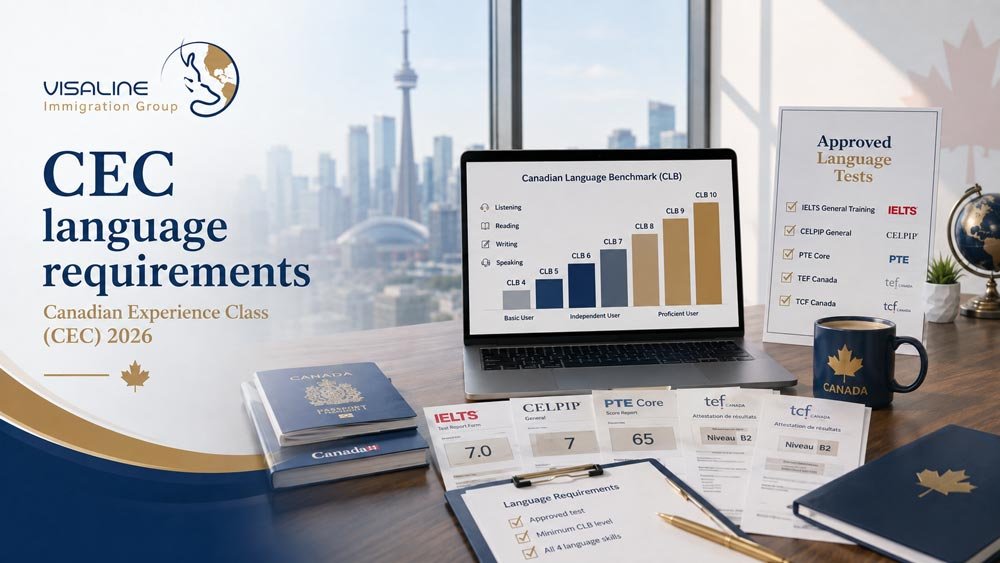
| NOC TEER | English requirement | French requirement |
|---|---|---|
| TEER 0 or 1 | CLB 7 in all 4 abilities | NCLC 7 in all 4 abilities |
| TEER 2 or 3 | CLB 5 in all 4 abilities | NCLC 5 in all 4 abilities |
The four abilities are:
- speaking;
- listening;
- reading; and
- writing.
Meeting the overall average is not enough. You must meet the required level in each individual language ability.
Which language tests does Express Entry accept?
For English:
- CELPIP-General;
- IELTS General Training; and
- PTE Core.
For French:
- TEF Canada; and
- TCF Canada.
IRCC does not accept IELTS Academic for Express Entry, and it currently does not accept IELTS One Skill Retake for Express Entry.
How long are language results valid?
Language-test results must be less than two years old both when you complete the Express Entry profile and when you submit the permanent residence application. Submitting a PR application with expired language results can lead to refusal.
This is one of the deadlines applicants should monitor carefully while waiting in the Express Entry pool.
Is education required for CEC?
No. There is no minimum education requirement for the Canadian Experience Class.
An applicant could meet the CEC program requirements without a university or college credential. Education can nevertheless be highly important for the applicant’s CRS ranking.
Canadian education may generate CRS points where applicable.
Foreign education can also contribute to the Express Entry score if the applicant has:
- a completed foreign credential; and
- a valid Educational Credential Assessment (ECA) for immigration purposes.
This creates an important distinction:
Education may not be required to qualify for CEC, but it can still affect whether your CRS score is competitive enough to receive an invitation.
Do you need a job offer for CEC?
No. A job offer is not required to qualify for the Canadian Experience Class.
IRCC expressly states that CEC applicants do not need a job offer, although an employer may choose to provide one.
This is different from programs where a qualifying offer of employment is an eligibility requirement.
Do job offers give CRS points in 2026?
Under the current CRS rules, no additional CRS points are awarded simply for having a qualifying job offer.
IRCC removed the former 50- and 200-point job-offer bonuses from the Comprehensive Ranking System on March 25, 2025.
There were consultations in 2026 about possible future Express Entry reforms, including potentially introducing points for certain high-wage occupations. Those proposals should not be treated as current CRS law or policy unless and until IRCC formally implements them.
For a 2026 CEC article, this distinction is essential because older Express Entry content may still refer to 50 or 200 job-offer CRS points.
CEC and CRS score in 2026
CEC has no single fixed CRS score that guarantees an Invitation to Apply.
Meeting CEC eligibility gets a candidate into the Express Entry pool; it does not mean IRCC will automatically invite them.
The Comprehensive Ranking System (CRS) ranks candidates using factors that can include:
- age;
- education;
- official-language proficiency;
- Canadian work experience;
- spouse or common-law partner factors;
- skill-transferability combinations; and
- additional factors such as a provincial nomination or qualifying French-language results.
IRCC then conducts different types of Express Entry invitation rounds:
- General rounds
- Program-specific rounds
- Category-based rounds
The CRS cut-off depends on the specific round and the candidates included in that round. There is therefore no responsible way to publish one permanent number as “the CEC CRS requirement for 2026.”
Eligibility score versus invitation score
These concepts are often confused.
CEC eligibility asks:
Do you satisfy the legal minimum requirements of the Canadian Experience Class?
CRS ranking asks:
How competitive is your Express Entry profile compared with other eligible candidates?
A person can therefore be fully eligible for CEC but remain in the pool without receiving an ITA.
2026 Express Entry category-based selection
CEC candidates may also benefit from category-based Express Entry selection if they satisfy the requirements of a current category.
For 2026, IRCC’s current categories include:
- French-language proficiency;
- healthcare and social services;
- STEM occupations;
- trades;
- education;
- transport;
- physicians with Canadian work experience;
- senior managers with Canadian work experience;
- researchers with Canadian work experience; and
- skilled military recruits.
A person must first be eligible for at least one Express Entry program, such as CEC, and then also satisfy the requirements of the category being targeted. Candidates who meet those criteria are ranked within the eligible group using CRS.
This means CEC strategy in 2026 should not focus only on a generic CRS cut-off. Occupation, French ability and category eligibility may also affect the types of rounds in which a candidate can compete.

Do CEC applicants need proof of funds?
No. Applicants invited under the Canadian Experience Class do not need to meet the Express Entry settlement-funds requirement.
IRCC specifically exempts CEC applicants from proof-of-funds requirements.
However, the Express Entry document system may still generate a proof-of-funds upload field.
Where a person has been invited under CEC and does not need proof of funds, IRCC instructs them to upload a letter explaining that they were invited under the Canadian Experience Class.
This is another example of why the personalized document checklist should be read in the context of the actual program under which the ITA was issued.
Documents required for CEC
CEC applications depend heavily on documents proving the accuracy of the work experience, language results and personal information entered into the Express Entry profile.
Documents commonly relevant to an Express Entry application include:
- passport or travel document;
- approved language test results;
- proof of Canadian work experience;
- employer reference or experience letters;
- employment contracts where relevant;
- pay records;
- T4 slips or Notices of Assessment where relevant;
- Canadian education documents;
- ECA for foreign education where CRS points are being claimed;
- police certificates;
- medical examination information;
- civil-status documents;
- documents for a spouse or dependent children; and
- provincial nomination documentation, if applicable.
What should employment evidence show?
IRCC identifies documents such as employer reference letters, pay stubs, contracts and tax records as possible evidence of employment or work experience. Reference letters can help demonstrate job duties, dates of employment and salary.
For CEC, this evidence is particularly important because the officer must be satisfied not simply that you worked for the employer, but that your work actually corresponds with the claimed NOC.
Why T4s alone may not solve an NOC problem
A T4 can help establish that you were paid by an employer.
It does not necessarily establish:
- your actual job duties;
- your NOC classification;
- hours worked;
- whether the experience was obtained while authorized;
- whether you were a full-time student; or
- whether your duties matched the lead statement.
Where employment documentation is incomplete or inconsistent, a case-specific document strategy may be useful before an ITA deadline starts running.
How to apply through CEC
CEC permanent residence applications are managed through Express Entry. You cannot simply file a CEC permanent residence application without first creating an eligible Express Entry profile and receiving an Invitation to Apply.
The process generally works as follows:
- Confirm that you have completed the required Canadian work experience.
- Identify the correct NOC and TEER category for the work you plan to claim.
- Take an approved English or French language test.
- Obtain an ECA if you want to claim CRS points for foreign education.
- Create and submit an Express Entry profile.
- Receive a CRS score and enter the Express Entry pool.
- Keep the profile and supporting documents current while waiting.
- Receive an Invitation to Apply if selected in an eligible round.
- Review the program identified in the ITA and recalculate your CRS if circumstances have changed.
- Submit the complete permanent residence application and documents within 60 calendar days.
- Complete biometrics, medical and any additional IRCC requirements.
- Wait for IRCC’s final decision.
The 60-day ITA deadline makes advance document preparation particularly useful. Police certificates and employment documentation can sometimes take time to obtain.

What if your work permit is expiring?
Becoming eligible for CEC or creating an Express Entry profile does not automatically extend your work authorization in Canada.
An Express Entry profile is not a permanent residence application and does not itself provide temporary status or authorization to continue working.
Some Express Entry applicants can later qualify for a Bridging Open Work Permit (BOWP), but generally only after they have:
- received an ITA;
- submitted a complete permanent residence application;
- passed the completeness check;
- received an Acknowledgement of Receipt; and
- satisfied the other BOWP eligibility conditions.
If your work permit is approaching expiry while you are merely waiting in the Express Entry pool, you should not assume that CEC eligibility protects your status.
IRCC specifically advises applicants who are not yet eligible for a BOWP not to allow their work permit to expire and to consider the appropriate mechanism for maintaining status where available.

CEC fees and processing time
CEC permanent residence fees in 2026
As of the IRCC fee schedule updated following the April 30, 2026 increase:
| Applicant | Federal fee |
|---|---|
| Principal applicant including RPRF | CAD $1,590 |
| Principal applicant without RPRF | CAD $990 |
| Spouse or common-law partner including RPRF | CAD $1,590 |
| Spouse or partner without RPRF | CAD $990 |
| Dependent child | CAD $270 |
The Right of Permanent Residence Fee is currently CAD $600 and is already included in the CAD $1,590 total shown above.
Biometrics, language testing, medical examinations, police certificates, translations and other third-party costs may be additional.
Government fees can change and should be checked directly with IRCC before payment.
How long does CEC processing take in 2026?
IRCC’s service standard for Canadian Experience Class permanent residence applications is six months, but actual processing and projected wait times can vary. Published departmental data as of January 31, 2026 showed a 4.5-month historical processing time at the 80th percentile and an estimated seven-month wait for many new CEC clients at that point in time.
More recent IRCC system-level reporting also indicated that from June 2025 to May 2026, about 79% of Federal Skilled Worker and CEC applicants received decisions within the six-month service standard.
These figures should not be treated as guaranteed timelines. Processing information is dynamic and should be rechecked before publication or client advice.
Common CEC mistakes and refusal risks
Many CEC problems arise from the gap between what a candidate entered in the Express Entry profile and what their documents can actually prove after receiving an ITA.
Common issues include:
- choosing the NOC based only on a job title;
- employment letters that do not sufficiently describe NOC duties;
- counting work performed during full-time study;
- counting self-employment without a valid exception;
- counting unauthorized work;
- including unpaid internships;
- miscalculating the one-year work requirement;
- counting remote work performed while physically outside Canada as Canadian experience;
- using an expired language test;
- claiming foreign education points without a valid ECA;
- assuming a job offer still provides 50 or 200 CRS points;
- failing to update the Express Entry profile after a change in circumstances;
- misunderstanding proof-of-funds requirements;
- assuming an Express Entry profile extends a work permit; and
- providing information after the ITA that does not support the CRS score on which the invitation was issued.
Why the CRS score should be checked again after an ITA
An ITA is based on the information in your Express Entry profile.
If a material change occurs—for example, language results expire or information affecting your points changes—the CRS score should be reassessed before filing.
IRCC warns in the Express Entry process that applicants whose recalculated score drops below the cut-off for the invitation round may face refusal if they proceed despite no longer meeting the score that supported their invitation.
That is why the post-ITA review should not be treated as a simple document-upload exercise.

Frequently asked questions
How many months of Canadian work experience do I need for CEC?
You generally need at least 12 months of qualifying Canadian skilled work experience, equivalent to 1,560 hours, acquired within the three years before your permanent residence application. The work must satisfy the applicable NOC, authorization and paid-employment requirements.
Can I apply for CEC after leaving Canada?
Yes. You do not necessarily need to be living or working in Canada when you apply. Your qualifying Canadian experience must still fall within the applicable three-year period, and you must satisfy the other CEC requirements.
Does work on a Post-Graduation Work Permit count for CEC?
It can. Post-graduation work may count if it was legally authorized, paid, performed in Canada, classified in TEER 0, 1, 2 or 3 and otherwise satisfies CEC requirements. Work performed while you were still a full-time student does not count toward the CEC minimum.
Do I need an LMIA or job offer for CEC?
No. A job offer and LMIA are not minimum eligibility requirements for the Canadian Experience Class. In addition, under the current 2026 CRS rules, job offers no longer receive the former 50 or 200 additional CRS points.
What IELTS score is required for Canadian Experience Class?
The required language level depends on your NOC TEER. TEER 0 and 1 require CLB 7 in all four abilities; TEER 2 and 3 require CLB 5. The exact IELTS General Training scores needed to reach each CLB level vary by speaking, listening, reading and writing.
What CRS score do I need for CEC in 2026?
There is no fixed CEC CRS score for 2026. CRS cut-offs depend on the type of Express Entry round, the number and ranking of eligible candidates and IRCC’s invitation instructions. CEC-eligible candidates may potentially be considered in general, program-specific or qualifying category-based rounds.
Conclusion
The Canadian Experience Class remains one of the most important permanent residence pathways for people who have already built qualifying skilled work experience in Canada. The basic concept is straightforward, but successful eligibility analysis depends on much more than simply completing one year with a Canadian employer.
The most important questions are whether the experience was legally acquired, whether it falls within TEER 0–3, whether the actual duties support the NOC selected, whether the correct language threshold is met and whether the candidate’s CRS remains competitive enough to receive an invitation.
For applicants with expiring work permits, complex employment arrangements, multiple NOCs, student work history or documentation that does not clearly reflect their duties, reviewing the record before an ITA—or immediately after receiving one—can help identify issues while there is still time to address them.

Legal information notice
This page provides general information about the Canadian Experience Class and Express Entry as of August 2026. It does not replace legal advice based on your complete immigration, employment and personal history.
Express Entry categories, CRS rules, fees, processing information and government procedures can change. Current requirements should always be verified through IRCC and applicable Canadian legislation before an application is submitted.
Sources
- Immigration and Refugee Protection Regulations — Section 87.1, Canadian Experience Class.
- IRCC — Express Entry: Canadian Experience Class.
- IRCC — Express Entry language test requirements.
- IRCC — Comprehensive Ranking System criteria.
- IRCC — Express Entry rounds of invitations.
Contact us today to review your case and book your immigration consultation. We also recommend following Visaline Immigration Institute on Instagram for real-time updates on IRCC news and immigration law changes. ☎️ Toronto WhatsApp: +1-647-860-0005
Published/updated: August 9, 2026 Author: Afifeh Hosseini, Visaline Team Member and Content Creator
