Canada Work Permit 2026: Open and Closed Work Permits, Eligibility, Costs and Application Steps
Suggested meta description: Compare Canada work permit types, eligibility, documents, 2026 fees, processing times, extensions and permits for spouses and dependants.
A Canadian job offer can open a door, but it does not automatically give you permission to work. A Canada work permit is temporary work authorization that lets an eligible foreign national work in Canada under specific conditions; depending on the category, it may be open or employer-specific. Visaline is with you on your immigration journey, from dream to reality, helping you identify the correct permit and prepare credible evidence without making promises about approval.
Table of Contents
- What is a Canada work permit?
- Open versus closed work permits
- Canada work permit eligibility
- LMIA and LMIA-exempt permits
- Open work permits for spouses
- Work permits for dependants
- Step-by-step application process
- Required documents
- Costs in 2026
- Processing time
- Extensions and changing conditions
- Work permit versus other pathways
- Frequently asked questions
- Conclusion
What Is a Canada Work Permit?
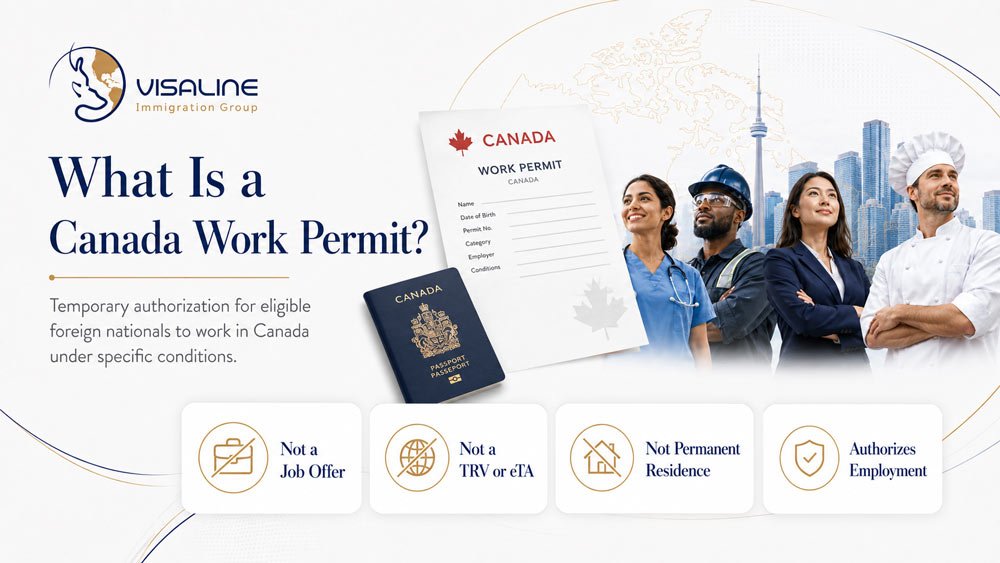
A Canada work permit is a document authorizing a foreign national to work temporarily in Canada. Most foreign nationals need one, although limited exemptions apply to specific activities and occupations.
A work permit is not the same as:
- A job offer
- A temporary resident visa, or TRV
- An electronic travel authorization, or eTA
- Permanent residence
- A Social Insurance Number
- A professional licence for a regulated occupation
Think of the documents as serving different purposes. The work permit authorizes employment. A TRV or eTA may be needed to travel to Canada, while the border services officer determines whether the person may enter. A job offer supports some applications but is not itself permission to start working.
IRCC recognizes two main work permit types: employer-specific and open work permits.
Open Work Permit vs Closed Work Permit
“Closed work permit” is a common informal term. IRCC generally calls it an employer-specific work permit.
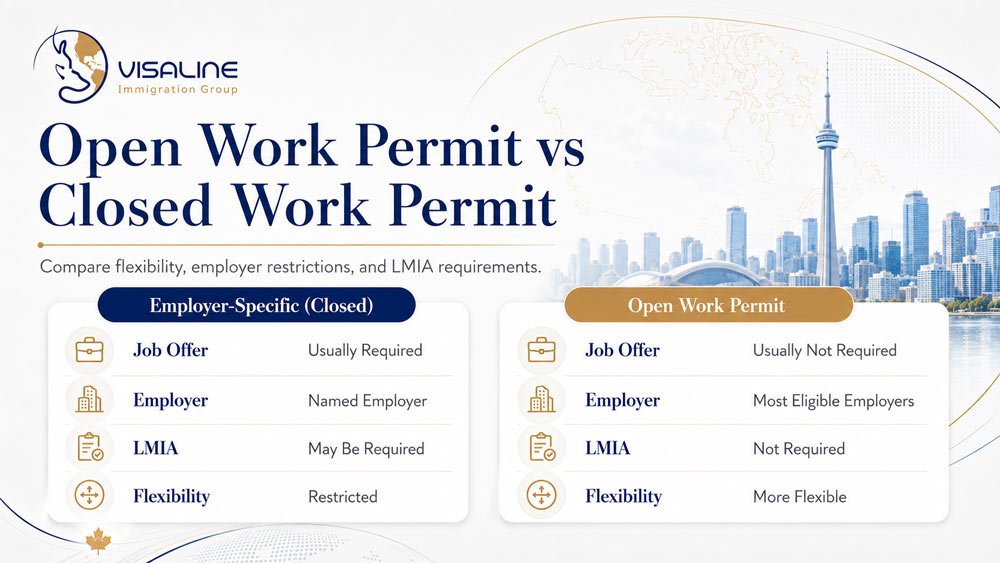
| Feature | Employer-specific or closed work permit | Open work permit |
|---|---|---|
| Job offer | Normally required | Usually not required |
| Employer | Limited to the employer named on the permit | Usually allows work for most eligible employers |
| LMIA | May be required unless an exemption applies | Not required |
| Occupation or location | May be restricted | Usually flexible, although restrictions may apply |
| Who can apply | Workers with an eligible offer and supporting employer process | Only people in designated categories |
| Changing employers | A new authorization is generally needed before starting | Usually permitted within the conditions of the permit |
Employer-specific work permit
An employer-specific permit may identify:
- The employer for whom you can work
- Your authorized occupation
- The work location
- The permit expiry date
- Other conditions attached to your employment
The employer usually must first complete an LMIA or an LMIA-exempt employer process. The exact procedure depends on the occupation, employer, international agreement and exemption category.
Changing jobs while holding this type of permit is not as simple as signing a new contract. In most cases, you need new work authorization before beginning employment with another employer.
Open work permit
An open work permit may let the holder work for most compliant Canadian employers. It does not require a job offer, an LMIA or an employer compliance submission. However, open permits are available only in specific situations; most people outside Canada cannot apply simply because they prefer employment flexibility.
Potential categories include certain:
- Spouses or common-law partners
- Graduates eligible for a post-graduation work permit
- International Experience Canada participants
- Permanent residence applicants and their eligible family members
- Vulnerable foreign workers
- Protected persons and refugee claimants
- Applicants covered by a specific public policy
An open permit may still contain restrictions. For example, a medical examination may be required before working in healthcare, childcare or certain agricultural settings. Some permits may also restrict the province or type of employment.
Canada Work Permit Eligibility Requirements
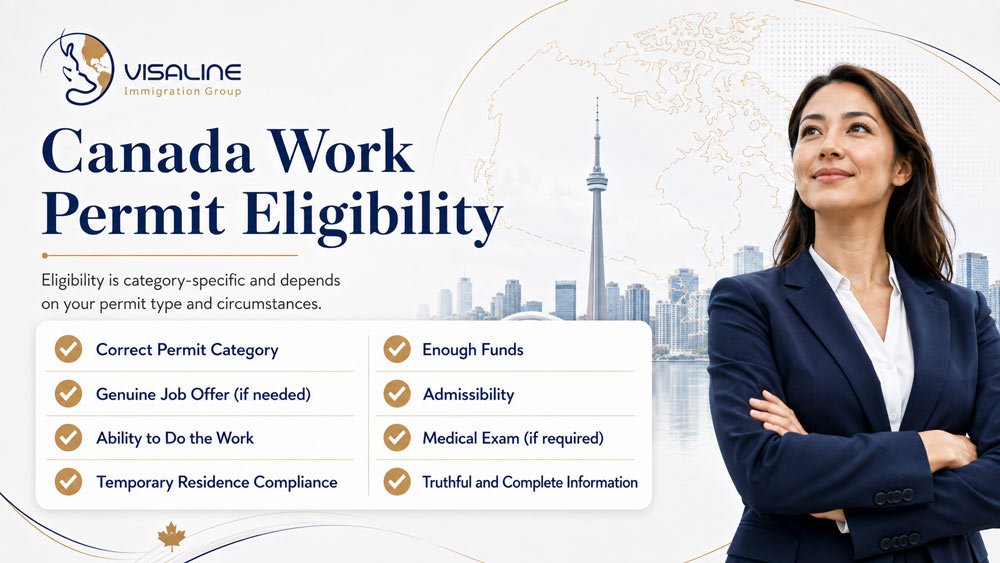
Eligibility is category-specific. There is no single checklist that applies identically to every temporary work visa Canada application.
Applicants generally need to demonstrate that they:
- Qualify for the requested work permit category
- Have a genuine job offer when applying for an employer-specific permit
- Can perform the proposed work
- Will comply with the conditions of temporary residence
- Have enough money for themselves and accompanying family members
- Do not intend to work for an ineligible employer
- Are admissible on medical, criminal and security grounds
- Will complete a medical examination when required
- Provide truthful, complete and consistent information
An officer reviews the full circumstances. A valid LMIA or an eligible LMIA exemption does not guarantee approval if the worker fails to establish admissibility, qualifications or the temporary purpose of the application.
Can you apply from inside Canada?
Only certain foreign nationals can apply from within Canada. Eligible situations may include holding a valid study or work permit or having a spouse, common-law partner or parent with valid status, but additional requirements and exceptions apply.
Visitors should not assume they can arrive in Canada and convert visitor status into a work permit. Eligibility depends on the rules and public policies in force when the application is submitted.
Can you apply at a port of entry?
Some visa-exempt foreign nationals may be eligible to apply at a Canadian port of entry, but this option is not available to everyone or for every permit category. Applying online before travel is mandatory in many situations.
LMIA and LMIA-Exempt Work Permits
LMIA-based work permits
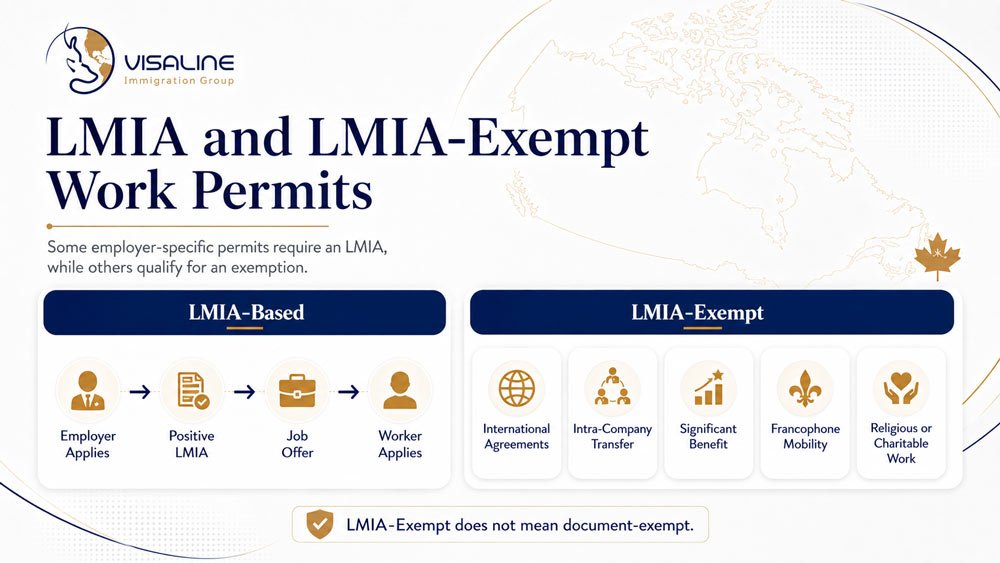
A Labour Market Impact Assessment is a decision issued by Employment and Social Development Canada. Under the Temporary Foreign Worker Program, it generally assesses whether hiring a foreign national could affect Canada’s labour market. The program allows employers to fill temporary positions when qualified Canadians or permanent residents are unavailable.
The process normally follows this order:
- The employer applies for an LMIA.
- The employer receives a positive decision, if approved.
- The employer gives the worker the LMIA information and employment offer.
- The worker applies separately to IRCC for a work permit.
- IRCC decides the worker’s application.
An LMIA belongs to the employer’s recruitment process; it is not a work permit and does not guarantee that IRCC will approve the foreign worker.
LMIA-exempt employer-specific permits
Some employer-specific permits are exempt from an LMIA under the International Mobility Program. Possible exemptions may arise from:
- International agreements
- Intra-company transfers
- Significant-benefit categories
- Reciprocal employment
- Francophone Mobility
- Certain federal-provincial arrangements
- Charitable or religious work
Unless another exemption applies, the Canadian employer generally submits an offer through the Employer Portal and completes the required compliance process before the worker applies.
“LMIA-exempt” does not mean “document-exempt.” The employer and employee must still prove that the specific exemption code and legal requirements apply.
Open Work Permit for a Spouse
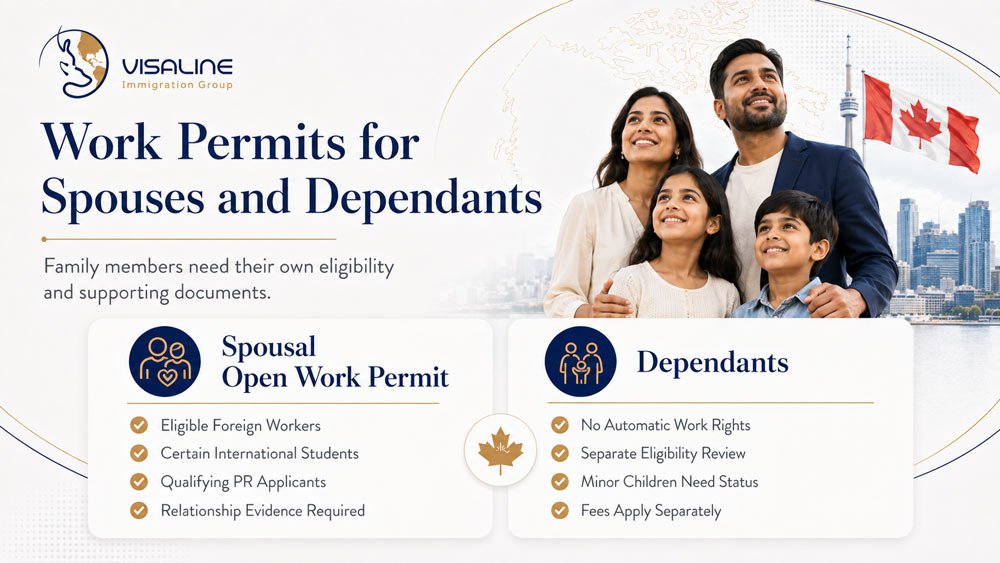
A spousal open work permit may be available to some spouses or common-law partners of:
- Eligible foreign workers
- Certain international students
- Applicants in qualifying permanent residence categories
- Canadian citizens or permanent residents who have submitted an eligible inland spousal sponsorship application
Eligibility is not automatic merely because one partner has a Canadian study or work permit. Since January 21, 2025, family open work permit access has been limited to spouses of certain international students and foreign workers.
The evidence may include:
- Marriage certificate or proof of a common-law relationship
- Principal applicant’s passport and Canadian status document
- Proof of the principal applicant’s employment or studies
- Employer letter, employment contract and recent pay records
- School enrolment and program details, where applicable
- Proof that the principal applicant’s status will remain valid for the required period
- Inland sponsorship records, if applying through that category
Because family open work permit rules have changed repeatedly, applicants should confirm the current eligibility criteria before relying on a spouse’s occupation or study program.
Canada Work Permits for Dependants
Including family members in an application does not automatically give them permission to work.
- A spouse or common-law partner needs an independent work permit or another authorization.
- Minor children usually require appropriate visitor or study status.
- An adult dependent child does not automatically qualify for an open work permit.
- Every accompanying family member must satisfy applicable admissibility and document requirements.
- Government fees apply separately to each person and application type.
Family applications may be submitted together when permitted, but IRCC assesses each applicant’s eligibility separately.
Step-by-Step Canada Work Permit Process
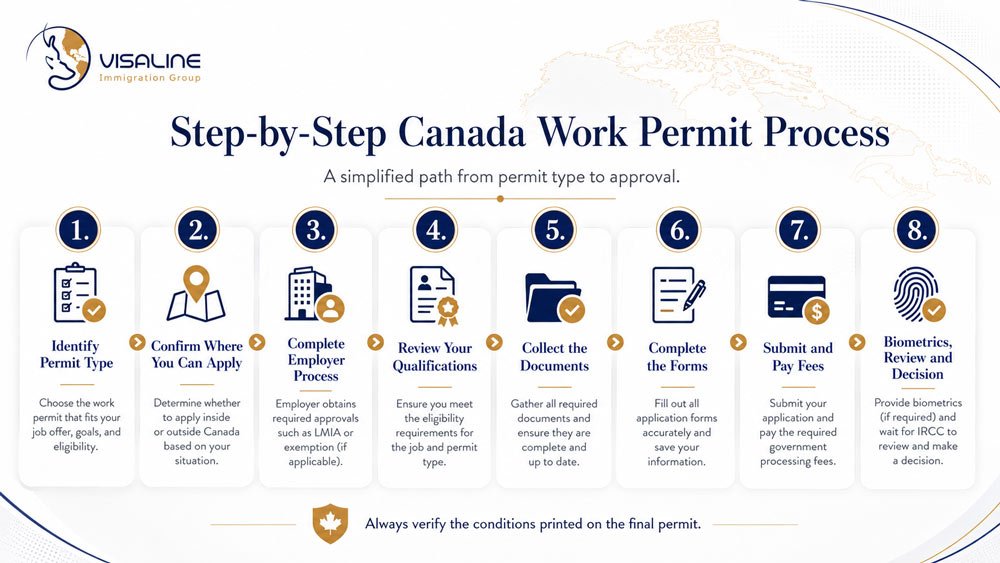
The correct sequence depends on whether the application is LMIA-based, LMIA-exempt or open.
- Identify the correct permit category. Determine whether you need an employer-specific or open work permit.
- Confirm where you can apply. Review the rules for applications from outside Canada, inside Canada or at a port of entry.
- Complete the employer process. If required, the employer obtains an LMIA or submits an LMIA-exempt offer.
- Review your qualifications. Make sure your education, experience, licensing and language ability support the proposed position.
- Collect the documents. Follow both IRCC’s general checklist and the instructions for your country or visa office.
- Complete the application forms. Employment history, refusals, family details and travel history must be accurate.
- Pay the applicable fees. Open permit, biometrics and other fees may apply in addition to the basic work permit charge.
- Submit the application. Most applications are filed through an IRCC secure account.
- Complete biometrics and medical requirements. Do so within the deadline if IRCC issues instructions.
- Respond to additional requests. IRCC may request updated employment evidence, documents or an interview.
- Review the decision and travel documents. An approval letter issued outside Canada is not usually the physical work permit.
- Present the required records at the border. If admitted, verify the employer, occupation, location and expiry date printed on the permit.
Applicants outside Canada upload their documents, pay the applicable fees, provide biometrics when required and wait for a decision before travelling.
Documents Required for a Canada Work Permit
The personalized checklist depends on the permit category, country of residence, family circumstances and proposed occupation.
Common personal documents
- Valid passport or travel document
- Digital photograph
- Completed IRCC forms
- Marriage or common-law evidence, if applicable
- Children’s birth certificates, if applicable
- Current immigration-status documents
- Previous Canadian permits and application records
- Police certificates, if requested
- Medical examination results, when required
- Certified translations for documents not in English or French
Employer-specific permit documents
- Detailed job-offer letter
- Signed employment contract
- Positive LMIA details, if required
- LMIA-exempt offer-of-employment number, if applicable
- Evidence of education, training and work experience
- Professional licence or certification, where required
- Employer letters and supporting work records
IRCC may request letters from current or former employers and proof of previous work experience for employer-specific applications.
Open work permit documents
The supporting records must establish the category under which the applicant qualifies. Depending on the case, that might involve:
- A spouse’s work or study records
- Proof of relationship
- A graduation or program-completion letter
- Acknowledgement of receipt for a permanent residence application
- Provincial nomination records
- Evidence of workplace abuse or vulnerability
- International Experience Canada documents
Submitting more pages does not necessarily create a stronger application. The goal is to provide relevant, verifiable evidence that addresses the legal requirements.
Canada Work Permit Cost in 2026
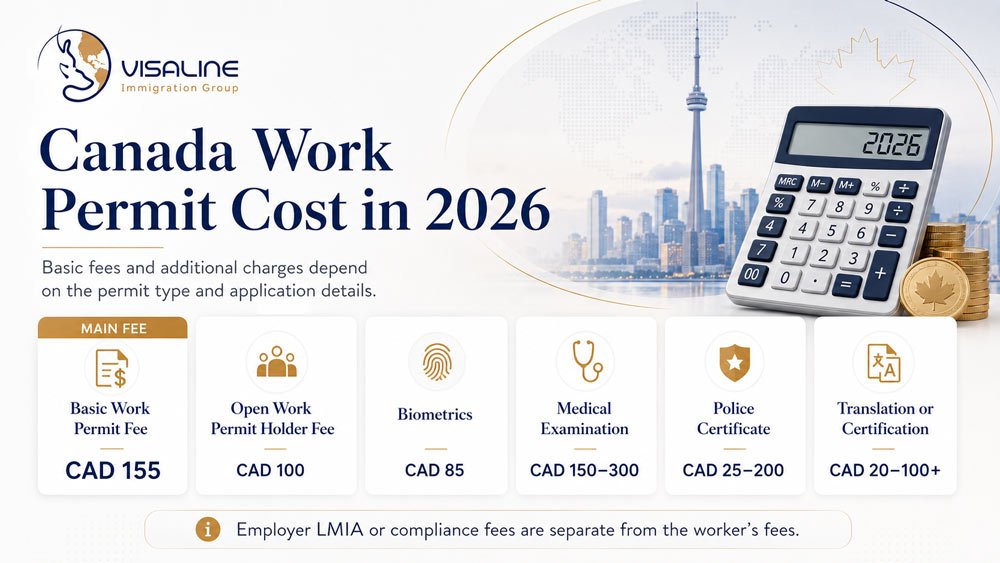
IRCC lists a basic work permit application fee of CAD 155, unless an exemption applies. Other charges may apply depending on the application.
| Potential expense | When it may apply |
|---|---|
| Basic work permit fee | Most work permit applications |
| Open work permit holder fee | Open work permit applications |
| Biometrics | If required |
| Medical examination | For designated occupations, travel or residence histories |
| Police certificate | If requested |
| Translation or certification | Documents not in English or French |
| TRV or eTA-related processing | Depending on nationality and application circumstances |
| Professional representation | If an authorized representative is retained |
An open work permit generally carries the basic work permit fee plus an additional open permit holder fee. Applicants should verify the current IRCC fee schedule on the payment date because fees and exemptions can change.
Employer expenses—such as an LMIA application fee or employer compliance fee—should not be confused with the worker’s government application charges.
Canada Work Permit Processing Time
There is no universal Canada work permit processing time. Timelines vary according to:
- Country of application
- Permit category
- Completeness of the file
- Biometrics and medical requirements
- Background and security screening
- Seasonal application volume
- Additional document requests
- Employer compliance or LMIA issues
IRCC publishes estimated processing times rather than guaranteed decision dates. The estimate can change while an application is in progress.
LMIA processing and work permit processing are also separate. If an employer needs an LMIA, the total timeline may include the employer’s recruitment and LMIA stage before the worker can submit the permit application.
Canada Work Permit Extension
A worker who wants to remain employed beyond the permit expiry date should apply to extend the permit or change its conditions before it expires.
An extension may be needed when:
- The same employment will continue beyond the current expiry date
- The worker changes employers
- The occupation or work location changes
- A passport renewal allows a longer period
- The applicant becomes eligible for an open work permit
- Conditions restricting certain work need to be changed
Maintained status
A person who submits an eligible extension application before the current permit expires may remain in Canada while IRCC decides the application. This is known as maintained status.
The person may usually continue working only under the existing permit’s conditions while the extension is pending. Leaving Canada can affect the ability to work after returning, even if the application remains in process.
Maintained status is not a new permit and does not automatically authorize a worker to begin employment with a different employer.
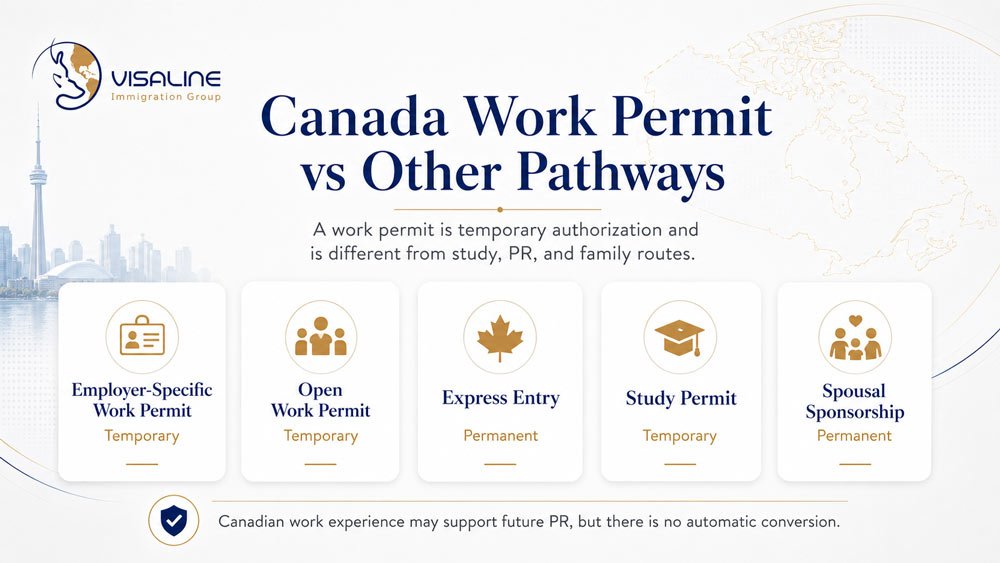
Canada Work Permit vs Other Immigration Pathways
| Pathway | Main purpose | Temporary or permanent? | Job offer required? |
|---|---|---|---|
| Employer-specific work permit | Work for a named employer | Temporary | Usually |
| Open work permit | Work for most eligible employers | Temporary | No |
| Express Entry | Skilled-worker permanent residence | Permanent | Not generally |
| Provincial Nominee Program | Provincial selection for immigration | Usually permanent residence | Depends on the stream |
| Study permit | Attend an eligible Canadian institution | Temporary | No employment offer required |
| Spousal sponsorship | Family reunification | Permanent residence | No |
A work permit is temporary authorization, while Express Entry manages applications for permanent residence under the Canadian Experience Class, Federal Skilled Worker Program and Federal Skilled Trades Program.
Canadian work experience may later support a permanent residence strategy, but there is no automatic “conversion” from a work permit to PR. The worker must qualify under an available federal, provincial or family immigration program.
Likewise, Study in Canada is a separate temporary pathway, and spousal sponsorship has its own relationship, eligibility and admissibility requirements.
Frequently Asked Questions
Do I need a job offer for a Canada work permit?
Usually, yes, for an employer-specific permit. A job offer is not required for an open work permit, but open permits are available only under designated eligibility categories.
What is the difference between a work permit and a work visa?
A work permit authorizes employment. A visa or eTA facilitates travel to Canada, depending on nationality. Neither document guarantees admission at the border.
Can I change employers on a closed work permit?
Not automatically. You generally need new work authorization before starting with another employer, even if you have already submitted an application to change the permit conditions.
Can my spouse receive an open work permit?
Possibly. Eligibility depends on your immigration category, occupation, permit validity, study program or permanent residence application. Being married to a worker or student does not by itself establish eligibility.
How long does a Canada work permit take in 2026?
There is no fixed timeline. Processing depends on the application country, work permit type, biometrics, medical requirements, background checks and whether IRCC requests more evidence.
Who is the best consultant for a Canada work permit?
Choose an authorized Canadian immigration professional who checks the employer process, job offer, LMIA or exemption code and your individual eligibility—and who does not guarantee approval. Visaline can assess whether a work permit or another pathway is appropriate for your circumstances.
Conclusion
A successful work permit strategy starts by identifying the correct legal category. An open work permit offers flexibility but is available only in defined circumstances. An employer-specific permit is more common, yet it requires the job offer and employer process to align closely with the worker’s application.
Visaline can review the employment offer, LMIA or exemption, qualifications, family options and extension history before submission. The purpose of the review is not to promise a result; it is to identify avoidable weaknesses and determine whether temporary work authorization fits your broader Canadian immigration plan.

Sources
Based on the latest regulations and program instructions published by Immigration, Refugees and Citizenship Canada. IRCC’s official guidance covers work permit types, applications from inside or outside Canada, open-permit eligibility, extensions and special instructions for family members.
Contact us today to review your case and book your immigration consultation. We also recommend following Visaline Immigration Institute on Instagram for real-time updates on IRCC news and immigration law changes.
☎️ Toronto WhatsApp: +1-647-860-0005
Published/Updated: July 23, 2026 Author: Visaline Legal Editorial Team