
Dependent Child Sponsorship Canada: Eligibility, Age Rules and Application Process
Being separated from a son or daughter after becoming a Canadian permanent resident or citizen can make one immigration question more urgent than almost any other: does the child still qualify for sponsorship? A Canadian citizen, permanent resident or eligible person registered under the Indian Act may be able to sponsor a qualifying dependent child for permanent residence, but the child must meet IRCC’s legal definition of a dependant and other admissibility requirements.
At Visaline, “With you on your immigration journey, from dream to reality” means identifying the legal issue that can actually decide the case — particularly age, dependency, parentage, custody and disclosure.
Table of contents
- Who is a dependent child under Canadian immigration law?
- Can a child over 22 still qualify?
- Who can sponsor a dependent child?
- Is there an income requirement?
- Custody and parental consent
- Age lock-in and turning 22 during processing
- Documents for child sponsorship
- How to sponsor a dependent child
- Fees and sponsorship undertaking
- Common risks and mistakes
- Frequently asked questions
Who is a dependent child under Canadian immigration law?
The legal definition matters more than how financially or emotionally dependent a child may feel in everyday life.
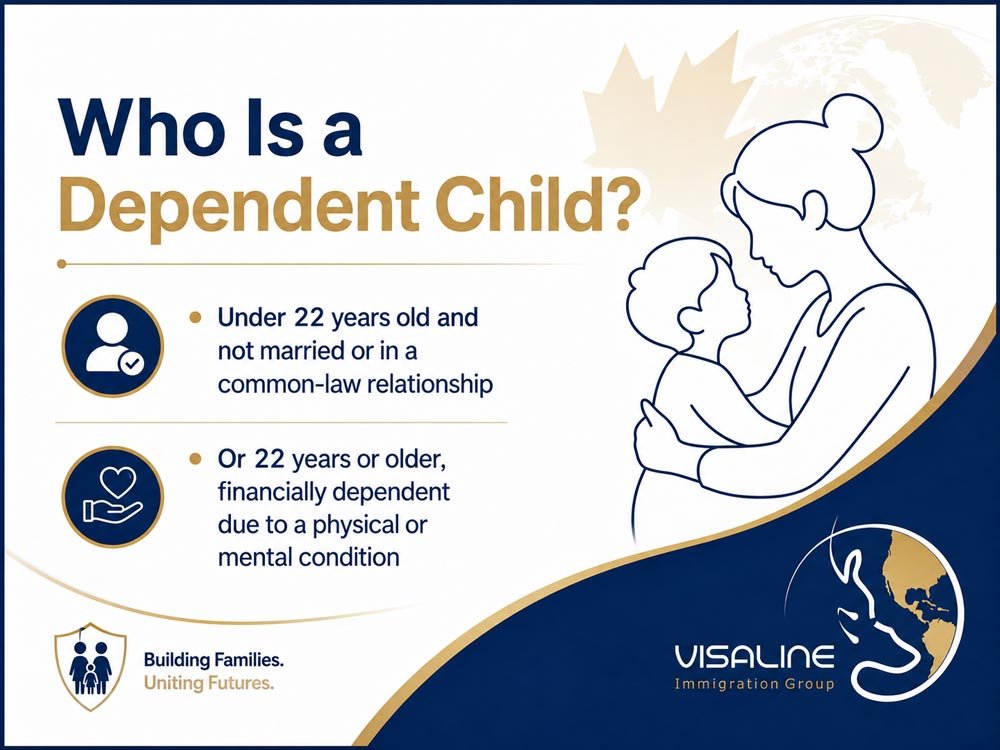
Under section 2 of the Immigration and Refugee Protection Regulations, a dependent child is generally a biological or adopted child who falls into one of two categories:
- Under 22 years old and not a spouse or common-law partner, or
- 22 years or older, but financially dependent on the parent since before age 22 and unable to be financially self-supporting because of a physical or mental condition.
For most cases, therefore, being a student, unemployed or financially supported by parents does not by itself allow an adult child over 22 to remain a dependant.
Can a child over 22 still qualify?
Yes, but only in a much narrower category.
A child aged 22 or older must generally establish both that:
- they have depended substantially on parental financial support since before turning 22; and
- they are unable to financially support themselves because of a physical or mental condition.
This is a legal test, not simply a question of whether the parent currently sends money.
Practical example
Example: Amir is 24 and has been studying full-time while his parents pay his expenses.
That fact alone does not necessarily make Amir a dependent child for immigration purposes.
By contrast, if Amir has depended on his parents since before age 22 and is unable to become financially self-supporting because of a qualifying physical or mental condition, the analysis may be different.
Medical and financial evidence can become central in an over-22 dependency case.
Who can sponsor a dependent child?
IRCC generally allows a person to sponsor a dependent child if the sponsor:
- is at least 18;
- is a Canadian citizen, permanent resident or person registered under the Indian Act;
- meets the applicable residence requirement;
- signs the sponsorship undertaking and agreement; and
- is not affected by a sponsorship bar or other ineligibility provision.
A Canadian citizen living outside Canada may potentially sponsor while abroad if they can establish their intention to live in Canada when the sponsored family member becomes a permanent resident.
A Canadian permanent resident living outside Canada cannot generally sponsor from abroad.
Check whether your child is already Canadian
If a sponsor is a Canadian citizen and the child was born outside Canada, the child may already have Canadian citizenship depending on the applicable citizenship rules.
A child who is already a Canadian citizen should not be sponsored for permanent residence as if they were a foreign national. IRCC expressly recommends checking citizenship status first.
Is there an income requirement?
In most dependent child sponsorship cases, there is no fixed Minimum Necessary Income requirement.
An income test generally becomes relevant if the dependent child being sponsored has one or more dependent children of their own. In that situation, IRCC may require the sponsor to meet the applicable financial requirement and complete the relevant Financial Evaluation form.
This should not be confused with the sponsor’s undertaking. Even where no fixed MNI threshold applies, the sponsor still accepts responsibility for providing the sponsored child’s basic needs.
Custody and parental consent
Custody issues can be decisive where a minor child has another parent or guardian who is not immigrating to Canada.
If the sponsored minor has a non-accompanying parent or legal guardian, IRCC may require evidence showing that the child is legally permitted to immigrate.
For relevant cases, IRCC uses IMM 5604 — Declaration from Non-Accompanying Parent/Guardian for Minors Immigrating to Canada.
Documents may also include:
- custody orders;
- divorce or separation documents;
- parental consent;
- birth certificates;
- guardianship documents; and
- evidence explaining why a required consent document cannot be obtained, where applicable.
A missing signature should not automatically be treated as a minor administrative problem. If another parent has legal rights over the child, the underlying family-law and immigration consequences may require case-specific analysis.
Age lock-in and turning 22 during processing
One of the most common concerns is: “What happens if my child turns 22 while IRCC is processing the application?”
Canadian immigration law uses an age lock-in concept for dependent children.
IRCC generally assesses the child’s age at the applicable lock-in date rather than simply using their age on the date the officer makes the final decision. This protects some children from aging out solely because IRCC processing takes time.
However, with the exception of age, the child must generally continue meeting the other elements of the dependent-child definition during processing. For example, a change in marital or common-law status may affect eligibility.
Documents for child sponsorship
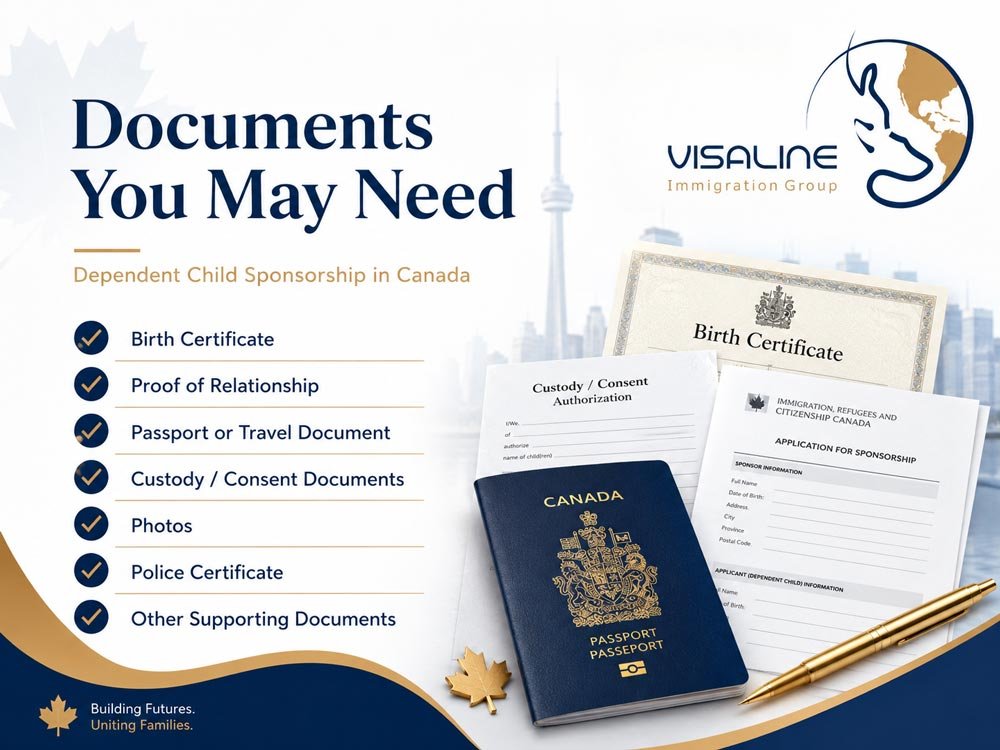
The exact document package depends on the circumstances and country-specific requirements, but common evidence includes:
- IMM 5534 — Document Checklist: Dependent Child;
- sponsorship forms;
- Generic Application Form for Canada (IMM 0008);
- Additional Family Information, where applicable;
- identity documents;
- passport or travel document;
- birth certificate;
- proof of parent-child relationship;
- custody documentation;
- IMM 5604 where required;
- supporting documentation for a child over 22 claiming dependency because of a physical or mental condition;
- photographs; and
- proof of payment of government fees.
IRCC requires applicants to use the applicable current document package and instructions.
Why document consistency matters
A birth certificate, family information form and custody document should tell the same factual story.
A discrepancy in names, dates, parentage or marital status can trigger requests for further evidence or create broader credibility concerns.
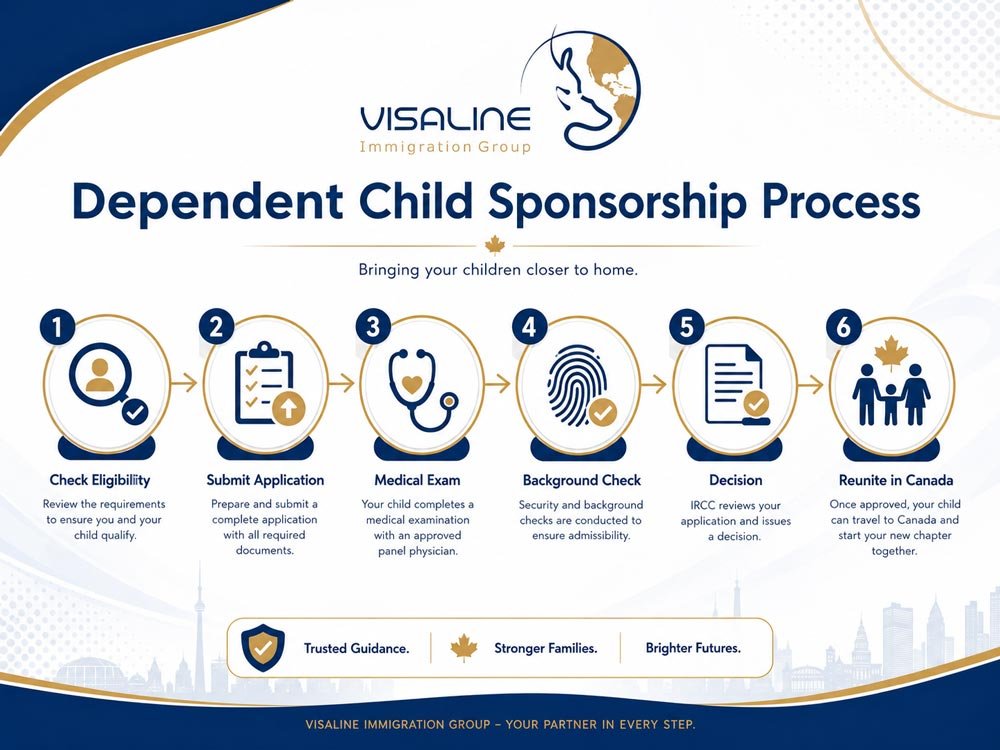
How to sponsor a dependent child
IRCC’s process generally involves two connected applications: the sponsorship application and the child’s permanent residence application.
The principal applicant submits the required package through the Permanent Residence Portal.
A simplified process is:
- Confirm the sponsor is eligible.
- Confirm the child meets the dependent-child definition.
- Check whether the child may already be a Canadian citizen.
- Determine custody and consent requirements.
- Download the correct current application package and IMM 5534 checklist.
- Complete the sponsorship and permanent residence forms.
- Gather supporting identity, parentage and custody evidence.
- Pay applicable fees.
- Submit the complete online application.
- Respond to biometrics, medical, background or additional-document requests where applicable.
IRCC warns that incomplete applications may be rejected and have to be corrected and resubmitted.
If more than one child is being sponsored as a principal applicant, IRCC generally requires separate complete applications for each child.
Fees and sponsorship undertaking
As of the IRCC fee list modified July 2, 2026, independently sponsoring a dependent child costs CAD $180 per child, covering the sponsorship and processing fees. Dependent children do not pay the Right of Permanent Residence Fee. Additional costs can arise for biometrics where applicable, medical examinations, translations, police certificates or other third-party requirements.
Government fees are subject to change and should be verified immediately before submission.
How long is the sponsor financially responsible?
Outside Quebec:
| Sponsored child | General undertaking period |
|---|---|
| Dependent child under 22 | 10 years or until age 25, whichever comes first |
| Dependent child age 22 or older | 3 years |
The period starts when the child becomes a permanent resident. Quebec has separate rules.
Once the undertaking begins, it generally cannot simply be cancelled because the sponsor’s financial or family circumstances change.
Common risks and mistakes
Dependent child sponsorship looks straightforward until a fact does not fit the standard pattern.
Common problems include:
- assuming every financially supported child is a “dependant”;
- overlooking the over-22 dependency test;
- failing to check possible Canadian citizenship;
- incomplete parental consent;
- unresolved custody disputes;
- using inconsistent birth or family records;
- failing to disclose a child;
- not declaring non-accompanying dependants;
- failing to arrange required medical examinations;
- using outdated forms; and
- misunderstanding age lock-in.
IRCC specifically emphasizes disclosure of dependent family members, including certain non-accompanying children. Failure to properly declare family members can have serious consequences for current and future immigration options.
A professional review may be particularly useful where parentage, custody, previous immigration applications, an adult dependent child or citizenship status is unclear.
Frequently asked questions
What is the age limit for dependent child sponsorship in Canada?
The standard age limit is under 22. The child must also not have a spouse or common-law partner. A child who is 22 or older may qualify only if they meet the separate financial-dependency and physical-or-mental-condition requirements.
Can I sponsor my child after they turn 22?
Possibly, but only under the adult dependent-child exception. The child generally must have relied on parental financial support since before age 22 and be unable to support themselves financially because of a physical or mental condition. Simply attending university or being unemployed is not enough.
What happens if my child turns 22 while the application is processing?
Turning 22 after the applicable age lock-in date does not automatically make the child ineligible. IRCC uses age-locking rules for permanent residence applications. The child must generally continue to satisfy the other elements of dependency during processing.
Do I need the other parent’s consent?
Often, yes, where another parent or guardian has legal rights and is not immigrating. IRCC may require IMM 5604 and relevant custody documents. If consent cannot be obtained, the facts and legal documents should be reviewed carefully rather than assuming the requirement can be ignored.
Is there a minimum income requirement to sponsor my child?
Usually not. Most dependent child sponsorship cases have no fixed MNI requirement. An exception applies where the dependent child being sponsored has dependent children of their own.
How much does dependent child sponsorship cost?
The current federal sponsorship and processing fee is CAD $180 per independently sponsored dependent child. Other costs may apply depending on biometrics, medical examinations and supporting documentation. IRCC fees should be verified again before payment.
Conclusion
The most important question in dependent child sponsorship is not simply whether the applicant is the sponsor’s son or daughter. The child must fit the immigration definition of a dependant, and issues involving age, marriage, medical dependency, citizenship, custody and disclosure can materially change the application.
Standard cases may be relatively direct. Cases involving a child over 22, disputed consent, undeclared family members or uncertain citizenship deserve closer review before submission.

Legal information notice
This page provides general Canadian immigration information and is not a substitute for legal advice based on your complete circumstances. Eligibility, forms, fees and procedures can change, and individual cases may involve immigration, citizenship or family-law considerations.
Sources
- Justice Laws Website — IRPR definition of dependent child
- IRCC — Who you can sponsor
- IRCC — Sponsorship eligibility
- IRCC — Complete Guide IMM 5289
- IRCC — IMM 5534 Dependent Child Checklist
- IRCC — Application process
- IRCC — Current fee list
Contact us today to review your case and book your immigration consultation. We also recommend following Visaline Immigration Institute on Instagram for real-time updates on IRCC news and immigration law changes. ☎️ Toronto WhatsApp: +1-647-860-0005
Published/updated: August 9, 2026 Author: Afifeh Hosseini, Visaline Team Member and Content Creator