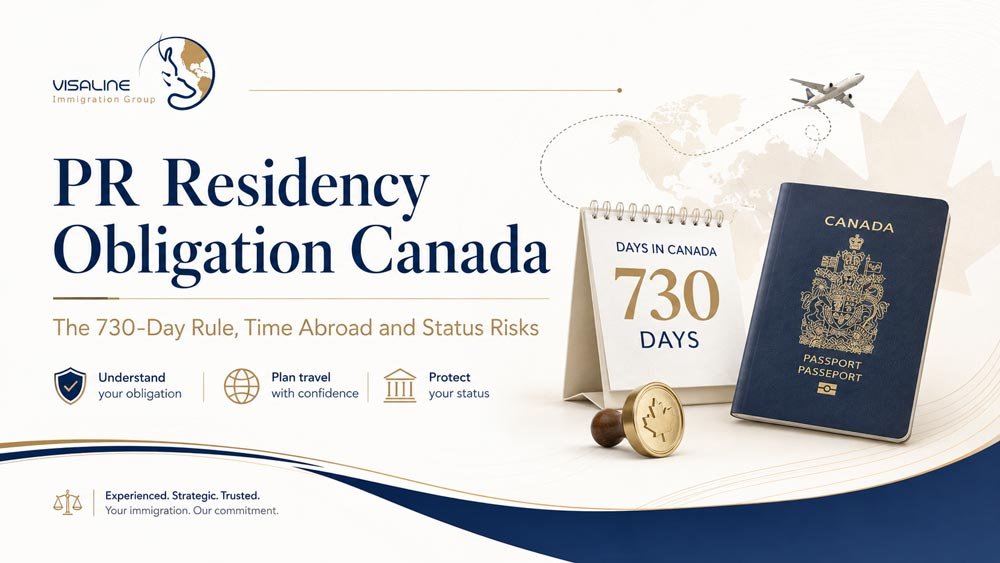
PR Residency Obligation Canada: The 730-Day Rule, Time Abroad and Status Risks
Editorial internal-link recommendations: Once the exact Visaline URLs are approved, link contextually to PR Card Renewal, Permanent Resident Travel Document (PRTD), Canadian Citizenship and Travel Outside Canada as a Permanent Resident. No unverified internal URLs should be added to the published copy.
A permanent resident who has spent several years abroad may not know whether the next PR card renewal, PRTD application or trip to Canada could trigger a residency assessment. Canada’s PR residency obligation generally requires at least 730 qualifying days in the relevant five-year period, but some time outside Canada can legally count and the calculation is different for people who have been permanent residents for less than five years. The governing rule is section 28 of the Immigration and Refugee Protection Act (IRPA).
For Visaline, “With you on your immigration journey, from dream to reality” includes helping permanent residents calculate compliance from actual dates and evidence rather than relying on a rough “two years out of five” estimate.
Table of contents
- What is the Canadian PR residency obligation?
- How the 730-day rule works
- If you have been a PR for less than five years
- When time outside Canada can count
- How to calculate your PR residency obligation
- Evidence of residency and qualifying time abroad
- What happens if you do not meet the residency obligation?
- Humanitarian and compassionate considerations
- Frequently asked questions
What is the Canadian PR residency obligation?
The PR residency obligation is the legal requirement that a Canadian permanent resident maintain sufficient qualifying connection to Canada over the applicable five-year period.
Section 28 of IRPA requires permanent residents to comply with a residency obligation for every five-year period. In general, compliance requires at least 730 qualifying days in the relevant period. The days do not have to be continuous.
This rule should not be confused with:
- the expiry date printed on a PR card;
- the 1,095-day physical-presence requirement for Canadian citizenship; or
- a requirement to remain inside Canada for exactly two uninterrupted years.
A PR card is a status document. The residency obligation is a statutory requirement for retaining permanent resident status.
How the 730-day rule works
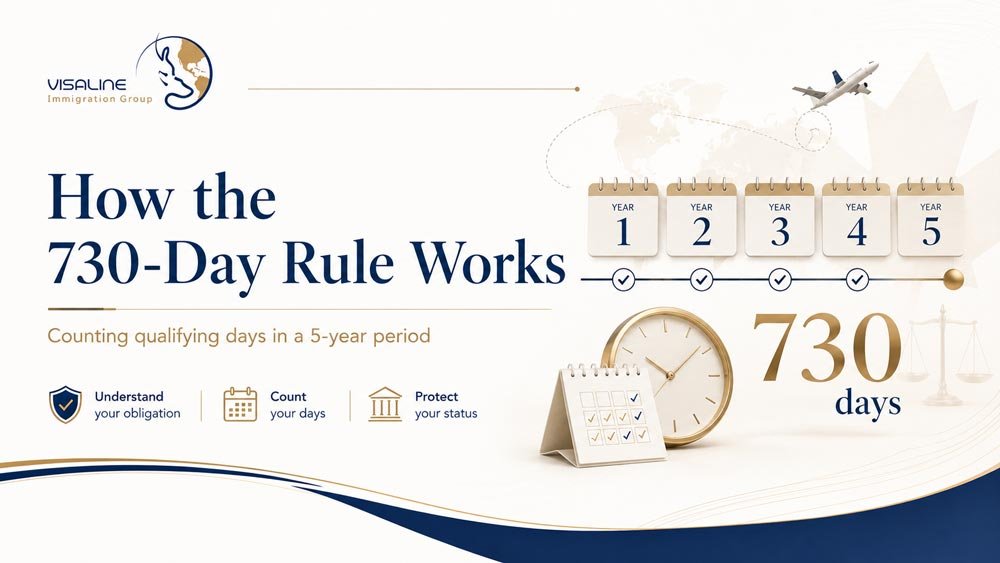
For a permanent resident who has held PR status for five years or more, the assessment generally looks at whether the person accumulated at least 730 qualifying days during the five years immediately before the relevant examination or determination.
A useful way to think about the calculation is:
Qualifying days physically present in Canada + qualifying statutory days outside Canada = total residency-obligation days
The target is at least 730 qualifying days.
Practical example
A permanent resident has held status for eight years. During the most recent five-year period, the person spent 690 days physically in Canada and 80 days abroad accompanying a Canadian citizen spouse in circumstances that satisfy section 28. If all 80 days qualify, the total would be 770 qualifying days.
The legal result depends on whether the time abroad actually meets the statutory test. A family relationship or Canadian employer name, by itself, does not automatically make every absence count.
If you have been a PR for less than five years
The calculation is different for newer permanent residents.
IRPA provides that if a person has been a permanent resident for less than five years, it is sufficient to show that they will be able to meet the residency obligation within the five-year period immediately after becoming a permanent resident.
Practical example
A person became a permanent resident three years ago and has spent 450 days in Canada so far. That does not automatically mean the residency obligation has been breached. The correct question is whether enough time remains before the fifth anniversary of becoming a PR to accumulate at least 730 qualifying days.
This is why simply counting backward five years from today is not always the correct method for a new permanent resident.
When time outside Canada can count
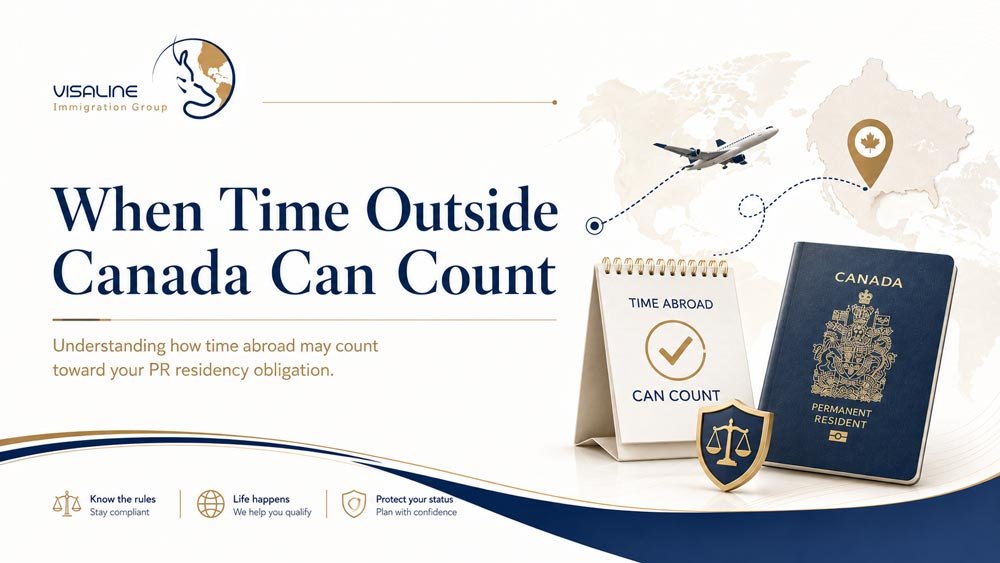
Section 28 recognizes several categories of time outside Canada that may count toward the residency obligation.
1. Accompanying a Canadian citizen
Time outside Canada can count when a permanent resident is accompanying a Canadian citizen who is:
- the PR’s spouse or common-law partner; or
- for a child, the child’s Canadian citizen parent.
2. Qualifying employment outside Canada
A permanent resident may count time abroad when employed full-time by:
- a qualifying Canadian business;
- the federal public administration; or
- the public service of a province.
The term Canadian business has a specific legal meaning. Working remotely from another country for an organization with a Canadian connection does not automatically satisfy the statutory test.
3. Accompanying a permanent resident in qualifying employment
Time abroad may also count when a permanent resident accompanies a PR spouse, common-law partner or parent who is employed full-time outside Canada in qualifying Canadian employment described by the Act.
How to calculate your PR residency obligation
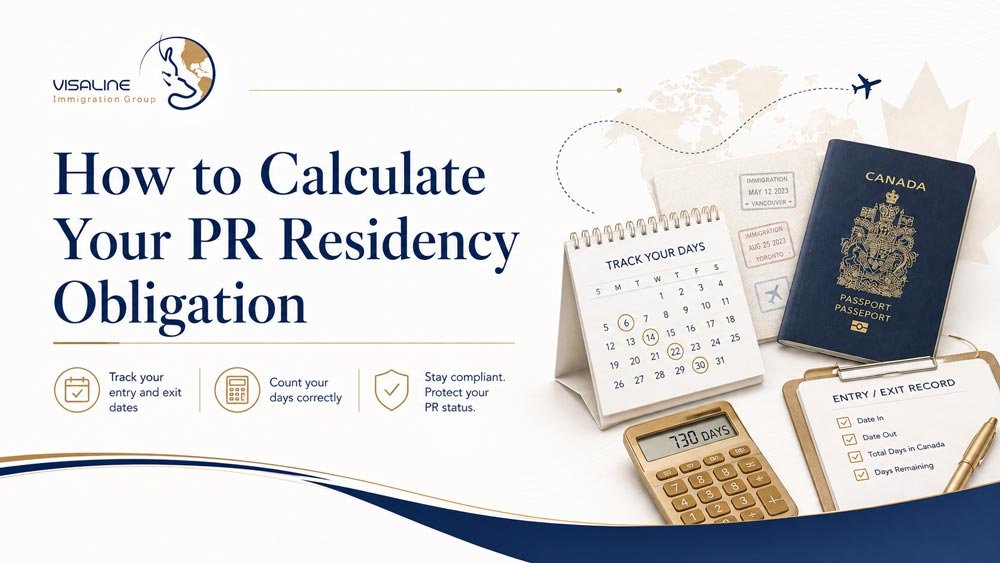
A reliable calculation should be built from records rather than memory.
- Identify the correct five-year period that applies to your case.
- List every departure from and return to Canada.
- Calculate the days you were physically present in Canada.
- Identify each period abroad that you believe may qualify under section 28.
- Separate statutory qualifying days from ordinary non-qualifying absences.
- Gather evidence supporting every claimed exception.
- Reconcile your calculation against passports, travel records, employment documents and residence evidence.
- Keep a reasonable margin above the minimum where possible rather than planning around exactly 730 days.
IRCC confirms that the 730 days do not have to be continuous and recommends keeping records of travel.
of residency and qualifying time abroad
The evidence needed depends on the facts. Documents that may help establish residence in Canada can include:
- employment records showing a Canadian address;
- leases or rental agreements;
- utility bills;
- tax-related records;
- school records;
- medical records;
- banking and financial activity;
- entry and exit records; and
- passports and travel documents.
For time abroad claimed under a statutory exception, the evidence may also need to establish:
- the qualifying family relationship;
- Canadian citizenship or permanent resident status of the accompanying family member;
- the nature of the employer;
- the full-time employment relationship;
- the assignment abroad; and
- the dates during which the qualifying conditions existed.
IRCC provides examples of residence evidence used in permanent resident document applications.
The objective is not to submit the largest possible document package. It is to prove the specific days and legal category being relied upon.
What happens if you do not meet the residency obligation?
Falling below 730 qualifying days can put permanent resident status at risk, but an expired PR card or an apparent mathematical shortfall does not by itself instantly erase PR status.
A formal residency determination may arise in situations such as:
- a PR card application;
- a Permanent Resident Travel Document application from outside Canada; or
- an immigration examination.
IRCC confirms that a person can lose permanent resident status for failing to meet the residency obligation, but the loss of status follows the applicable legal process.
| Situation | General effect |
|---|---|
| PR card expires | Does not automatically end PR status |
| Residency obligation may not be met | Can create a risk of a negative residency determination |
| Person becomes a Canadian citizen | PR status ends because citizenship replaces it |
| Person voluntarily renounces PR | PR status ends when the renunciation is approved |
A person with a substantial residency shortfall should understand the consequences before filing an application that necessarily asks IRCC to assess compliance.
Humanitarian and compassionate considerations
Section 28(2)(c) of IRPA provides a statutory safeguard. An officer may determine that humanitarian and compassionate considerations, taking into account the best interests of a child directly affected, justify retaining permanent resident status despite a prior breach of the residency obligation.
This is discretionary and highly fact-specific.
Depending on the case, relevant evidence may address:
- the reasons for the extended absence;
- the degree of non-compliance;
- family responsibilities;
- medical or other compelling personal circumstances;
- establishment and connections in Canada;
- hardship if PR status is lost;
- efforts made to return to Canada; and
- the best interests of a child directly affected.
It is not enough to say that losing PR status would be inconvenient. The evidence should explain why the circumstances justify relief from the consequences of the breach.
A case-specific review can be particularly useful before a PR card or PRTD filing if the applicant already knows the 730-day requirement may not be met.
Frequently asked questions
How many days must a permanent resident stay in Canada?
The general rule is at least 730 qualifying days in the relevant five-year period. The days do not have to be continuous, and some legally defined time outside Canada may count. A newer PR who has held status for less than five years is assessed on whether they can still meet the obligation by the fifth anniversary of becoming a permanent resident.
Does time outside Canada count toward PR residency?
Sometimes. Time abroad can count in specific situations, including accompanying a Canadian citizen spouse or qualifying parent, certain full-time Canadian employment abroad, or accompanying a PR family member in qualifying Canadian employment. Ordinary travel, retirement abroad or remote work does not automatically qualify.
Can I keep Canadian PR while living abroad?
It depends on whether you continue to satisfy section 28 of IRPA. Long-term residence outside Canada can be compatible with PR status only if enough days remain qualifying through physical presence in Canada or one of the statutory exceptions.
Can I lose PR status because my PR card expired?
No. Card expiry alone does not cancel permanent resident status. However, applying for a new PR card may require IRCC to assess whether you meet the residency obligation. PR card validity and PR status are legally distinct.
What should I do if I am below 730 days?
Do not assume the calculation is final until the correct five-year period and any potentially qualifying time abroad have been reviewed. If there is a genuine shortfall, humanitarian and compassionate considerations may be relevant in some cases. The consequences also depend on where you are, what application is being made and whether a formal residency determination has already occurred.
Conclusion
The PR residency obligation Canada rules are simple at the headline level—730 qualifying days—but the legal calculation can become complex when the person is a newer PR, has extensive absences, worked abroad or accompanied family members outside Canada.
The safest approach is to reconstruct the timeline before a PR card, PRTD or travel decision creates an urgent problem. Where the numbers are close or a breach appears likely, a case-specific review can help identify qualifying days, evidentiary gaps and any humanitarian considerations.

Legal information notice
This page provides general information about the permanent resident residency obligation under Canadian immigration law. It is not legal advice and does not replace an assessment of your complete travel, employment, family and immigration record.
Sources
- Justice Laws — Immigration and Refugee Protection Act, section 28
- IRCC — Understand permanent resident status
- IRCC — Can time abroad count toward PR status?
- IRCC — Common supporting documents
- IRCC — Loss of permanent resident status
Published/updated: August 12, 2026 Author: Visaline Legal Editorial Team
Contact us today to review your case and book your immigration consultation. We also recommend following Visaline Immigration Institute on Instagram for real-time updates on IRCC news and immigration law changes. ☎️ Toronto WhatsApp: +1-647-860-0005