
Renting a House in Canada: Housing Guide for Newcomers
Finding a place to live can become one of the most stressful parts of moving to Canada, especially when a newcomer does not yet have Canadian credit history, employment references or familiarity with local rental rules. Newcomers can rent housing in Canada, but the process, deposits, tenant protections and landlord requirements vary by province or territory.
IRCC provides dedicated newcomer guidance covering rental types, landlord and tenant responsibilities, finding a property, leases, rent increases and moving in or out.
At Visaline, “With you on your immigration journey, from dream to reality” includes understanding practical settlement issues such as where and how you will live after arrival.
Table of contents
- How renting in Canada works
- Types of rental housing
- How newcomers can find a rental
- Documents and credit checks
- Understanding the lease
- How much is rent in Canada?
- Common rental mistakes
- Frequently asked questions
How renting in Canada works
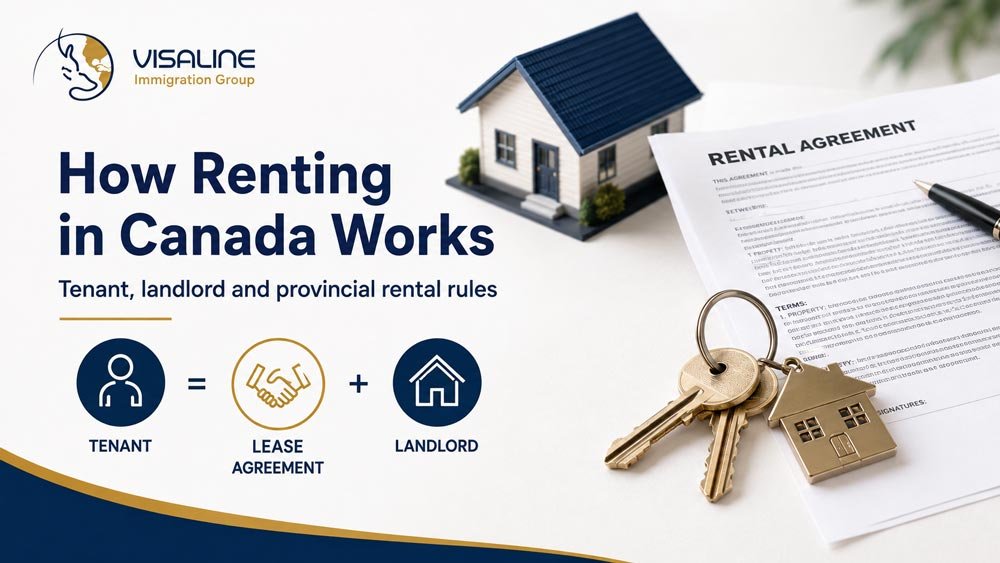
When you rent a property, you become the tenant, while the owner or housing provider is generally the landlord.
A rental agreement or lease is a contract that gives the tenant the right to occupy the rental unit in exchange for rent and compliance with the agreed terms.
However, landlord-tenant law is largely provincial or territorial.
That means rules regarding:
- deposits
- rent increases
- notice periods
- maintenance
- pets
- eviction procedures
- lease forms
can differ depending on where the property is located.
A national article can explain the rental process, but provincial rules should always be checked before signing or ending a tenancy.
Types of rental housing
Newcomers may encounter several housing options:
- studio apartments
- one-bedroom or multi-bedroom apartments
- condominiums
- basement apartments
- townhouses
- detached or semi-detached houses
- rooms in shared houses
- student housing
- temporary housing
IRCC’s newcomer housing resources distinguish between renting, buying and alternative forms of housing such as co-operative, student, temporary and government-assisted housing.
The cheapest option is not necessarily the best option.
Consider access to:
- work
- public transit
- schools
- grocery stores
- medical services
- childcare
- community services
before comparing rent alone.

How newcomers can find a rental
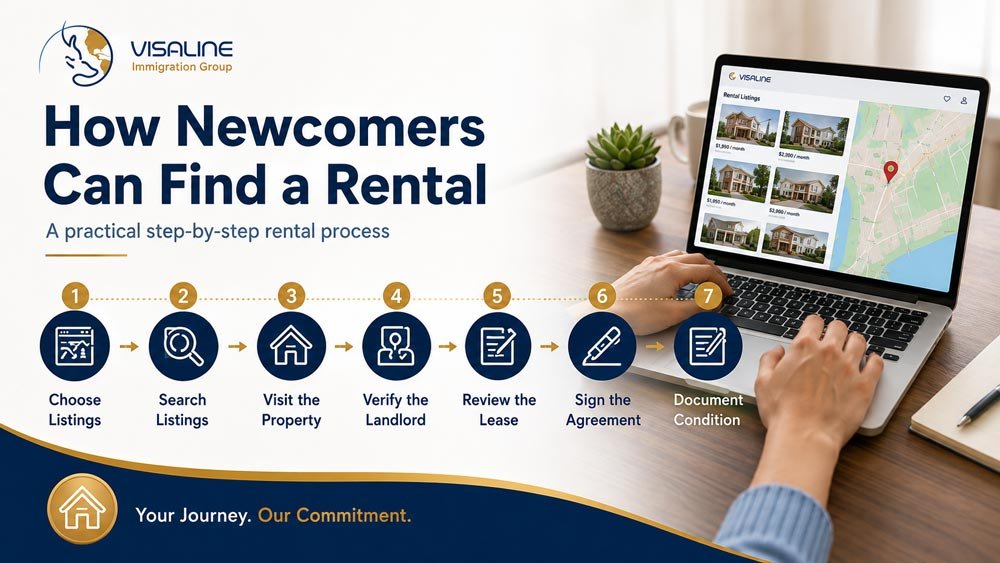
A practical rental process can look like this:
- Choose a realistic neighbourhood and budget.
- Compare several listings.
- Confirm what utilities are included.
- Visit the property where possible.
- Confirm the landlord or property manager is legitimate.
- Review the lease before paying money.
- Keep copies of agreements and payment records.
- Document the condition of the property when moving in.
IRCC advises newcomers to consider the broader neighbourhood, including public transit, schools, shopping and community facilities when deciding where to live.
Documents and credit checks
A common newcomer concern is:
“How can I rent without Canadian credit history?”
Some landlords may conduct credit checks or review rental and employment history when evaluating applicants. CMHC notes that credit checks may form part of the rental screening process.
Depending on the landlord and province, an applicant may be asked for information such as:
- identification
- proof of employment
- proof of income
- references
- rental history
- credit information
A lack of Canadian credit does not automatically mean that renting is impossible.
Newcomers may be able to strengthen an application through documented income, employment information, references or previous rental-payment records. The precise requirements are determined by the landlord and applicable provincial rules.
Practical example
A newcomer who arrived in Canada two weeks ago may have no Canadian credit score.
Instead of assuming every landlord will reject the application, the newcomer could prepare:
- an employment offer or employment confirmation;
- bank information demonstrating available funds;
- references;
- previous rental-payment records; and
- reliable identification.
Whether a landlord accepts these alternatives remains case-specific.

Understanding the lease
A lease should be read carefully before signing.
Key issues to review include:
| Lease item | What to confirm |
| Monthly rent | Exact amount and due date |
| Lease term | Fixed-term or other arrangement |
| Utilities | What is included or excluded |
| Parking | Whether a space is included and its cost |
| Tenant insurance | Whether it is required |
| Occupants | Who is permitted to live in the unit |
| Rules | Building or property restrictions |
| Deposits | Amount, purpose and legality |
| Move-out provisions | Notice requirements |
Do not rely only on verbal promises where the lease says something different.
Provincial tenancy rules may override contractual terms that are not legally permitted, but tenants should not assume that a signed clause is harmless without checking the applicable law.

How much is rent in Canada?
There is no meaningful single Canadian rent.
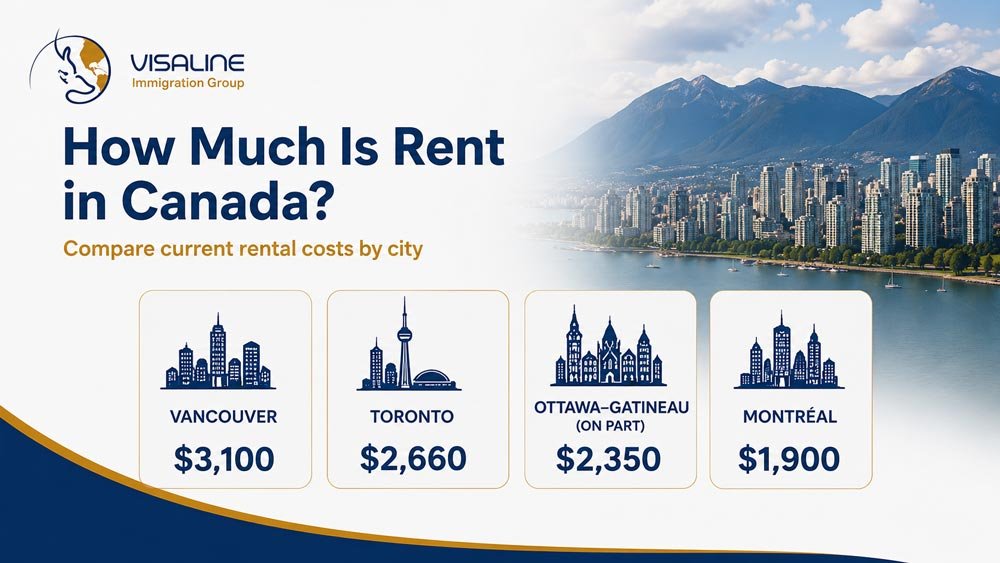
Statistics Canada reported the following average asking rents for two-bedroom apartments in the first quarter of 2026:
- Vancouver: $3,100
- Toronto: $2,660
- Ottawa–Gatineau, Ontario part: $2,350
- Montréal: $1,900
These are asking rents for units available in the market, not the average rent paid by every tenant.
CMHC’s 2025 Rental Market Report also found that rental conditions were changing as new supply increased in several markets. Nationally, the average rent paid by tenants in comparable two-bedroom units rose year over year, while asking rents for some newly available units softened in several major cities.
For newcomers, current listing prices are therefore more useful for budgeting than old city-wide rent averages.
Common rental mistakes
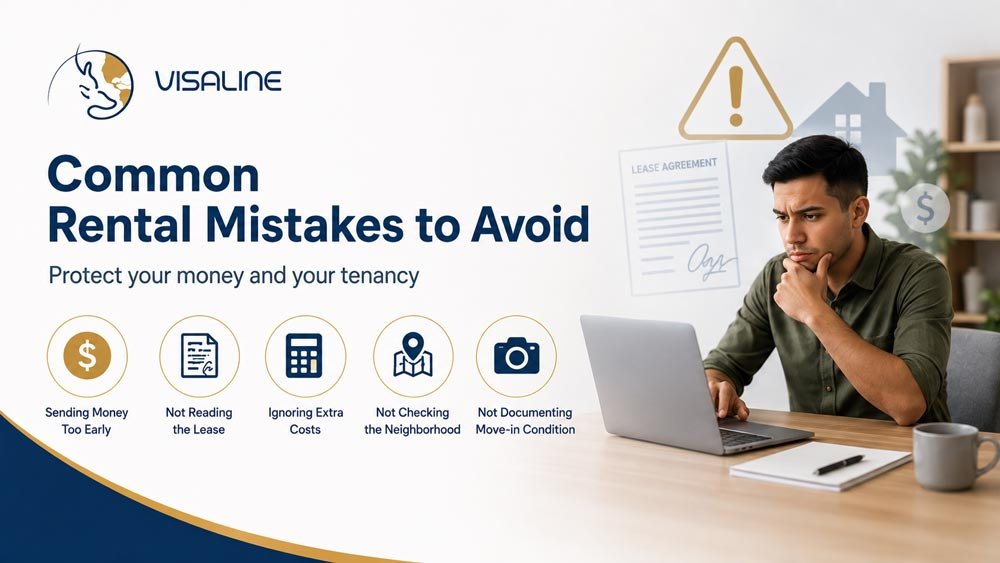
Newcomers should be especially careful about:
- sending large payments before confirming a property is legitimate;
- signing a lease they do not fully understand;
- assuming utilities are included;
- ignoring commuting costs;
- relying on outdated rent averages;
- choosing a home without checking local schools;
- failing to document the property’s condition at move-in;
- assuming tenancy law is the same across Canada.
Housing fraud can be particularly damaging because newcomers often need accommodation quickly.
Urgency should not replace basic verification.
Renting versus buying for newcomers
Renting often provides more flexibility during the first stage of settlement.
It can allow newcomers time to understand:
- neighbourhoods;
- employment location;
- school options;
- transportation;
- long-term finances; and
- where they actually want to live.
Buying a property introduces separate questions involving mortgages, down payments, creditworthiness, closing costs and ownership restrictions or tax considerations that are outside the scope of a basic rental guide.

Frequently asked questions
Can newcomers rent an apartment without Canadian credit history?
Yes, it may be possible. Landlords have different screening criteria, and applicants may be able to demonstrate reliability through employment, income, savings, references or previous rental history. Credit screening practices and tenant protections vary by province.
What documents do I need to rent a home in Canada?
Requirements vary, but landlords may request identification, employment or income information, references, rental history or permission to conduct a credit check. Provincial rules may restrict how certain information or deposits can be handled.
Can I rent a house before arriving in Canada?
It is possible to arrange accommodation remotely, but applicants should use extra caution when sending money for a property they have not personally inspected. Confirm the identity of the landlord or property manager and understand the lease before paying.
Are utilities included in Canadian rent?
Sometimes, but not always. Electricity, heating, water, internet and parking may be included, partially included or billed separately. The lease or rental advertisement should clearly identify what the rent covers.
Can a landlord increase my rent every year?
Rent-increase rules vary by province or territory and can involve limits, notice requirements or exemptions. Always check the current tenancy rules in the jurisdiction where the property is located.
Is Toronto or Vancouver more expensive for rent?
In Statistics Canada’s first-quarter 2026 two-bedroom asking-rent data, Vancouver was more expensive than Toronto. Current listings should still be checked because market conditions change.
Conclusion
Renting a home in Canada is not simply a matter of finding the cheapest listing.
Newcomers should evaluate the property, neighbourhood, commute, schools, utilities, lease terms and provincial tenant rules together.
A well-planned housing decision can also improve other parts of settlement, including access to employment, education and healthcare.
Legal information notice
This article provides general information about renting and housing in Canada. Residential tenancy laws differ by province and territory. It does not constitute legal advice about a particular lease, landlord dispute or tenancy.

Sources
- IRCC — Housing in Canada: Newcomers.
- IRCC — Renting a Home in Canada.
- Financial Consumer Agency of Canada — Renting an Apartment or House.
- Canada Mortgage and Housing Corporation — Renting Your First Home in Canada.
- Statistics Canada — Quarterly Rent Statistics, First Quarter 2026.
- CMHC — 2025 Rental Market Report.
Published/updated: August 10, 2026 Author: Afifeh Hosseini, Visaline Team Member and Content Creator
Contact us today to review your case and book your immigration consultation. We also recommend following Visaline Immigration Institute on Instagram for real-time updates on IRCC news and immigration law changes. ☎️ Toronto WhatsApp: +1-647-860-0005
