
Canada Visa Refusal Appeal: What to Do After a Canadian Visa Refusal
Suggested Meta Description: Canada visa refused? Learn when to reapply, seek reconsideration, appeal to the IAD or pursue Federal Court judicial review with Visaline.
A refusal letter can feel final, but in Canadian immigration law it is often the point where the strategy needs to become more precise. A Canada visa refusal appeal does not always mean filing a formal “appeal”: depending on the application, the right response may be a stronger new application, a reconsideration request, an appeal to the Immigration Appeal Division (IAD), or an application for judicial review in Federal Court. Temporary residence refusals—including many visitor visa, study permit and work permit decisions—do not have a formal statutory appeal process. At Visaline, “With you on your immigration journey, from dream to reality” means first understanding why the refusal happened, then choosing the legal or immigration strategy that actually fits the case.
Table of Contents
- What Does a Canada Visa Refusal Appeal Mean?
- What Should You Do After a Visa Refusal?
- Your Options After a Canadian Immigration Refusal
- Reapplying After a Visa Refusal
- Requesting Reconsideration
- Sponsorship Refusal Appeals to the IAD
- Federal Court Judicial Review
- Documents Needed After a Refusal
- How Visaline Handles Refused and Complex Cases
- FAQ
- Conclusion
What Does a Canada Visa Refusal Appeal Mean?
The phrase visa refusal appeal Canada is commonly used online, but Canadian immigration law does not provide the same appeal route for every refusal.
For example:
- a refused visitor visa generally has no formal appeal to the IAD;
- a refused study permit or work permit generally has no statutory appeal process;
- certain refused family-class sponsorship applications may be appealed by the sponsor to the Immigration Appeal Division;
- an immigration decision may, in appropriate circumstances, be challenged through an application for leave and judicial review at the Federal Court;
- an applicant may sometimes request that IRCC reconsider its decision, although reconsideration is discretionary rather than an automatic right.
The correct response therefore depends on what was refused, why it was refused, where the decision arose and whether a statutory deadline is running.
What Should You Do After a Canadian Visa Refusal?
The biggest mistake after a refusal is immediately submitting the same application again with a different cover letter.
IRCC itself warns that reapplying with essentially the same information will likely produce the same decision.
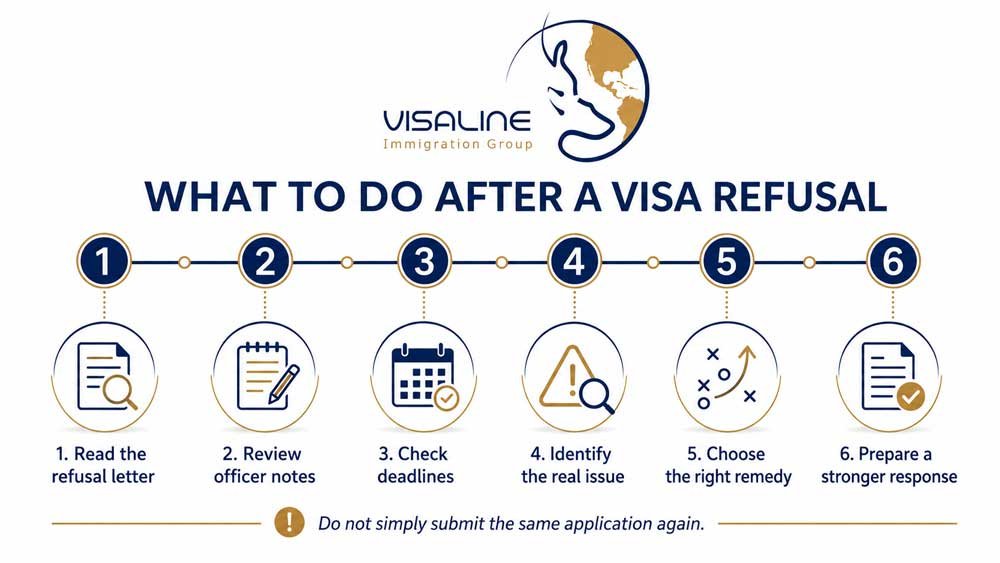
A better process is:
- Read the refusal letter carefully.
Identify each reason given by the immigration officer. - Review the officer’s decision notes.
IRCC now provides officer decision notes with refusal letters for most temporary resident applications and most permanent residence applications. These notes often provide more context than the short refusal wording alone. - Check whether a deadline is running.
Judicial review and IAD appeals can have short statutory deadlines. - Compare the refusal reasons with the application actually submitted.
The issue may be weak evidence, inconsistent information, eligibility, credibility, procedural fairness or a legal error. - Choose the correct remedy.
That may be reapplication, reconsideration, an IAD appeal or Federal Court judicial review. - Prepare the new evidence or legal arguments.
Do not simply add documents without explaining how they address the refusal. - Submit within the applicable deadline.
This is where professional refusal analysis can be valuable: a refusal should be treated like a diagnosis, not simply a signal to submit more paperwork.
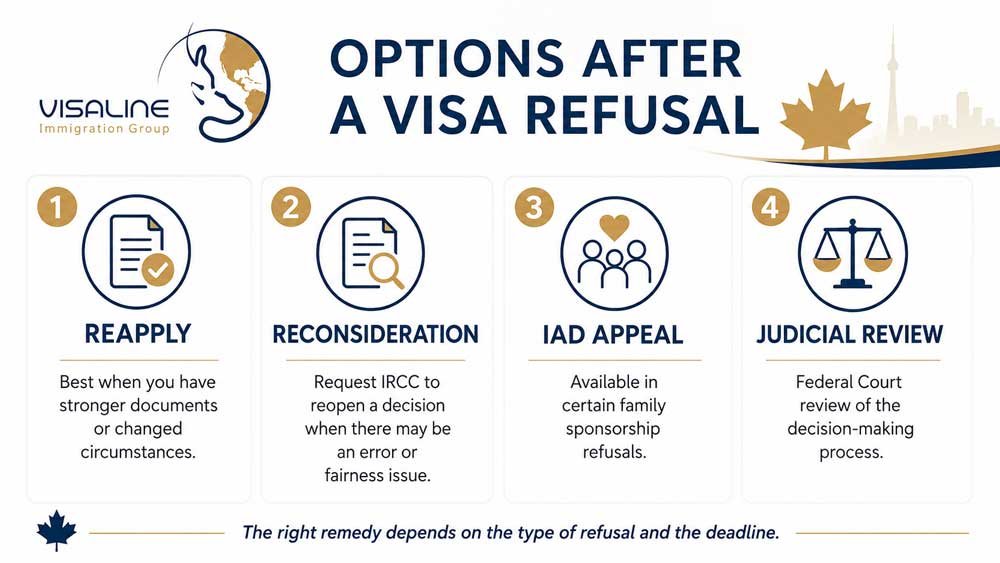
Your Options After a Canada Visa Refusal
| Option | Commonly relevant to | Formal deadline | Main purpose |
|---|---|---|---|
| Reapplication | Visitor visa, study permit, work permit and many other applications | Usually no waiting period unless the decision says otherwise | Submit a materially improved application addressing the refusal |
| Reconsideration request | Decisions involving possible error, fairness issue or exceptional circumstances | No universal statutory deadline; prompt action is important | Ask the original decision-maker to reconsider |
| IAD sponsorship appeal | Certain refused family-class sponsorship cases | Generally 30 days | Ask the Immigration Appeal Division to overturn the refusal |
| Federal Court judicial review | Immigration decisions where legality, reasonableness or fairness is challenged | Generally 15 days for matters arising in Canada or 60 days outside Canada | Ask the Court to review the decision-making process |
Federal Court deadlines under section 72 of the Immigration and Refugee Protection Act are generally 15 days for matters arising in Canada and 60 days for matters arising outside Canada.
For sponsorship appeals, the IAD states that the sponsor generally has 30 days from receiving the refusal decision to file the Notice of Appeal.
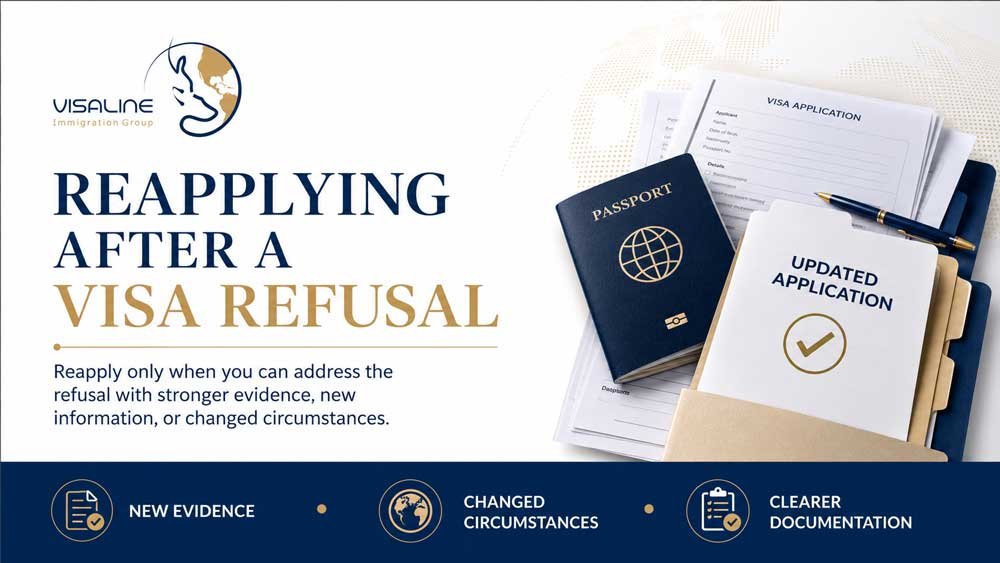
Reapplying After a Canadian Visa Refusal
For many temporary residence refusals, reapplication is the most familiar option—but it should not be automatic.
IRCC states that a person may generally apply again after a refusal unless the decision letter says otherwise. However, applicants should normally reapply only when they can provide information that was not included previously or otherwise address the refusal.
When Reapplying May Make Sense
A new application may be reasonable when:
- your circumstances have materially changed;
- you now have stronger financial or employment evidence;
- important documents were missing previously;
- the purpose of travel or study can now be documented more clearly;
- the employer or work permit documentation has changed;
- a refusal concern can be directly addressed with new evidence;
- the previous application contained avoidable inconsistencies.
For example, if a Canada visitor visa (replace with your actual page slug) was refused because the officer was not satisfied about the temporary purpose of travel, simply resubmitting the same itinerary and financial documents is unlikely to solve the problem.
The same principle applies to a refused Study in Canada application (replace with your actual page slug) or Canada work permit (replace with your actual page slug).
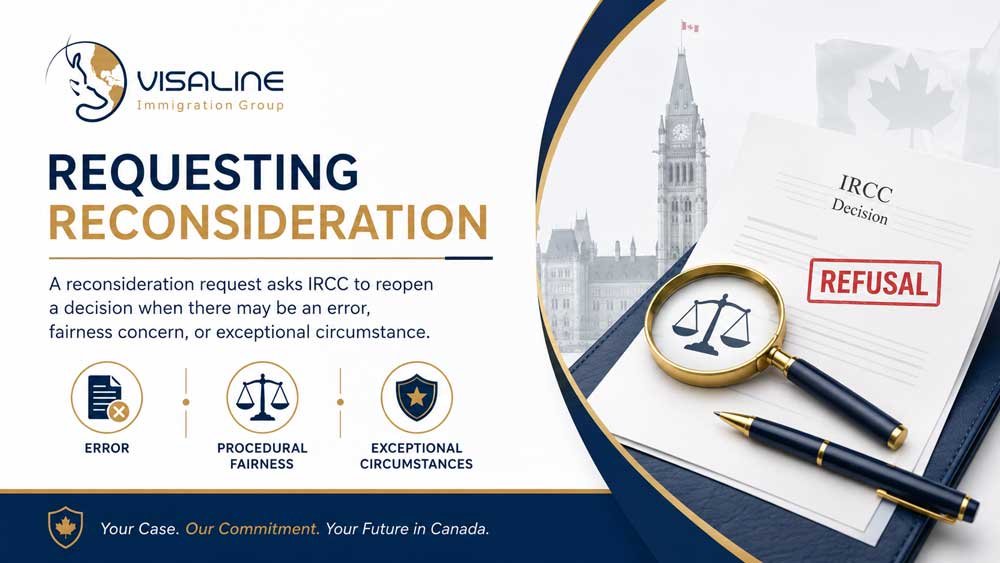
Requesting Reconsideration After an IRCC Refusal
A reconsideration request asks the decision-maker to reopen and reconsider a decision.
It is not the same as a formal appeal, and there is no automatic right to have a refusal reconsidered.
Government guidance describes reconsideration as discretionary and notes that circumstances potentially supporting reconsideration may include:
- procedural fairness concerns;
- clerical or administrative error;
- an issue with how the original decision was made;
- exceptional circumstances that justify reopening the file.
Simply disagreeing with the officer is generally not enough.
A reconsideration request should therefore explain what specific problem occurred in the decision-making process and why reopening the application is justified.
Sponsorship Refusal Appeal to the Immigration Appeal Division
Certain family sponsorship refusals are different because the sponsor may have a statutory appeal right.
If IRCC refuses a permanent resident visa application for a sponsored family member, an eligible Canadian citizen or permanent resident sponsor may be able to appeal to the Immigration Appeal Division of the Immigration and Refugee Board.
The IAD can consider whether:
- the decision was wrong in law;
- the decision was wrong in fact;
- procedural fairness or natural justice was breached;
- humanitarian and compassionate considerations are relevant where the law permits them.
Sponsorship Appeal Deadline
The IAD generally requires the Notice of Appeal and refusal letter within 30 days of receiving the refusal decision.
Not every sponsorship refusal carries an appeal right, so eligibility should be checked immediately after the decision.
If your case involves a spouse or partner, you can also review Visaline’s spousal sponsorship page (replace with your actual page slug).
What Happens if a Sponsorship Appeal Is Allowed?
If the IAD allows the appeal, the original refusal is set aside and IRCC resumes processing the permanent residence application. This does not mean permanent residence is automatically issued; IRCC must continue processing the case and remaining requirements still apply.

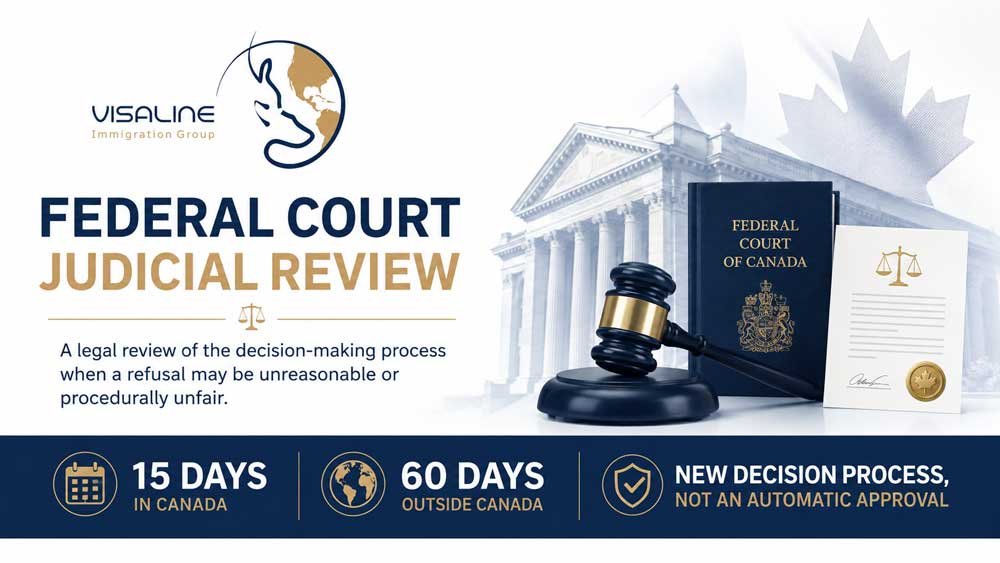
Federal Court Judicial Review After a Visa Refusal
For many immigration refusals, especially temporary residence decisions, judicial review may be the formal legal route available when the applicant believes the decision was unreasonable, unlawful or procedurally unfair.
A Federal Court judicial review is not a second visa application.
The Court generally examines whether the decision-making process and result met the requirements of Canadian law.
Judicial Review Deadlines
An application for leave and judicial review generally must be filed:
- within 15 days for a matter arising in Canada;
- within 60 days for a matter arising outside Canada.
Because these deadlines are short, anyone considering judicial review should obtain legal advice quickly.
Does Winning Judicial Review Mean You Get the Visa?
No.
If the Federal Court grants judicial review, the usual result is that the decision is set aside and the matter is sent back for reconsideration by a different or appropriately assigned decision-maker. The Court does not normally replace IRCC’s decision with an approval.
That distinction is important.
A successful judicial review gives you a new decision-making process, not a guaranteed visa.
Documents to Review After a Canadian Immigration Refusal
A professional refusal assessment normally begins with the entire history of the case—not just the refusal letter.
Useful documents can include:
- refusal letter;
- officer decision notes;
- complete copy of the application submitted;
- forms and questionnaires;
- supporting financial documents;
- employment letters;
- invitation letters;
- study documents or letter of acceptance;
- LMIA, job offer or employer documentation;
- previous Canadian immigration applications;
- correspondence with IRCC;
- biometrics or medical correspondence where relevant;
- documents that were unavailable at the time of the original application;
- evidence relevant to the specific refusal reasons.
Information submitted in a previous application remains part of your immigration history. A new application should therefore be consistent with previous filings or clearly explain any legitimate difference.
Visa Refusal Appeal and Refusal Review Services at Visaline
A refused immigration application requires a different approach from a first-time application.
At Visaline, the first objective is not to tell every client to “appeal.” It is to determine which remedy makes sense for that particular refusal.
Our Refusal Case Review May Include
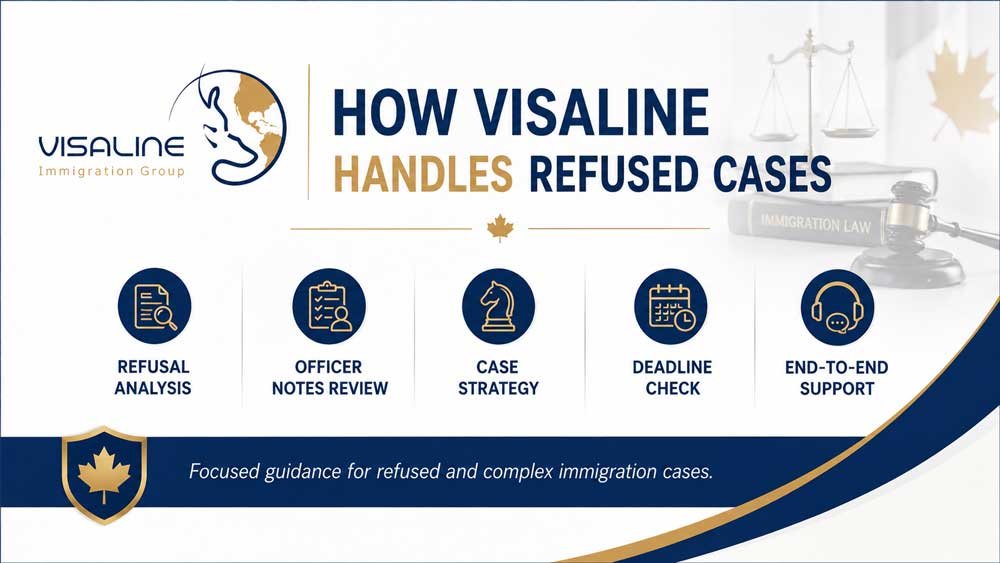
- detailed review of the refusal reasons;
- analysis of officer decision notes;
- comparison of the refusal with the evidence submitted;
- assessment of errors, weaknesses and inconsistencies;
- review of immigration history;
- determination of applicable deadlines;
- assessment of reapplication versus reconsideration;
- identification of possible IAD appeal rights;
- assessment of whether Federal Court advice may be required;
- development of a personalized next-step strategy.
Why Choose Visaline for a Refused Immigration Case?
Case-Specific Strategy
A visitor visa refusal, a study permit refusal and a sponsorship refusal should not be treated the same way.
Visaline evaluates the specific decision and builds the strategy around the actual facts of the case.
Specialized Immigration and Legal Team
Complex refusals may involve both application strategy and legal analysis. Visaline’s specialized immigration and legal team reviews the case from both perspectives where relevant.
End-to-End Follow-Up
Our involvement does not stop after the initial consultation. Within the agreed service scope, the team follows the case through preparation, submission and subsequent immigration steps.
Transparent Process and Fees
Before moving forward, clients should understand:
- what service is being recommended;
- why that route is being recommended;
- what documentation is required;
- what the professional service covers;
- what fees apply.
No Unrealistic Guarantees
No representative can guarantee that IRCC, the IAD or the Federal Court will decide a matter in the applicant’s favour.
Visaline’s role is to identify the available options, explain the risks and prepare the case carefully—not promise a result that no representative controls.
Frequently Asked Questions About Canada Visa Refusal Appeals
1. Can I appeal a Canada visitor visa refusal?
There is no formal statutory appeal process for a temporary resident visa refusal. Depending on the circumstances, you may reapply, request reconsideration or seek leave for judicial review at the Federal Court.
2. How long do I have to appeal a Canadian visa refusal?
It depends on the remedy. Federal Court judicial review generally has a 15-day deadline for matters arising in Canada and a 60-day deadline for matters arising outside Canada. Certain sponsorship appeals generally have a 30-day IAD deadline.
3. Should I reapply immediately after a visa refusal?
Not necessarily. IRCC advises that applicants should generally reapply only when they have new information or changed circumstances that address the refusal reasons. Submitting essentially the same application is unlikely to change the outcome.
4. Can I get the visa officer’s notes after a refusal?
For most temporary resident applications, and most permanent residence applications, IRCC now provides officer decision notes with refusal letters. Some application categories remain excluded.
5. What is the difference between an appeal and judicial review?
An appeal may allow a tribunal such as the IAD to reconsider issues of law, fact and, in some cases, humanitarian considerations. Judicial review asks the Federal Court to examine whether the original decision was legally reasonable and procedurally fair.
6. Does judicial review guarantee that my visa will be approved?
No. If judicial review succeeds, the Federal Court will generally send the matter back for a new decision. The new decision-maker can still refuse the application after reconsidering it lawfully.
Conclusion
A Canada visa refusal appeal is not one single procedure.
For a visitor visa, work permit or study permit refusal, the practical options may include a stronger reapplication, a discretionary reconsideration request or Federal Court judicial review. For certain family sponsorship refusals, a formal appeal to the Immigration Appeal Division may be available.
What matters most is choosing the correct response before a deadline expires or another application is submitted.
Visaline’s refusal review process focuses on understanding the officer’s concerns, reviewing the complete immigration record and identifying the most appropriate next step based on the facts—not simply repeating the same application and hoping for a different result.

Sources
- Immigration, Refugees and Citizenship Canada (IRCC) — Temporary residence refusals and available options.
- Immigration, Refugees and Citizenship Canada (IRCC) — Reapplying after a visitor visa refusal.
- Immigration, Refugees and Citizenship Canada (IRCC) — Officer decision notes included with refusal letters.
- Federal Court of Canada — Application for leave and judicial review in immigration matters and filing deadlines.
- Immigration and Refugee Board of Canada — Sponsorship appeals to the Immigration Appeal Division.
- Immigration and Refugee Board of Canada — Immigration appeal grounds and procedures.
Contact us today to review your case and book your immigration consultation. We also recommend following Visaline Immigration Institute on Instagram for real-time updates on IRCC news and immigration law changes.
☎️ Toronto WhatsApp: +1-647-860-0005
Author: Visaline Legal Editorial Team