Post-Graduation Work Permit Canada: PGWP Eligibility, Requirements and Application Guide
Suggested meta description: Learn who qualifies for a Post-Graduation Work Permit in Canada, required documents, language rules, permit length, fees and how to apply.
Graduating in Canada is exciting, but the weeks after receiving your final marks can also bring urgent questions about your immigration status and ability to work. The Post-Graduation Work Permit allows eligible international graduates to gain Canadian work experience after completing their studies, but approval is not automatic. At Visaline, we are “With you on your immigration journey, from dream to reality,” helping you understand the rules before a missed deadline, an ineligible program or an incomplete document creates an avoidable problem.
Table of Contents
- What is a Post-Graduation Work Permit?
- Who is eligible for a PGWP in Canada?
- PGWP language and field-of-study requirements
- How long is a PGWP valid?
- Documents required for a PGWP application
- How to apply for a Post-Graduation Work Permit
- Working while waiting for a PGWP decision
- Common PGWP application problems
- PGWP and permanent residence
- Frequently asked questions
What Is a Post-Graduation Work Permit?
A Post-Graduation Work Permit, commonly called a PGWP, is a Canadian work permit available to certain graduates of eligible designated learning institutions, or DLIs. It gives eligible graduates an opportunity to gain Canadian work experience after completing their program.
A PGWP is especially valuable because the Canadian work experience gained during its validity may later support an application through programs such as Express Entry (replace with your actual page slug). A PGWP itself, however, does not create permanent resident status or guarantee eligibility for permanent residence.
Students planning to study in Canada (replace with your actual page slug) should check both the institution and the specific program before enrolling. Graduating from a DLI does not automatically mean that every program offered by that institution is PGWP-eligible.
Who Is Eligible for a PGWP in Canada?
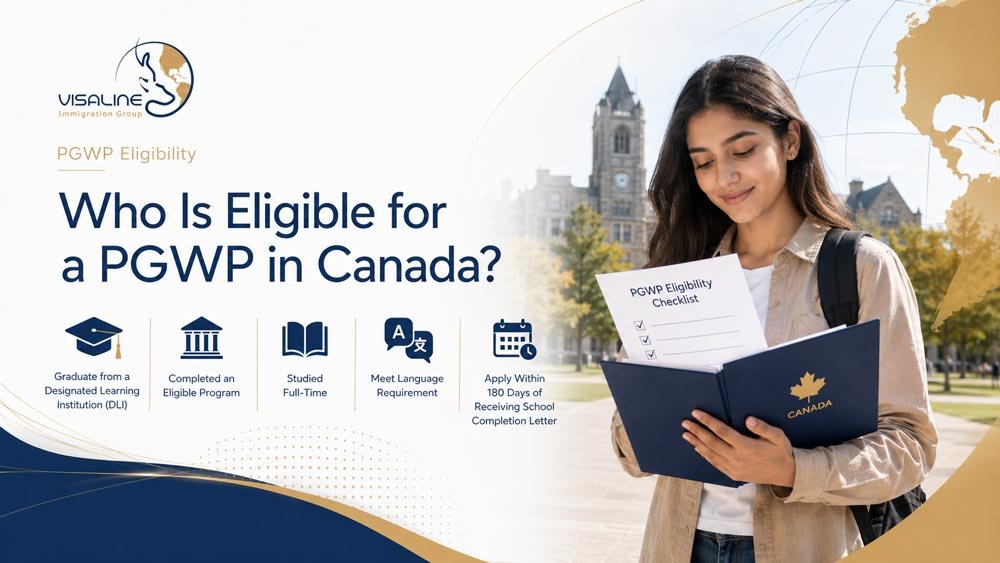
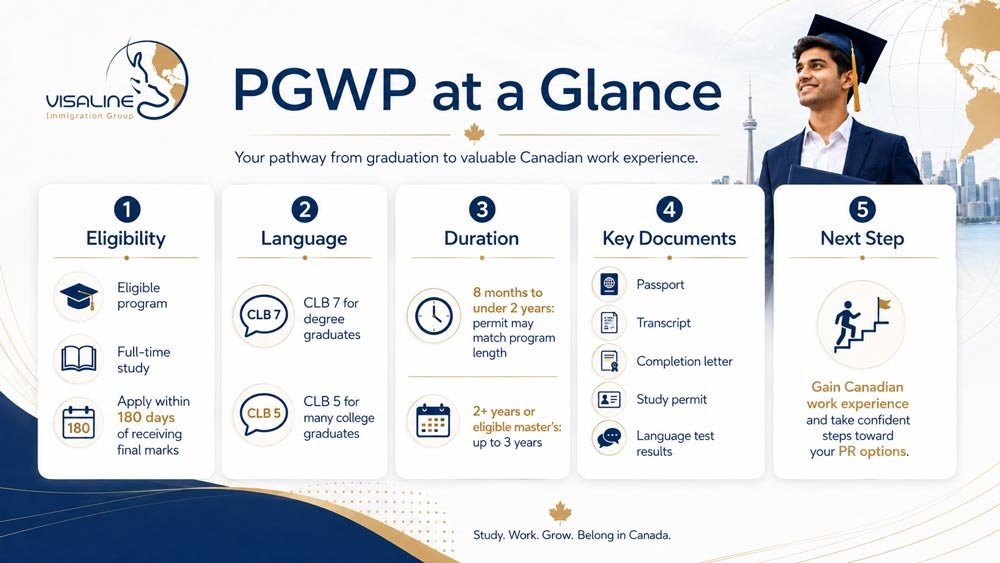
The general PGWP eligibility requirements include:
- Completing a PGWP-eligible program at an eligible DLI
- Completing a program lasting at least eight months, or at least 900 hours for certain Quebec programs
- Maintaining full-time student status during each academic semester, except that part-time study may be permitted in the final semester
- Applying within 180 days of receiving confirmation that the program was completed
- Having held a valid study permit at some point during that 180-day period
- Meeting the applicable language and field-of-study requirements
- Not having previously received a PGWP
IRCC recognizes limited exceptions for circumstances such as authorized study leave, accelerated programs, certain school transfers and some distance-learning situations. These exceptions are fact-specific and should not be assumed to apply automatically.
Who may not qualify for a Post-Graduation Work Permit?
You may be ineligible if you:
- Previously received a PGWP
- Completed only English or French as a second-language studies
- Took general-interest, self-improvement or certain non-credit courses
- Completed a program that is not PGWP-eligible
- Completed more than 50% of the program through distance learning, subject to limited transitional exceptions
- Studied through an ineligible public-private curriculum licensing arrangement
- Took an unauthorized leave that resulted in non-compliance with your study permit conditions
Programs delivered by private colleges on behalf of public institutions require particular care. Depending on the province and the date the program began, graduates may not qualify for a PGWP even when the public institution itself appears on the DLI list.
PGWP Language and Field-of-Study Requirements
Most people submitting a PGWP application on or after November 1, 2024 must provide valid English or French language results. Flight-school graduates who meet the applicable requirements are generally exempt.
| Type of completed program | Minimum language level | Field-of-study requirement |
|---|---|---|
| Bachelor’s degree | CLB 7 or NCLC 7 in all four abilities | No |
| Master’s degree | CLB 7 or NCLC 7 in all four abilities | No |
| Doctoral degree | CLB 7 or NCLC 7 in all four abilities | No |
| Other university program | CLB 7 or NCLC 7 in all four abilities | May apply if the study permit application was submitted on or after November 1, 2024 |
| College, polytechnic or other non-university program | CLB 5 or NCLC 5 in all four abilities | May apply if the study permit application was submitted on or after November 1, 2024 |
| Eligible flight-school program | No general language requirement | No general field-of-study requirement |
CLB means Canadian Language Benchmarks for English. NCLC is the corresponding Canadian standard for French. Applicants must meet the required level separately in reading, writing, listening and speaking.
Accepted language tests for PGWP applications
IRCC currently accepts:
- CELPIP–General
- IELTS General Training
- PTE Core
- TEF Canada
- TCF Canada
The results must generally be less than two years old when the PGWP application is submitted. A test may appear as “optional” in the online document checklist even when it is legally required, so applicants should not rely only on the wording shown in the upload portal.
PGWP field-of-study requirement and CIP codes
The field-of-study requirement is based on the program’s six-digit Classification of Instructional Programs code, known as a CIP code. For applicants who must satisfy this rule, the CIP code must be eligible when the study permit application or PGWP application is submitted.
IRCC has announced that the PGWP field-of-study list will remain frozen during 2026, meaning eligible fields will not be added or removed during the year. Students should still verify the exact six-digit code with their institution rather than relying only on a broad program title.
How Long Is a PGWP Valid?
The length of a Post-Graduation Work Permit depends on the credential, program duration and passport expiry date.
| Completed program | Possible PGWP validity |
| Program of at least 8 months but less than 2 years | Up to approximately the same length as the program |
| Program of 2 years or longer | Up to 3 years |
| Eligible master’s degree of at least 8 months | Up to 3 years, even when the master’s program is shorter than 2 years |
| Two or more eligible programs | The program lengths may be combined, subject to eligibility rules |
| Any program where the passport expires early | Permit may be shortened to the passport expiry date |
For example, completing a nine-month eligible certificate may result in a PGWP valid for up to nine months. By contrast, an eligible master’s graduate may qualify for a three-year permit even when the master’s program lasted less than two years. The final validity period remains an IRCC decision.
A PGWP is normally a one-time opportunity. It cannot usually be renewed simply because the holder needs more time in Canada. A limited extension may be possible when IRCC shortened the original permit only because the applicant’s passport expired before the full eligible period.
Documents Required for a PGWP Application
The exact PGWP document checklist depends on the applicant’s history and program, but commonly includes:
- A valid passport
- A copy of the current or most recent study permit
- An official completion letter from the educational institution
- An official transcript or a copy obtained through the institution’s online portal
- Proof of full-time enrolment
- Valid language-test results, when required
- Evidence of an eligible CIP code or field of study, when required
- A medical examination, where applicable
- Additional explanation letters or supporting documents for study gaps, authorized leave, part-time semesters, transfers or other unusual circumstances
Applicants who may work in health care, child care, primary or secondary education, elder care or certain agricultural occupations may require an immigration medical examination to avoid employment restrictions on the permit.
How to Apply for a Post-Graduation Work Permit
Most applicants submit the PGWP application online through their IRCC account.
- Confirm that the institution and program are PGWP-eligible. Check the DLI and the specific credential, not just the school’s name.
- Calculate the 180-day deadline. The period generally begins when the school confirms that program requirements have been completed, such as through final marks, a transcript or a completion letter.
- Review your immigration status. Determine whether the study permit remains valid and whether restoration or visitor status may be relevant.
- Confirm the language and CIP requirements. Check the credential type, study permit application date and applicable field-of-study rule.
- Collect the supporting documents. Make sure the completion letter, transcript, language results and passport are clear and current.
- Complete the online forms carefully. Disclose previous refusals, status issues, study gaps and other immigration history accurately.
- Upload documents in the correct sections. Proof of an eligible field of study may need to be uploaded under “Client Information” because the online checklist may not create a separate upload field.
- Pay the required government fees and submit the application. The PGWP government fee is currently CAD $255. Biometrics or restoration fees may apply separately.
Applicants can apply from inside or outside Canada, provided they meet the relevant requirements. For other employer-specific or open Canada work permit (replace with your actual page slug) options, the eligibility criteria and application process may be different.
What if the study permit has expired?
If your study permit expires before you apply and you did not change your status to visitor, you may have up to 90 days after the permit expiry to apply for restoration of student status together with the PGWP application.
During restoration, you are not authorized to work while waiting for the PGWP decision. If more than 90 days have passed, you may need to leave Canada. Because the 90-day restoration period and the 180-day PGWP deadline are separate rules, these cases should be reviewed carefully.
Working While Waiting for a PGWP Decision
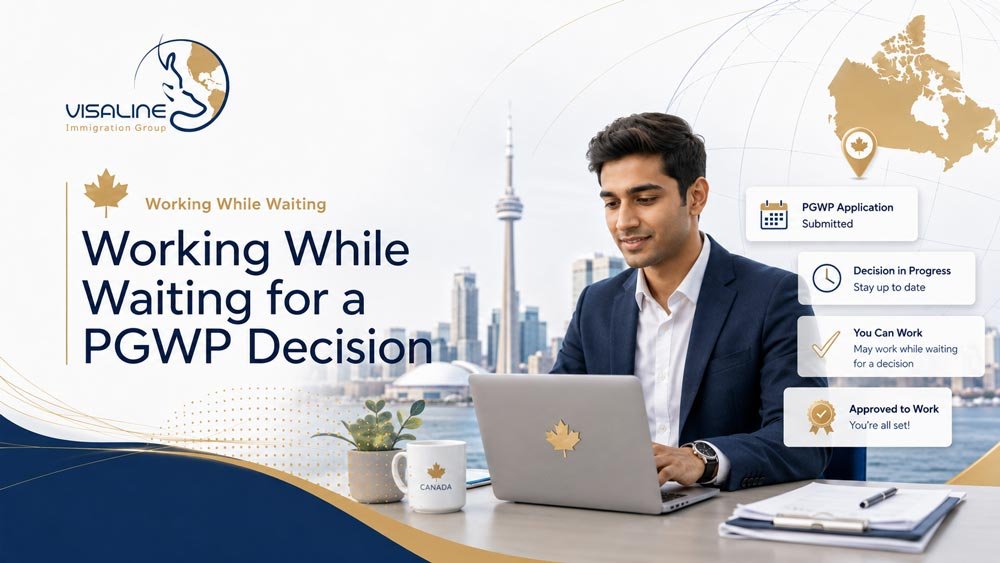
You may work full-time while IRCC processes an in-Canada PGWP application when all of the following apply:
- Your study permit was valid when the PGWP application was submitted
- You completed your study program
- You were eligible to work off campus during your studies
- You did not exceed the number of working hours permitted under your study authorization
When these conditions are not met, you must wait for the work permit to be approved before beginning or continuing employment. If the PGWP application is refused, the authorization to work ends when IRCC communicates the refusal.
Travelling After Applying for a PGWP
A work permit is not a travel document. A person returning to Canada must also have the appropriate temporary resident visa or electronic travel authorization.
Applicants who apply from inside Canada are not automatically issued a new visitor visa when the PGWP is approved. Those who require a visa may need to submit a separate Canada visitor visa (replace with your actual page slug) application before travelling and returning to Canada.
Leaving and re-entering Canada after submitting a PGWP application does not automatically end interim work authorization, provided the applicant met the work-while-waiting conditions. Admission to Canada is still decided by a border services officer.
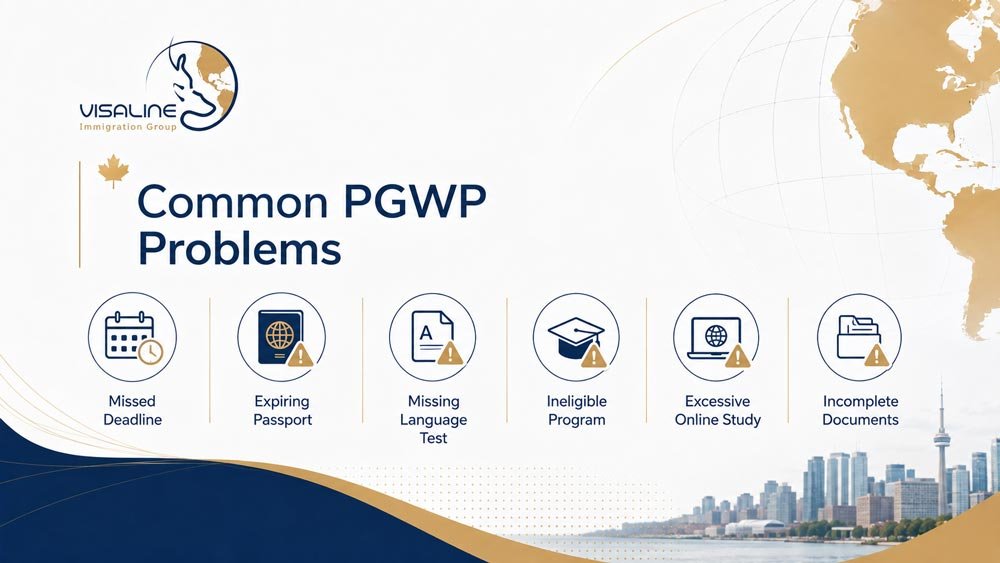
Common PGWP Application Problems
A PGWP application can appear straightforward, yet small details often determine whether the legal requirements are met. Common issues include:
Applying after the deadline
IRCC generally gives graduates up to 180 days to apply. Waiting for a job offer is not necessary and can create unnecessary deadline risk.
Assuming every DLI program is eligible
A school may be designated while a particular program, delivery arrangement or campus is not PGWP-eligible.
Missing language-test results
Language evidence can appear as an optional upload in the portal, but it is mandatory for most applications submitted on or after November 1, 2024.
Uploading no proof of the eligible CIP code
When the field-of-study rule applies, evidence may need to be placed in the Client Information section rather than a dedicated document field.
Part-time study or an unexplained academic break
Part-time study is generally permitted in the final semester, but part-time semesters earlier in the program, unauthorized leave or extended gaps may require a detailed explanation and supporting evidence.
Passport expiring too soon
IRCC may issue the permit only until the passport expiry date. Renewing the passport before applying can help prevent the PGWP from being shortened, where timing permits.
Excessive distance learning
For programs with a lock-in date on or after September 1, 2024, at least 50% of the program generally must be completed in class in Canada. Time spent studying outside Canada may be deducted from the PGWP’s length.
PGWP and Permanent Residence
A Post-Graduation Work Permit is temporary status. It does not convert automatically into permanent residence.
The strategic value of a PGWP is that it may allow a graduate to build skilled Canadian work experience, improve language ability and potentially become eligible for a federal or provincial immigration program. The best pathway depends on factors such as:
- Age
- Education
- Language scores
- Occupation and job duties
- Length and type of Canadian work experience
- Province of residence
- Provincial nomination opportunities
- Marital or family circumstances
- Changes to federal and provincial selection rules
For some graduates, the best plan may involve Express Entry. For others, a provincial nominee program, an employer-supported work permit or another immigration category may be more realistic. A strategy should be developed before the PGWP expiry date, not during the final weeks of the permit.
Frequently Asked Questions
Can I apply for a PGWP without a job offer?
Yes. A job offer is not a general eligibility requirement for a Post-Graduation Work Permit. You must still meet the education, status, deadline, language and field-of-study requirements that apply to your case.
How long do I have to apply for a PGWP?
You generally have up to 180 days after your school confirms that you completed the program. Your study permit must have been valid at some point during that 180-day period.
Can I work while waiting for my PGWP?
You may work full-time if you submitted the application while your study permit was valid, completed your program and were eligible to work off campus without violating your permitted hours. Otherwise, you must wait for approval.
Can I get a three-year PGWP after a one-year program?
Usually, a non-degree program shorter than two years results in a permit of up to approximately the same length as the program. An eligible master’s degree lasting at least eight months may qualify for a three-year PGWP.
Can a PGWP be extended or renewed?
A PGWP is generally issued only once and is not normally renewable. An extension may be available when the initial permit was shortened because the passport expired before the end of the period for which the applicant was eligible.
How long does PGWP processing take?
Processing times change and depend on whether the application was submitted inside or outside Canada and whether IRCC requests additional information. Applicants should check IRCC’s processing-time tool rather than relying on an old estimate.
Conclusion
The Post-Graduation Work Permit can provide valuable time to gain Canadian work experience and prepare for the next immigration step. The key is confirming eligibility before applying: the program, DLI, study history, language result, CIP code, immigration status and submission deadline must all align with current IRCC rules.
A careful review is especially important when you studied part-time, changed schools, completed part of the program online, took a leave, applied for your study permit after November 1, 2024 or have an expiring passport. Visaline can review these details and explain the available options without promising an outcome that only IRCC can decide.
 Sources
- Immigration, Refugees and Citizenship Canada: Post-graduation work permit overview and current government fee.
- Immigration, Refugees and Citizenship Canada: PGWP eligibility requirements.
- Immigration, Refugees and Citizenship Canada: PGWP validity and passport-expiry rules.
- Immigration, Refugees and Citizenship Canada: Language-test and document requirements.
- Immigration, Refugees and Citizenship Canada: Field-of-study and CIP-code requirements.
- Immigration, Refugees and Citizenship Canada: Application, restoration and work-while-waiting rules.
Contact us today to review your case and book your immigration consultation. We also recommend following Visaline Immigration Institute on Instagram for real-time updates on IRCC news and immigration law changes.
☎️ Toronto WhatsApp: +1-647-860-0005
Published/updated: August 6, 2026 Author: Visaline Legal Editorial Team
