
College and University Study in Canada: Best Schools, Programs, Admissions and Costs for International Students
Suggested meta description:
Compare Canadian colleges and universities, programs, admissions, tuition, housing, food costs, study permits and PGWP options.
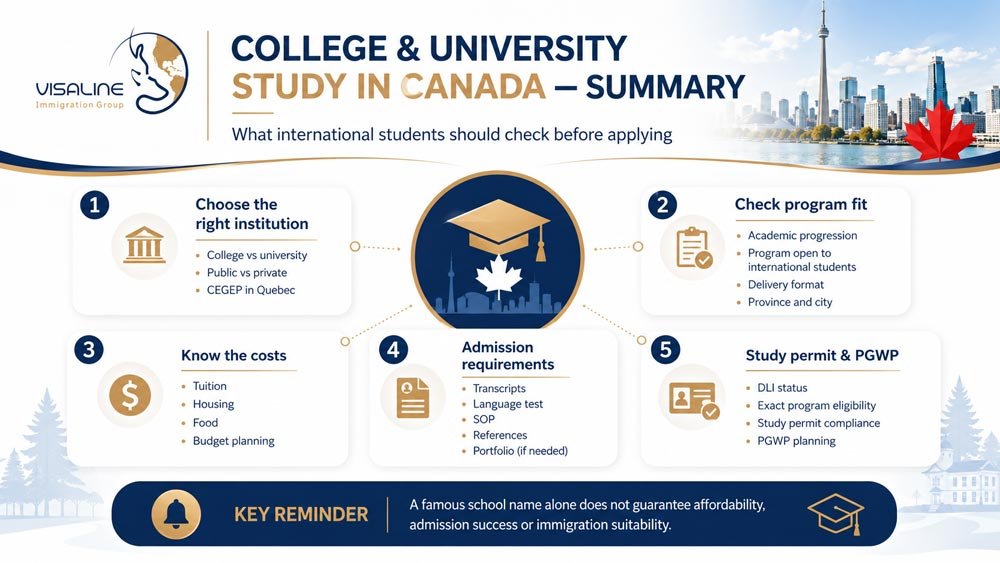
A famous university name is useful, but it does not automatically make a program affordable, suitable for your background or eligible for the immigration options you expect after graduation. College and University Study in Canada is available to international students through certificates, diplomas, bachelor’s degrees, graduate certificates, master’s programs and doctoral studies—but the right choice depends on your academic history, budget, career plan and immigration strategy. Visaline is with you on your immigration journey, from dream to reality, helping you compare the real academic and financial consequences before paying a deposit.
Table of Contents
- College vs university in Canada
- Types of colleges and universities
- Best Canadian universities
- Best Canadian colleges and polytechnics
- Popular programs and fields of study
- International admission requirements
- Tuition and living costs
- Dormitory, rent and food costs
- Study permit and PGWP rules
- Application process
- Frequently asked questions
College vs University in Canada
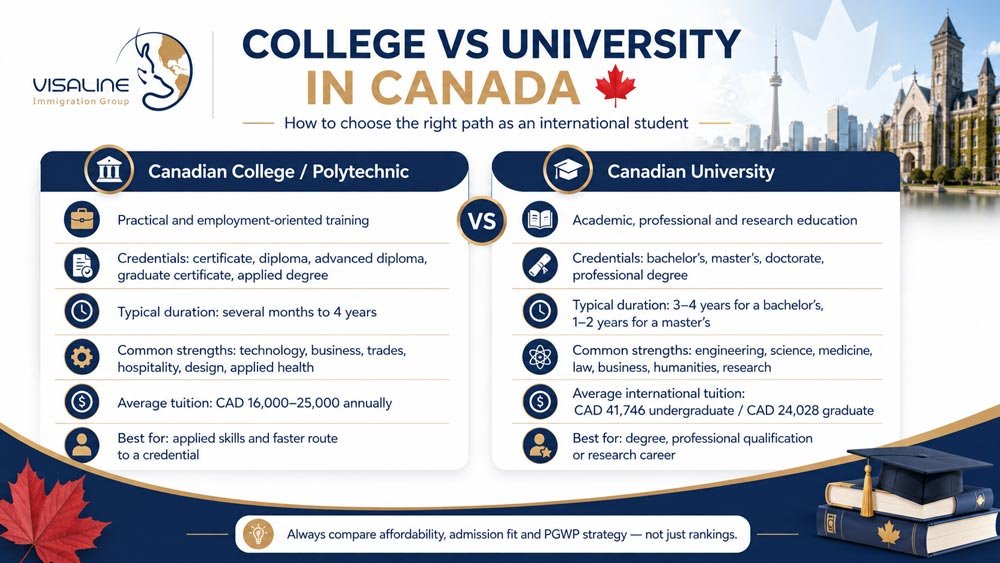
Canadian colleges are generally more career-focused. Their programs often combine classroom instruction with labs, projects, internships, co-op terms or practical placements. Universities place more emphasis on academic theory, professional degrees, research and advanced study.
| Factor | Canadian college or polytechnic | Canadian university |
|---|---|---|
| Main focus | Practical and employment-oriented training | Academic, professional and research education |
| Common credentials | Certificate, diploma, advanced diploma, graduate certificate, applied degree | Bachelor’s, master’s, doctorate and professional degree |
| Typical duration | Several months to four years | Three to four years for a bachelor’s; one to two years for a master’s |
| Admission basis | High school or previous college/university education, depending on program | High school for bachelor’s; relevant degree for graduate study |
| Common strengths | Technology, business, trades, hospitality, design and applied health programs | Engineering, science, medicine, law, business, humanities and research |
| Average tuition | College diplomas commonly cost about CAD 16,000–25,000 annually | Average international tuition is about CAD 41,746 for undergraduate and CAD 24,028 for graduate study |
| Best suited to | Students seeking applied skills and a shorter route to a credential | Students seeking a degree, professional qualification or research career |
Canada has publicly funded colleges, community colleges, institutes of technology and polytechnics offering more than 10,000 programs. Universities award bachelor’s, master’s and doctoral degrees and also offer co-op, internship and professional programs.
Types of Colleges and Universities in Canada
Public colleges and polytechnics
Public institutions receive provincial funding and usually offer career-oriented certificates, diplomas, advanced diplomas, graduate certificates and applied bachelor’s degrees. Many have strong relationships with local employers.
For immigration planning, public institutions are often easier to assess than private career colleges. Still, being public does not mean every program qualifies for a post-graduation work permit.
Public universities
Public universities provide undergraduate, graduate and doctoral programs. They may be:
- Large research universities
- Comprehensive universities offering research and professional programs
- Smaller regional universities
- Primarily undergraduate institutions
- Specialized institutions focused on areas such as art, technology or agriculture
Private institutions and career colleges
Some private institutions are designated learning institutions and can admit international students. However, a DLI number alone does not confirm PGWP eligibility. Private-college programs, partnership programs and curriculum-licensing arrangements require particularly careful review before tuition is paid. IRCC’s DLI list identifies schools offering PGWP-eligible programs, but also warns that not every program at a listed institution qualifies.
CEGEPs in Quebec
Quebec’s CEGEP system includes pre-university and technical programs. International applicants studying in Quebec generally need a Quebec Acceptance Certificate, known as a CAQ, in addition to meeting federal study permit requirements.
Best Canadian Universities for International Students
“Best” should be defined by your program—not only by a general ranking. A university may be excellent for medical research but less appropriate for a student seeking affordable undergraduate business studies.
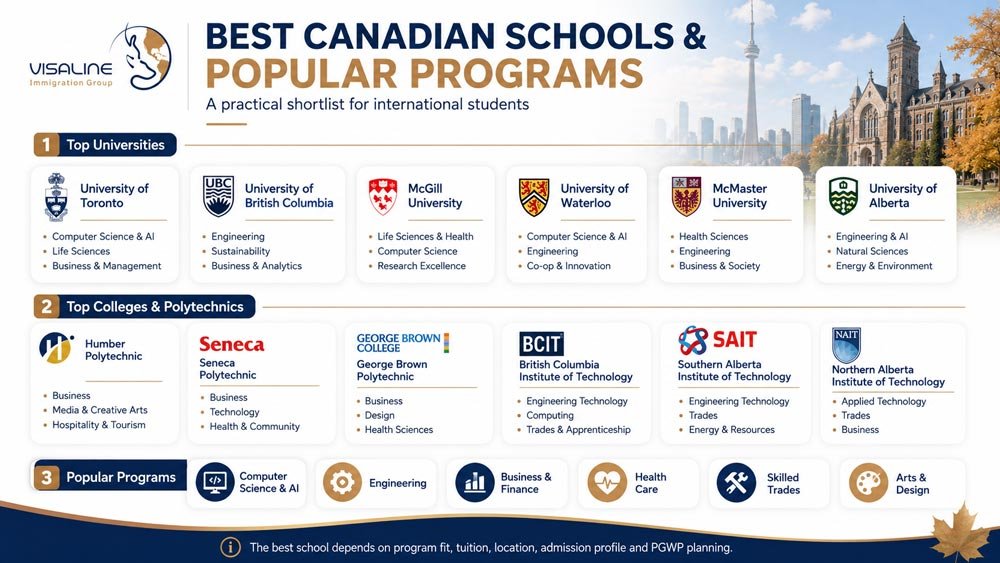
The 2026 Times Higher Education ranking places the University of Toronto, McGill University and the University of British Columbia as Canada’s three highest-ranked universities, followed by McMaster University and the University of Alberta. Rankings are useful for comparing research reputation, but they do not measure immigration suitability, affordability or your probability of admission.
| University | Notable areas | International-student considerations |
|---|---|---|
| University of Toronto | Computer science, engineering, business, life sciences, health, humanities and social sciences | Offers more than 700 undergraduate programs; admission and costs are highly competitive |
| University of British Columbia | Engineering, computer science, business, forestry, environmental studies, food and land systems | Strong international profile; Vancouver housing and tuition can make the total budget high |
| McGill University | Medicine, health sciences, engineering, science, management and arts | Strong research reputation in Montreal; tuition depends heavily on faculty and degree |
| University of Waterloo | Computer science, engineering, mathematics, accounting, finance and co-op education | Particularly attractive for co-op; international tuition is among the higher ranges |
| McMaster University | Health sciences, engineering, science, business and research | Competitive admission, particularly in health-related programs |
| University of Alberta | Engineering, energy, artificial intelligence, science, agriculture, health and business | Major research university with lower living costs than Toronto or Vancouver in many cases |
| Memorial University | Marine and ocean studies, engineering, science, business, arts and technology | A lower-tuition public-university option; 2026–27 international undergraduate tuition is CAD 22,500 |
| University of Manitoba | Agriculture, engineering, business, environment, science, nursing and social sciences | Broad program selection and comparatively moderate Winnipeg living costs |
| University of Saskatchewan | Agriculture, engineering, business, science, health, pharmacy and environment | 2026–27 international undergraduate tuition is approximately CAD 39,000–59,000 for many major faculties |
The University of Toronto has dedicated international admissions pathways, while UBC welcomes qualified international high-school, college, university and transfer applicants. Waterloo estimates 2026 first-year international tuition at approximately CAD 51,000–75,000, depending on faculty. Memorial’s published 2026–27 international undergraduate tuition is CAD 22,500 for two semesters.
More affordable universities in Canada
Students focused on cost should compare universities in Newfoundland and Labrador, Manitoba, Saskatchewan, New Brunswick and Prince Edward Island. A lower tuition figure, however, should not be viewed in isolation. Program quality, international availability, internship options, housing supply and PGWP eligibility remain important.
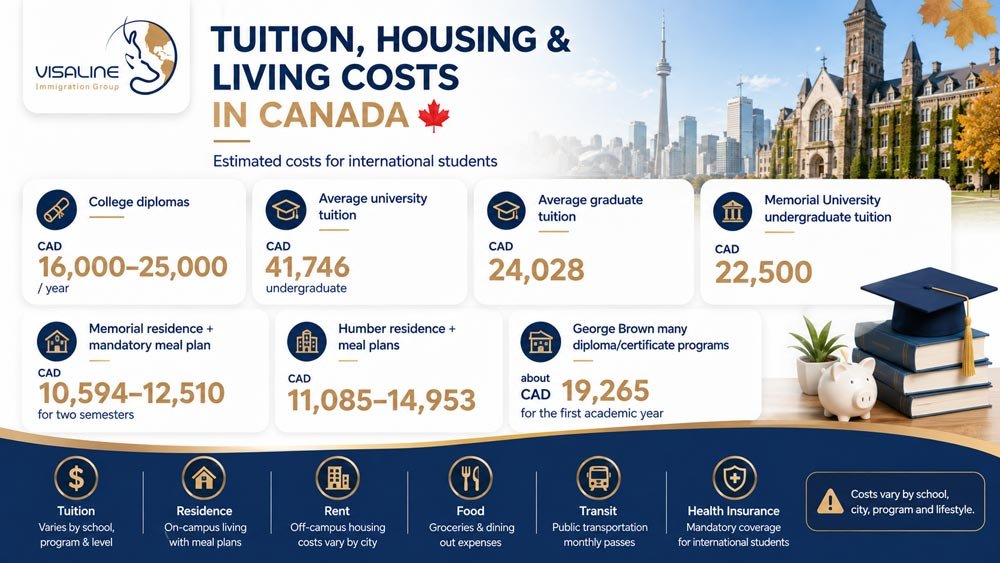
Memorial University is a useful example: its 2026–27 international undergraduate tuition is CAD 22,500, while residence with a mandatory meal plan costs approximately CAD 10,594–12,510 for two semesters, depending on room type.
Best Canadian Colleges and Polytechnics for International Students
Canada does not have one official national ranking that identifies the “best” college. The strongest choice usually depends on the specific department, campus, employer connections, co-op structure and whether the program is open to international applicants.
| College or polytechnic | Popular study areas | Cost and admission notes |
|---|---|---|
| Humber Polytechnic | Business, technology, media, design, hospitality, health and skilled trades | Toronto institution with international programs; residence and meal plans are approximately CAD 11,085–14,953 |
| Seneca Polytechnic | Business, IT, aviation, engineering technology, creative arts and health | Publishes program-specific 2026–27 tuition for programs accepting international applicants |
| George Brown Polytechnic | Culinary arts, hospitality, business, design, construction, IT, health and community services | Many 2026–27 diploma and certificate programs are approximately CAD 19,265 for the first academic year |
| BCIT | Computing, engineering technology, construction, business, media, applied science and trades | Strong applied focus in Metro Vancouver; tuition varies significantly by program |
| SAIT | Energy, engineering technology, IT, business, hospitality, media and skilled trades | Calgary-based applied institution with program-specific international fees |
| NAIT | Engineering technology, health, IT, business, transportation and trades | Edmonton-based polytechnic; 2026–27 tuition varies by program and credential |
| Fanshawe College | Aviation, business, health, media, design, hospitality, technology and trades | Publishes a list of programs available to international applicants and program-level tuition |
| Centennial College | Business, engineering technology, transportation, hospitality, media and community services | International availability and PGWP status must be checked for the exact intake |
| Sheridan College | Animation, design, film, technology, business and applied computing | Known for creative programs; admission may require a portfolio |
| Conestoga College | Engineering technology, trades, business, health, IT and community services | Program availability and PGWP eligibility should be verified carefully before applying |
Humber publishes housing options for international applicants, while Seneca’s tuition search identifies fees for 2026–27 programs. George Brown’s international viewbook lists approximately CAD 19,265 for many certificate, diploma and advanced-diploma programs starting in fall 2026. BCIT and NAIT publish program-specific international tuition tools rather than one standard college-wide fee.
A college may accept international students generally while closing a particular program or intake to international applications. Always check the program page for the exact campus and start date.
Popular Programs for International Students
Computer science, AI and information technology
Common options include:
- Computer science
- Software engineering
- Artificial intelligence and machine learning
- Data science and analytics
- Cybersecurity
- Cloud computing
- Information systems
- Mobile and web development
- Network administration
University programs typically provide deeper mathematical and theoretical foundations. College programs may focus more heavily on applied development, systems administration or job-ready technical skills.
Engineering and engineering technology
Universities award engineering degrees in fields such as civil, mechanical, electrical, software, chemical and environmental engineering. Colleges and polytechnics commonly offer engineering-technology diplomas.
An engineering degree and an engineering-technology diploma are not interchangeable. Applicants intending to become licensed professional engineers should investigate provincial licensing requirements before choosing a program.
Business, finance and management
Popular programs include:
- Accounting
- Finance
- Marketing
- Human resources
- Supply-chain management
- Business analytics
- Project management
- International business
- Entrepreneurship
A general graduate certificate should make sense after your previous degree and work experience. For example, an experienced senior accountant applying for an entry-level general business certificate may need to explain why the program represents reasonable academic progression.
Health care and nursing
Options may include nursing, health information management, public health, medical laboratory science, respiratory therapy and other allied health programs.
Health programs can be highly competitive, require clinical placements and impose additional vaccination, background-check or licensing conditions. Medicine, dentistry, pharmacy and veterinary programs may restrict or exclude international applicants. For example, the University of Saskatchewan lists no international tuition category for its medicine and veterinary medicine programs, meaning applicants must verify eligibility rather than assuming every faculty accepts international students.
Skilled trades and technical programs
Applied institutions offer programs in:
- Electrical and construction technology
- Heating, ventilation and air conditioning
- Welding
- Automotive and heavy-equipment technology
- Industrial automation
- Power engineering
- Water and wastewater technology
- Aircraft maintenance
These programs may have strong practical value, but international availability, apprenticeship rules and PGWP field-of-study requirements must be checked separately.
Agriculture, environment and food sciences
Canada offers programs in agriculture, agri-food, environmental science, forestry, sustainability, natural-resource management and food safety. UBC, the University of Saskatchewan, the University of Manitoba and several regional colleges have established programs in these areas.
Hospitality, culinary arts and tourism
Colleges commonly offer culinary management, baking, hotel operations, hospitality management, event management and tourism programs. Students should review work-placement requirements and employment conditions rather than selecting a course only because it appears easier to enter.
Arts, design, media and communication
Common options include animation, graphic design, user-experience design, broadcasting, film production, photography, journalism and digital media. Competitive programs may require portfolios, auditions or creative assignments.
How to Choose the Best Program
The best field is the one that creates a credible bridge between your past education and your realistic future plans. A useful shortlist should meet these conditions:
- The institution is a designated learning institution.
- The exact program is open to international applicants.
- The credential represents reasonable academic progression.
- The tuition and living budget are sustainable.
- The program’s delivery format supports study-permit compliance.
- The program is PGWP-eligible if post-graduation work is part of your plan.
- The program’s CIP code meets any applicable field-of-study requirement.
- Professional licensing requirements are understood.
- The province and city suit your employment and housing budget.
- The school’s refund policy is acceptable if a study permit is refused.
Canada offers official program-search tools allowing students to search by subject, province, language and credential. However, EduCanada advises international students to confirm current program and tuition details directly with the institution.
For individualized program selection, review Visaline’s Study in Canada page (replace with your actual page slug).
International Admission Requirements
Admission requirements vary by school and program, but most international applicants need some combination of:
- Passport identification page
- High-school diploma and transcripts
- College or university transcripts, if applicable
- Certified English or French translations
- English or French language test results
- Program prerequisite courses
- Resume or curriculum vitae
- Statement of purpose or letter of intent
- Academic or professional references
- Portfolio or audition for creative programs
- GMAT or GRE where required for certain graduate programs
- Proof of professional experience for some graduate certificates or master’s programs
Universities generally assess academic performance and prerequisite subjects more heavily. College admission may be more accessible, but competitive health, technology and creative programs can still require high grades or additional assessments. Each institution controls its own admission process and may impose separate requirements for applicants educated outside Canada.
English-language requirements
Accepted tests may include IELTS Academic, TOEFL, CAEL, Cambridge English or institution-specific assessments. Minimum scores differ by credential and department. A score accepted for a general college diploma may not satisfy nursing, law, education or graduate-program requirements.
Common intake periods
- September: Main intake with the widest program selection
- January: Available at many colleges and some universities
- May: More limited and commonly offered by colleges
- Rolling or continuous admission: Available for selected programs
A published deadline does not guarantee that seats will remain open until that date. Competitive programs may fill earlier.
Cost of College and University Study in Canada
Tuition and mandatory fees
| Expense | Indicative 2026 planning amount |
|---|---|
| Public college diploma tuition | CAD 16,000–25,000 per year |
| International undergraduate university tuition | National average of CAD 41,746 per year |
| International graduate university tuition | National average of CAD 24,028 per year |
| Study permit fee | CAD 150 |
| Biometrics | CAD 85 per person, when required |
| Books and supplies | Commonly CAD 1,000–2,000, but technical programs may cost more |
| Health insurance | Often CAD 500–1,300 per year, depending on province and institution |
| Co-op, laboratory or program fees | Varies by program |
| Application fee and tuition deposit | Set by each institution |
College tuition commonly ranges from CAD 16,000–25,000 annually. Statistics Canada’s 2025–26 national averages are CAD 41,746 for international undergraduate students and CAD 24,028 for international graduate students. Tuition varies sharply by province and discipline; engineering, business, architecture and some professional programs are often more expensive.
The study permit processing fee remains CAD 150 and the standard individual biometrics fee is CAD 85 when biometrics are required.
Examples of university costs
| Institution | Tuition example | Residence and food example |
|---|---|---|
| Memorial University | CAD 22,500 for two semesters in 2026–27 | Approximately CAD 10,594–12,510 with mandatory meal plan |
| UBC | Many 2026–27 undergraduate programs are approximately CAD 51,500–67,200 | First-year room and meal plan commonly about CAD 14,000–18,100 |
| University of Waterloo | Approximately CAD 51,000–75,000 for two academic terms, depending on faculty | Approximately CAD 15,701–18,103 for selected residences with meals |
| University of Toronto | Approximately CAD 61,720–63,570 at UTM in the published 2025–26 example | Approximately CAD 14,965–21,236 at selected residences with meal plans |
| University of Saskatchewan | Approximately CAD 39,000 for arts to CAD 59,383 for engineering in 2026–27 | Residence costs depend on room and dining plan |
These are representative published figures, not universal prices for every student or faculty.
Student Housing, Rent and Food Costs
On-campus residence
University and college residences may offer:
- Traditional single or shared rooms
- Suite-style rooms with shared kitchens
- Studio units
- Apartment-style accommodation
- Mandatory or optional meal plans
- Utilities and internet included in the residence fee
Residence can make arrival easier, but space is limited and applications may open before academic admission decisions are complete.
Published 2026–27 examples show residence and meal-plan costs of approximately CAD 14,000–18,100 at UBC, CAD 15,701–18,103 at selected Waterloo residences and CAD 16,548–21,236 at University College, University of Toronto.
Homestay
Homestay usually includes a private room and some or all meals with a Canadian host. Humber’s international planning guide estimates homestay with meals at approximately CAD 9,250–11,000 and above, depending on the arrangement.
Shared off-campus accommodation
Sharing an apartment or house can cost less than renting alone, but students should budget for:
- Monthly rent
- Electricity and heating
- Internet
- Furniture
- Tenant insurance
- Transportation
- Security deposit
- Kitchen and household supplies
BCIT advises students in the Vancouver region to expect housing costs ranging roughly from CAD 800–2,500 per month, depending on location and housing type. Shared rooms may cost less, while private apartments in Vancouver can exceed CAD 2,500 monthly.

Food and groceries
Students in traditional residence may be required to purchase a meal plan. McGill’s mandatory 2026–27 residence meal plan totals CAD 6,650. Waterloo advises students without meal plans to budget approximately CAD 3,000–5,000 for groceries and dining during the first academic year.
Other living costs
Budget separately for:
- Mobile phone
- Public transportation
- Winter clothing
- Personal care
- Laundry
- Entertainment
- Health and dental expenses not covered by insurance
- Airfare
- Emergency savings
Combining published tuition and housing figures, a first-year budget may exceed CAD 40,000–50,000 at a lower-cost college or regional university and CAD 70,000–95,000 for expensive university programs in Toronto or Vancouver. This is a planning inference, not a fixed national fee; the exact amount must be calculated using the school’s current invoice and your housing choice.
Proof of Funds for a Study Permit
For applications submitted on or after September 1, 2025, a single applicant outside Quebec must show at least CAD 22,895 for first-year living expenses. This is separate from tuition and transportation costs. A family of two requires CAD 28,502, and the required amount increases with each additional family member.
IRCC may accept evidence such as:
- Four months of bank statements
- Proof of tuition and housing payments
- Canadian bank-account records
- Guaranteed Investment Certificate
- Education loan
- Scholarship documents
- Sponsor letter accompanied by financial evidence
Meeting the minimum number does not automatically establish that the financial plan is credible. The source, history, accessibility and sufficiency of the money may all matter.
Study Permit, DLI and PGWP Planning
Designated learning institution
A study permit application for post-secondary education generally requires a letter of acceptance from a DLI—a school authorized by its province or territory to host international students.
However:
DLI status does not mean every program at the institution is PGWP-eligible.
IRCC instructs students to verify the exact program, not merely the institution’s name.
PAL, TAL and Quebec CAQ
Most post-secondary study permit applicants need a provincial or territorial attestation letter. In Quebec, students normally need a CAQ.
Starting January 1, 2026, applicants entering degree-granting master’s or doctoral programs at public DLIs are exempt from the federal PAL/TAL requirement. Evidence of the exemption must still be included.
Post-graduation work permit
General PGWP requirements include completing an eligible program of at least eight months at a PGWP-eligible DLI, maintaining full-time status during required academic terms and applying within 180 days after receiving confirmation of completion.
For some non-degree programs, PGWP eligibility also depends on the program’s Classification of Instructional Programs code. IRCC froze the eligible field-of-study list for 2026, meaning no fields will be added or removed during the year.
Before paying tuition, check:
- The school’s DLI number.
- Whether the exact campus and program are PGWP-eligible.
- Whether a field-of-study rule applies.
- The program’s CIP code.
- The normal duration of the credential.
- Whether the program is delivered through a public-private partnership.
- Language requirements that may apply when requesting the PGWP.
More details are available on Visaline’s Canada study permit page (replace with your actual page slug).
Step-by-Step Admission and Study Permit Process
- Define your objective. Decide whether you need practical college training, a bachelor’s degree, graduate specialization or research study.
- Set a realistic budget. Include tuition, housing, food, insurance, books, travel and emergency funds.
- Shortlist schools and programs. Compare curriculum, location, international availability, co-op and career outcomes.
- Verify DLI and PGWP status. Check the exact program and campus on IRCC’s current list.
- Review admission requirements. Confirm prerequisites, language scores, portfolio requirements and deadlines.
- Submit academic applications. Apply early and upload accurate, translated records.
- Review the admission offer. Check tuition, deposit, refund policy, campus, program duration and start date.
- Obtain a PAL, TAL or CAQ. Complete the provincial process unless you qualify for an exemption.
- Prepare the study permit application. Include identity documents, financial evidence, study plan and applicable medical or police documents.
- Arrange housing after approval planning. Avoid non-refundable commitments unless you understand the institution’s cancellation policy.
Admission does not guarantee a study permit. The school evaluates academic eligibility, while IRCC separately examines finances, admissibility, study purpose and compliance with immigration requirements.
Working During and After Studies
Eligible international students may work up to 24 hours per week off campus during regular academic sessions and unlimited hours during scheduled breaks. Working beyond the permitted limit can violate study permit conditions and affect future immigration applications.
As of April 1, 2026, eligible post-secondary international students no longer require a separate co-op work permit for student work placements such as co-op terms or internships. Students must still satisfy the applicable placement and study-permit conditions.
Students who later qualify for a PGWP may gain Canadian work experience. That experience may support eligibility under Express Entry or a provincial nominee program, but studying in Canada does not guarantee permanent residence.
Students requiring employment authorization outside the student-work rules should review Visaline’s Canada work permit page (replace with your actual page slug).
Frequently Asked Questions
Which Canadian university is best for international students?
There is no single best university. U of T, McGill and UBC lead major 2026 research rankings, while Waterloo is particularly strong in co-op, computer science and engineering. Memorial may be more suitable for applicants prioritizing lower tuition.
What are the best colleges in Canada for international students?
Humber, Seneca, George Brown, BCIT, SAIT, NAIT and Fanshawe are established public institutions with international programs. The best choice depends on the exact program, campus, cost and PGWP eligibility—not only the college name.
Which programs are easiest for international students to enter?
General business, arts and some college diplomas may have broader admission than nursing, engineering or competitive technology programs. However, choosing a program only because it appears easier can weaken the academic logic of a study permit application.
How much does one year of study in Canada cost?
College students should often plan for at least CAD 40,000–50,000 including tuition and living costs. University students may need CAD 55,000–95,000 or more, particularly in engineering, business or major cities. Exact costs depend on the program and accommodation.
Can international students live in university dormitories?
Yes, but residence is not guaranteed. Students usually apply separately after admission, and many first-year residences require a meal plan.
Does studying in Canada lead directly to permanent residence?
No. A Canadian credential may support future work-permit or permanent-residence options, but PGWP and immigration eligibility are assessed under separate rules.
Conclusion
Choosing a Canadian college or university requires more than comparing rankings. The institution must accept international students, the program should fit your academic history, the budget must include real housing and food costs, and any PGWP or permanent-residence plan must be verified under current rules.
Visaline can compare your education, work experience, language level, budget and long-term plans against appropriate institutions and programs. The goal is not to promise approval. It is to prevent avoidable mistakes—such as selecting an ineligible program, underestimating living costs or applying for a credential that does not make sense for your profile.

Sources
- Immigration, Refugees and Citizenship Canada: DLI and PGWP-eligible institution list.
- IRCC: proof-of-funds requirements for international students.
- IRCC: PAL/TAL requirements and 2026 graduate exemptions.
- IRCC: PGWP eligibility and field-of-study requirements.
- EduCanada: college, university, program and tuition information.
- Statistics Canada: international tuition data for the 2025–26 academic year.
- Official university and college tuition, housing and international-admission pages cited throughout this guide.
Contact us today to review your case and book your immigration consultation. We also recommend following Visaline Immigration Institute on Instagram for real-time updates on IRCC news and immigration law changes.
☎️ Toronto WhatsApp: +1-647-860-0005
Published/Updated: August 5, 2026
Author: Visaline Legal Editorial Team