C11 Entrepreneur Work Permit Canada: Eligibility, Significant Benefit, Process and PR Options
Suggested meta description: C11 Entrepreneur Work Permit eligibility, significant-benefit evidence, documents, fees, application steps and Canadian PR options.
A promising Canadian business can support an immigration strategy, but incorporation papers or a business purchase do not create immigration status on their own. The C11 Entrepreneur Work Permit may allow an eligible foreign entrepreneur to actively establish, purchase or operate a business in Canada without an LMIA when the proposed work offers a significant benefit to Canada. IRCC confirms that an entrepreneur may apply without a Labour Market Impact Assessment if the business would create or maintain significant social, cultural or economic benefits—or jobs for Canadian citizens and permanent residents.
At Visaline, “With you on your immigration journey, from dream to reality” means starting with a realistic assessment: Is the business commercially credible, is the applicant essential to its operation, and can the proposed benefit to Canada be supported with evidence?
Table of Contents
- What is a C11 Entrepreneur Work Permit?
- Who may qualify for a C11 Work Permit?
- What is a significant benefit to Canada?
- C11 Work Permit compared with other business pathways
- C11 Work Permit document checklist
- C11 Entrepreneur Work Permit application process
- Government fees and processing time
- Can a C11 Work Permit lead to permanent residence?
- Common reasons for refusal
- Frequently asked questions
What Is a C11 Entrepreneur Work Permit?
C11 is an administrative exemption code used under Canada’s International Mobility Program. It is based on paragraph 205(a) of the Immigration and Refugee Protection Regulations, which permits a work permit to be issued when the proposed work would create or maintain significant social, cultural or economic benefits or opportunities for Canadian citizens or permanent residents.
Unlike a standard LMIA-supported application, C11 does not require the employer to prove that no qualified Canadian or permanent resident is available for the position. The applicant must instead establish why their own work in the business would advance a meaningful Canadian interest.
The C11 category is:
- A temporary immigration option, not permanent residence.
- LMIA-exempt when the significant-benefit test is satisfied.
- Intended for entrepreneurs or self-employed applicants who will actively work in Canada.
- Assessed individually rather than through a fixed points grid.
- Subject to the normal requirements for a Canadian work permit (replace with your actual page slug).
The officer must still be satisfied that the applicant can perform the proposed work and will leave Canada at the end of the authorized stay if no further status is granted. Canadian law recognizes dual intent—the intention to seek permanent residence while holding temporary status—but temporary-residence requirements still apply.
Is C11 the Same as the Start-Up Visa Program?
No. The C11 Work Permit is temporary work authorization under the International Mobility Program. The federal Start-Up Visa Program is a separate permanent residence program.
As of August 4, 2026, the Start-Up Visa Program is paused for new applications, with limited provisions for previously eligible applicants, while the optional Start-Up Visa work permit is closed to new applicants. These changes do not automatically close the C11 category.
Applicants considering broader options can review Visaline’s business immigration to Canada page (replace with your actual page slug).

Who May Qualify for a C11 Work Permit?
There is no single entrepreneur profile that guarantees approval. A persuasive C11 application usually demonstrates that the applicant has both the ability to operate the business and a credible plan for producing benefits in Canada.
Important factors generally include:
- Relevant ownership, management or industry experience.
- An active and essential role in the Canadian business.
- Sufficient authority to implement the business plan.
- A viable business model supported by market evidence.
- Verifiable funds for the investment and business operations.
- Personal funds sufficient to support the applicant and accompanying family.
- Meaningful preparations to establish, acquire or expand the business.
- A specific economic, social or cultural benefit to Canada.
- A credible explanation of temporary intent and long-term immigration plans.
- Compliance with medical, security and admissibility requirements.
Business ownership is only one part of the assessment. An applicant who owns shares but intends to remain a passive investor may have difficulty explaining why a Canadian work permit is necessary.
Is There a Minimum Investment for a C11 Work Permit?
IRCC’s current public entrepreneur guidance does not state one universal minimum investment for every C11 application. The practical amount depends on the business model, industry, location, acquisition price, staffing plan, equipment, rent and working-capital needs. This is an inference from the current public guidance rather than a guarantee that a low-investment business will qualify.
For example, a consulting business and a food-processing facility cannot reasonably be evaluated against the same investment amount. The applicant should show that the available capital is appropriate for the actual business—not simply that a particular amount has been transferred to Canada.
What Is a Significant Benefit to Canada?
The central question is not merely whether the company can generate revenue. The application must explain how the applicant’s work would create or maintain significant economic, social or cultural benefits or opportunities for Canadians and permanent residents.
Economic benefits
Relevant economic benefits may include:
- Creating sustainable employment for Canadians or permanent residents.
- Preserving jobs in an existing Canadian business.
- Introducing specialized knowledge, technology or production methods.
- Expanding Canadian exports or opening access to new markets.
- Purchasing products and services from Canadian suppliers.
- Establishing an essential service in an underserved community.
- Supporting regional economic development.
- Increasing productive business activity rather than holding a passive investment.
Social or cultural benefits
Depending on the business and the applicant’s background, the proposed benefit may involve:
- Improving access to an important community service.
- Supporting a cultural, artistic or athletic activity.
- Serving a rural, linguistic or underserved population.
- Introducing recognized professional or creative expertise.
- Strengthening Canadian cultural or community organizations.
The word “significant” matters. A business plan that merely states “we will create jobs and pay taxes” is usually less persuasive than one that identifies the positions to be created, the hiring timeline, expected payroll, local suppliers and evidence of customer demand.
A practical example
Consider two applicants buying similar Canadian companies.
The first submits a share purchase agreement and optimistic revenue projections. The second provides industry experience, proof of funds, due-diligence records, supplier agreements, an operating plan and evidence that the acquisition will preserve five existing Canadian jobs.
Neither applicant is guaranteed approval. However, the second application gives the officer clearer evidence of business viability, implementation readiness and Canadian benefit.
C11 Work Permit Compared with Other Business Pathways
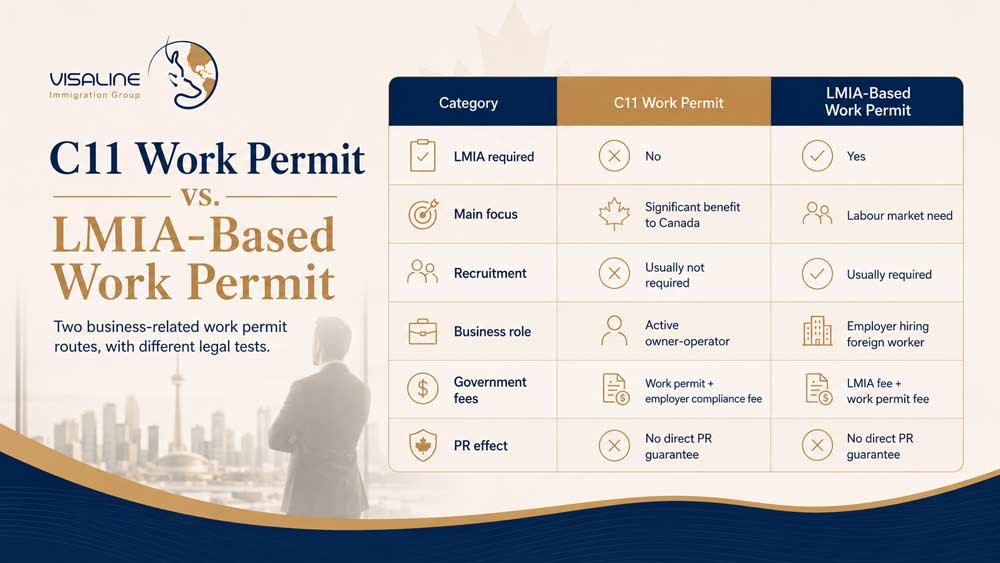
| Feature | C11 Entrepreneur Work Permit | Regular LMIA Work Permit | Provincial Entrepreneur Stream |
|---|---|---|---|
| LMIA required | No, if C11 eligibility is established | Yes | Provincial rules vary |
| Main assessment | Significant benefit to Canada | Labour-market need and a genuine job offer | Provincial investment, experience and business requirements |
| Entrepreneur’s role | Active operator or self-employed entrepreneur | Employee working in the approved position | Active owner-manager |
| Recruitment process | No standard LMIA recruitment process | Usually required | Depends on the provincial program |
| Permanent residence | No direct PR status | No direct PR status | May support nomination after provincial conditions are met |
| Best suited to | Entrepreneurs with a viable and beneficial business proposal | Businesses with a genuine need to hire a foreign worker | Applicants prepared to meet provincial investment and performance conditions |
The International Mobility Program allows LMIA-exempt hiring where broader Canadian economic, social or cultural priorities are supported. By contrast, the Temporary Foreign Worker Program generally requires an LMIA. Provincial Nominee Programs can include entrepreneur and investor categories, but every province and territory sets its own requirements.
C11 Work Permit Document Checklist
The exact checklist depends on the applicant, corporate structure and proposed business. A C11 application commonly includes:
- Passport, photographs and completed immigration forms.
- Detailed résumé outlining ownership, management and industry experience.
- Corporate registration and shareholder records.
- Share purchase, asset purchase or partnership agreements.
- A detailed C11 business plan.
- Evidence of the applicant’s active management role.
- Personal and corporate bank statements.
- Documents showing the legal and traceable source of funds.
- Proof that investment capital is available.
- Commercial lease, conditional lease or property documents.
- Business licences and regulatory approvals.
- Market research and competitor analysis.
- Financial projections with realistic assumptions.
- Supplier, customer, distributor or partnership agreements.
- Staffing plan, job descriptions and hiring schedule.
- Evidence of branding, a website or operational preparations.
- Employer Portal offer-of-employment number, where required.
- Marriage and birth records for accompanying family members.
- A submission letter addressing significant benefit and temporary intent.
The evidence should tell one consistent story. Ownership percentages, investment figures, job duties, financial projections and the applicant’s proposed role should agree across all forms and supporting documents.
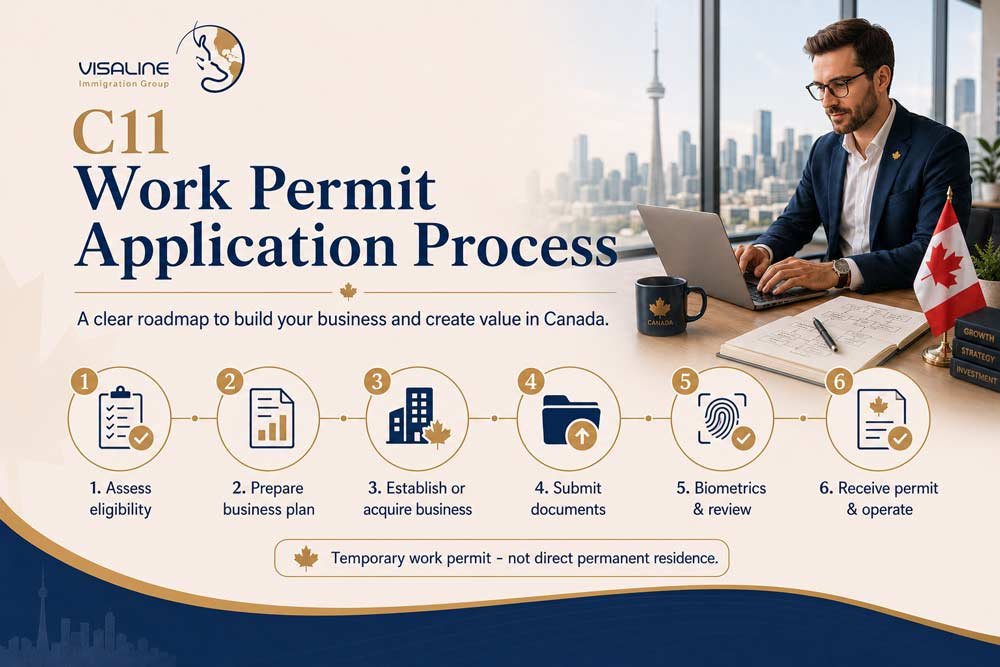
C11 Entrepreneur Work Permit Application Process
1. Assess the correct immigration category
The first step is deciding whether the business fits C11, a regular LMIA, a provincial entrepreneur stream, an intra-company transfer or another immigration option.
C11 should not be selected simply because it avoids an LMIA. The facts must satisfy the significant-benefit test.
2. Evaluate or establish the Canadian business
The applicant may propose a new venture, purchase an existing business or expand business activities into Canada.
For an acquisition, due diligence should examine financial statements, tax records, debts, employment obligations, licences, leases, customer concentration and the commercial reason for the sale.
3. Create the ownership and operating structure
Corporate records should accurately show who owns the company, who controls business decisions and why the applicant must be present in Canada.
Immigration planning should also be coordinated with independent corporate, tax and accounting advice.
4. Prepare the business plan and significant-benefit evidence
The business plan should explain:
- What the company will sell.
- Who its customers are.
- How operations will be financed.
- Why the applicant is qualified to operate it.
- When Canadian employees may be hired.
- What economic, social or cultural benefit will be created.
- How the business will manage commercial risks.
5. Complete the employer-side process
Where an employer-specific LMIA-exempt offer is required, the Canadian business must generally submit the employment information through the Employer Portal and pay the employer compliance fee, unless a specific exemption applies. The employer then provides the applicant with the offer-of-employment number.
6. Submit the Work Permit application
The applicant submits the forms, business documents, significant-benefit evidence, proof of funds and applicable fees through the appropriate IRCC process.
A complete application should also address the applicant’s ability to perform the work, admissibility and intention to comply with temporary-residence conditions.
7. Complete biometrics, medical or additional-document requests
Biometrics may be required depending on the applicant’s circumstances. A medical examination may also be necessary based on residence history, intended work and public-health requirements.
8. Operate the business and maintain records
After approval, the entrepreneur should preserve evidence of genuine operations, including invoices, payroll records, tax filings, contracts, licences and proof of progress against the business plan.
These records may be relevant to a future extension or separate permanent residence application.

Government Fees and Processing Time
Current federal fees include:
| Government item | Current fee |
|---|---|
| Work Permit processing fee | CAD 155 |
| Employer compliance fee, where applicable | CAD 230 |
| Biometrics per person, where required | CAD 85 |
IRCC’s fee list was updated on July 2, 2026. Fees should still be confirmed immediately before submission because government charges may change.
Additional costs may include:
- Incorporation and corporate legal services.
- Accounting and financial due diligence.
- Business-plan preparation.
- Commercial rent or purchase deposits.
- Licensing and regulatory costs.
- Medical examinations.
- Translation and document certification.
- Immigration representation.
How long does a C11 Work Permit take?
There is no single processing time that applies to every C11 application. Timelines depend on the country of application, case complexity, biometrics, medical requirements, background screening and whether IRCC requests additional evidence.
IRCC’s processing-time figures are estimates based on complete applications and can change. Applicants should check the official processing-time tool before filing or making irreversible business commitments.
Can a C11 Work Permit Lead to Permanent Residence?
A C11 Work Permit does not itself grant permanent residence. It may form part of a longer-term plan, but the applicant must independently qualify under a separate immigration program.
Potential options may include:
- A provincial entrepreneur or business stream through the Provincial Nominee Program (replace with your actual page slug).
- Express Entry (replace with your actual page slug), if the applicant meets the requirements of an eligible federal program.
- A provincial skilled-worker stream.
- A Quebec business or skilled-worker program.
- Another federal or provincial pathway available at the relevant time.
Applicants should not assume that operating their own business will automatically create qualifying Canadian Experience Class work experience. IRCC states that self-employment generally does not count toward the CEC minimum work-experience requirement, subject to limited exceptions such as certain qualifying physicians.
Canadian immigration law permits dual intent. An applicant may plan to seek permanent residence while applying for temporary status, provided the officer is satisfied that the applicant will leave Canada when required if the permanent residence plan does not succeed.
Common Reasons for Refusal
A C11 application may be weakened by:
- Treating business ownership as automatic eligibility.
- Submitting a generic or unrealistic business plan.
- Providing limited evidence of market demand.
- Failing to explain why the applicant must work in Canada.
- Presenting a passive investment as active entrepreneurship.
- Using unsupported revenue or hiring projections.
- Showing insufficient or unexplained funds.
- Providing inconsistent corporate and immigration documents.
- Choosing a job title or NOC that does not match the actual duties.
- Failing to establish a significant Canadian benefit.
- Ignoring Employer Portal obligations.
- Providing a weak explanation of temporary intent.
- Purchasing a business without adequate due diligence.
A professionally formatted plan cannot repair an unsuitable business transaction. The underlying business, financing and proposed Canadian benefit must make commercial sense.

Frequently Asked Questions
Is the C11 Entrepreneur Work Permit available in 2026?
Yes. Current IRCC guidance continues to confirm that an entrepreneur may apply for an LMIA-exempt work permit when the Canadian business would create significant benefits or jobs. Approval remains discretionary and evidence-based.
Does a C11 Work Permit require an LMIA?
No. C11 is an LMIA-exempt category under the International Mobility Program. The applicant must instead establish a significant economic, social or cultural benefit to Canada.
Can I obtain a Work Permit by buying a Canadian business?
Purchasing a business may support a C11 application, but the purchase does not automatically provide a work permit. The applicant must still establish an active role, viable operations, sufficient funds and significant Canadian benefit.
How much investment is required for C11?
IRCC’s current public guidance does not specify one universal minimum investment. The amount must be credible for the industry, location, business model and operating plan.
Can my spouse receive an open Work Permit?
A spouse or common-law partner may qualify only if the current family open-work-permit requirements are met. Eligibility can depend on the principal applicant’s occupation, permit validity and immigration pathway, and approval is not automatic.
Does C11 guarantee Canadian permanent residence?
No. C11 is temporary work authorization. Permanent residence requires eligibility and approval under a separate federal, Quebec or provincial immigration program.
Conclusion
The C11 Entrepreneur Work Permit can be appropriate for an experienced business owner who has a credible Canadian venture, sufficient resources and a well-supported plan to create significant benefit. It is not a shortcut based solely on investment or company ownership.
The strongest strategy connects four elements: the applicant’s background, the commercial reality of the business, the significant-benefit evidence and a realistic long-term immigration plan.
Visaline reviews these elements together before an applicant commits substantial funds. Careful preparation cannot guarantee approval, but it can identify weaknesses early, reduce avoidable inconsistencies and determine whether C11 or another business pathway is more appropriate. Applicants can arrange an online Canadian immigration consultation (replace with your actual page slug) for an individual assessment.
This page provides general information and does not replace legal advice based on the facts of a particular case.
Sources
- Immigration, Refugees and Citizenship Canada: Entrepreneur eligibility for an LMIA-exempt work permit.
- Immigration and Refugee Protection Regulations, section 205(a): Significant Canadian benefits and opportunities.
- Immigration and Refugee Protection Regulations, section 200: Work permit requirements and genuine employment offers.
- IRCC: International Mobility Program and LMIA-exempt hiring.
- IRCC: Employer Portal and employer compliance requirements.
- IRCC: Citizenship and immigration application fee list.
- Immigration and Refugee Protection Act, section 22(2): Dual intent.
- IRCC: Canadian Experience Class treatment of self-employment.
- IRCC: Provincial Nominee Program.
- IRCC: Current Start-Up Visa Program status.
Contact us today to review your case and book your immigration consultation. We also recommend following Visaline Immigration Institute on Instagram for real-time updates on IRCC news and immigration law changes.
☎️ Toronto WhatsApp: +1-647-860-0005
Published: August 4, 2026
Last updated: August 4, 2026
Author: Visaline Legal Editorial Team